The Blizzard of '26: Massachusetts pounded by nor'easter that sparks travel ban; power restoration will take days
Published in Weather News
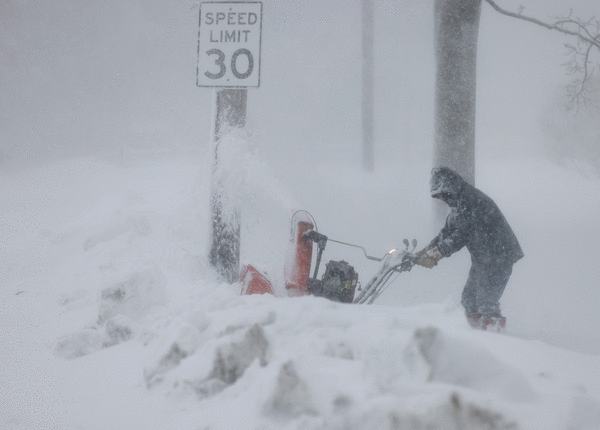
BOSTON — Had enough yet?
A historic nor’easter pummeled the region on Monday — with one spot even breaking the snow record from the Blizzard of ’78 — as power crews work around the clock to try to restore electricity for hundreds of thousands.
Power restoration will take days following the hurricane-force wicked winds and heavy wet snow, officials warn.
The “serious and severe” storm led Gov. Maura Healey to issue a travel ban for the hardest-hit areas dealing with treacherous roads, limited visibility, blowing and drifting snow, downed power lines and fallen trees. Hundreds of vehicles were reported stranded on state roads, according to Mass State Police.
Meteorologists were measuring in feet, not inches for this whopper, as more than three feet of snow were dumped on parts of Rhode Island. The jackpot zone for Massachusetts was in Bristol and Plymouth counties, where more than 30 inches of snow was recorded.
It was a record-breaking storm for Providence, R.I. The measurement of 37.9 inches of snow at T.F. Green International Airport broke the record for the city’s greatest single snow storm on record. The previous mark was 28.6 inches set during the Blizzard of ’78.
“This is a very impressive storm,” said National Weather Service meteorologist Andy Nash, who noted all the wind damage and significant power outages across the region.
“When plow crews are dealing with more than 1 inch an hour, they can’t keep up,” he added. “This was 3 to 4 inches an hour at times, and that is just impossible to plow and keep things manageable, leading to big travel problems.”
Healey during a midday blizzard update announced an executive order to ban non-essential motor vehicle travel in Bristol, Plymouth, and Barnstable counties due to the dangerous road conditions. That ban was later extended to Martha’s Vineyard.
Those who violate the travel ban can face a $500 fine.
“We needed to do this because this is a particularly hard-hit area,” Healey said during a press conference at the State Emergency Operations Center in Framingham. “We need to have the ability for all essential vehicle travel to be able to go through, and anybody who doesn’t need to be on the road should not be on the road.”
Those who are exempt from the travel ban include: first responders, public emergency personnel, utility crews, food and fuel delivery, and medical staff.
The governor also activated an additional 150 members of the Massachusetts National Guard to assist with the response.
Mass State Police reported more than 400 disabled motor vehicles as of 4 p.m. Monday. State Police, National Guard, and MassDOT were helping free the vehicles or transporting the occupants to a safe location.
State Police Deputy Col. Daniel Tucker noted the $500 fine for violating the travel ban.
“That’s the last thing the State Police wants to be dealing with,” Tucker added. “We just want the public to stay off the roads, and let us do our job along with our partners at DOT and the National Guard.”
The travel ban will be lifted when Highway Administrator Jonathan Gulliver determines conditions are safe.
Meanwhile, close to 300,000 households were in the dark at the peak of the storm amid incredibly strong winds on Monday, and it’s expected to take days for many to get power back.
The Cape had the most households without power, according to the Massachusetts Emergency Management Agency. More than 80% of Barnstable County was without power — more than 155,000 outages reported — as of 5 p.m. Monday.
Wind gusts surpassed 75 mph on the Cape, which is hurricane-force.
More than 75,000 households were without power in Plymouth County, about 33% of the county. And Bristol County had around 15,000 outages, about 7% of customers there.
More than 50% of Nantucket was without power, more than 8,000 customers. Wind gusts topped 80 mph on Nantucket.
And more than 40% of Martha’s Vineyard was in the dark, also more than 8,000 households. Gloucester and Rockport on the North Shore were also hard hit.
“It’s going to take days for power crews to get all that repaired across the region,” said Nash, the National Weather Service meteorologist.
Eversource and National Grid have extra crews staged, and they have more crews coming, but “this takes time,” Healey said at the press conference.
“The issue isn’t crews. The issue is going to be access,” Healey said. “When does the wind die down enough so that it’s safe for people to get out in bucket trucks. Also, the roads need to be cleared, so the crews can get into these areas.”
Healey also directed that nonemergency Executive Department state employees should not report to their workplaces on Tuesday. She urged employers to consider having employees work remotely to the extent possible, especially those subject to the travel ban.
The governor also told people to check in on their neighbors. She added that those who lose power and need to get to a warming center should call 211 for help.
It was such a strong storm that even Market Basket shut down on Monday.
“Due to the severe weather today, and for the safety of our associates and customers, the majority of Market Basket stores will be closing at noon,” posted Market Basket, which noted that the stores remaining open were in lesser-hit New Hampshire and Maine.
Many are wondering how long this snow will stick around, after last month’s whopper caused big issues on streets and sidewalks. Some snow might melt this week with temps climbing into the upper 30s and low 40s, but unfortunately, even more snow could be on the way.
A clipper system may bring precipitation late Tuesday night into Wednesday, and another system could arrive late Thursday into Friday.
“It’s still winter in the middle of February,” Nash said. “Unfortunately, it’s not the end of the season.”
_____
©2026 MediaNews Group, Inc. Visit at bostonherald.com. Distributed by Tribune Content Agency, LLC.





Comments