Sprawling US winter storm strains power grids, snarls travel
Published in Weather News
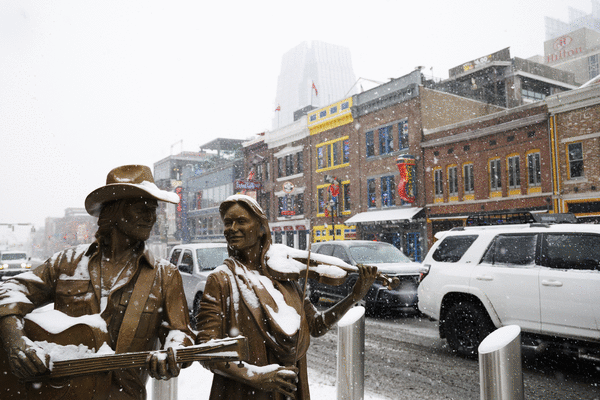
A massive U.S. winter storm stretching from the southern Rocky Mountains to New England is straining power systems, causing cascading travel disruptions, while threatening large amounts of snow and ice in some of the country’s most densely populated corridors.
The travel disturbance is shaping up to be the worst since the U.S. government shutdown last year, which led to air traffic control staffing shortages at airports nationwide. The same weather system is pushing electricity demand sharply higher, raising the risk of outages in several regions.
Nearly 13,000 flights into and around the U.S. have been canceled through Monday, according to FlightAware, an airline tracking company. Some 132,000 homes and businesses didn’t have power as of 4:00 p.m. ET on Saturday, with about 60,000 in Texas, according to Power Outage.US.
Early Saturday, the Midcontinent Independent System Operator — which runs an electric grid across parts of the Midwest and South — declared an energy-emergency alert 2 in its northern and central sections, citing forced power-plant outages and limited transfer capability across the regions. MISO later downgraded the grid to a maximum generation warning before returning to an energy-emergency alert 2 in an effort to shore up reserves as conditions worsened.
EEA2 is the second level of emergency action, triggered as operating reserves continue to decline. It means MISO is facing an energy shortage and needs to reduce energy demand.
“The extreme cold caused gas and fuel supply and mechanical issues, resulting in unplanned generator outages and capacity derates,” said MISO spokesperson McKenzie Barbknecht. “MISO has been in close contact with the U.S. Department of Energy on grid conditions throughout this winter storm event.”
Wholesale prices on the Texas grid jumped to $1,500 a megawatt hour for the Dallas-Fort Worth area and $1,600 in the panhandle just before midnight local time, which typically has strong wind resources. That’s when prices and demand are typically at low levels. Hourly prices Saturday topped at about $44.
Exxon Mobil Corp. is shutting down some equipment at its Baytown, Texas, oil refinery because of freezing weather, the company said in a public notice. The plant, among the largest U.S. fuel-making facilities, is 30 miles east of downtown Houston.
Celanese Corp. also wound down operations at its Houston-area plant as the weather worsened, according to a notice. The company’s Clear Lake plant makes chemicals used in paints, adhesives and packaging.
As much as 0.5 inch of ice may fall across the South through northern Virginia, threatening roads, power lines and trees. The storm will also drop heavy snow from Oklahoma and across the Ohio Valley, before doing the same in New York and New England on Sunday.
New Jersey Transit will temporarily suspend bus, light rail and Access Link service for the entire service day on Sunday, Jan. 25. Trains will operate until 2 p.m. on Sunday.
“It’s a good weekend to stay indoors if you need to make a last run to the grocery store or Home Depot. Get it done now. Get this done today,” New Jersey Gov. Mikie Sherrill said at a press conference Saturday. “Anything you need go out today and grab it and plan to stay off the roads tomorrow.”
In the Western hub of PJM Interconnection, a big U.S. grid from Chicago to Washington, power was trading at $420 a megawatt-hour at 2:50 p.m., after spiking to more than $3,000 earlier. The highest prices are in Exelon Corp.’s Baltimore Gas & Electric Utility at more than $550.
PJM’s region has the highest concentration of data centers in the U.S. and is the focus of concern over how electricity generation can keep pace with the AI-driven demand boom. U.S. Energy Secretary Chris Wright urged companies to make backup power available from facilities including data centers.
The storm is estimated to cost up to $24 billion in damages and economic losses, said Chuck Watson of Enki Research. Most damage from winter systems comes from prolonged freezing temperatures, according to reinsurance firm Swiss Re. Average annual insured losses from winter weather have more than tripled to $7 billion since 2021 compared with the preceding decade, the company said.
New York
New England, which pays exorbitant prices for natural gas produced in Appalachia in the winter because of a dearth of pipeline capacity connecting the regions, was generating 31% of its electricity by burning oil, as of 2:43 p.m., according to the regional grid operator. That’s higher than the amount of power being generated by natural gas as dual-fuel generators often switch from gas to oil when gas prices spike.
Gas prices for near-term delivery of gas at the New England trading hub Algonquin Citygates surged as high as $44 per million British thermal units this week as utilities and other buyers bid up the price of scarce pipeline capacity.
New York is expected to see snowfall around daybreak Sunday. It may see more than of 14 inches of powder before the storm winds down Monday, said Scott Kaplan, a meteorologist with Hometown Forecast Services, which provides outlooks for Bloomberg Radio. The Boston area may see as much as 20 inches of snow, while Washington may get 8 inches or more.
That would be the heaviest snowfall in New York since January 2022 when 7.3 inches fell in Central Park and for Boston since February 2022 when 8.5 inches fell, said Allison Santorelli, a forecaster with the U.S. Weather Prediction Center. For the U.S. as a whole, it may be one of the most expansive in the U.S. since a 1993 “superstorm,” said Rob Carolan, chief executive officer of Hometown Forecast Services.
New York’s Metropolitan Transportation Authority urged customers to avoid unnecessary travel Sunday and Monday, warning of disruptions to subways, bus lines and commuter rail services. Federal offices in the Washington, D.C., area will be closed on Monday.
US exports
Several U.S. liquefied natural gas export plants began reducing gas supply following a reduction of activity on Friday.
Sabine Pass in Louisiana, Corpus Christi LNG and Freeport LNG in Texas, and Cove Point in Maryland all showed reduced gas supplies as of Saturday morning, according to data from BloombergNEF.
———
(With assistance from Lauren Rosenthal, Valentine Baldassari, Ruth Liao, Julian Hast and Joe Carroll.)
©2026 Bloomberg L.P. Visit bloomberg.com. Distributed by Tribune Content Agency, LLC.






Comments