Illinois River tagging effort to count invasive carp and help protect Lake Michigan
Published in Science & Technology News
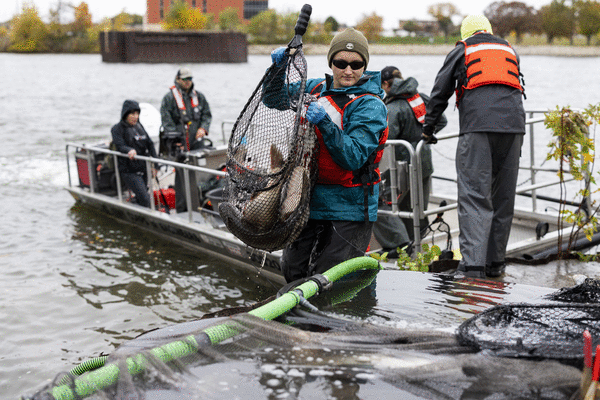
CHICAGO — The fish, caught in a net with dozens of others like it, had just been brought to the boat ramp and placed in one of several large, water-filled tubs, where it patiently waited its turn.
Soon enough, it was whisked up and away in a catch net, weighed in at 10.14 pounds, the same as a 12-pack of soda, measured at 25.7 inches, or about the length of a standard rolling pin. Then it was laid on its back on a surgery tray, where it was tagged twice.
Despite some wriggling resistance, it was released back into the water within 1 minute and swam away like nothing happened.
After repeating a similar process several hundred times over two days last week as part of a multi-agency effort, scientists from the U.S. Geological Survey will be keeping a close eye on about 1,000 silver carp caught and tagged near the confluence of the Illinois and Fox rivers to track the movements of the invasive fish in these waterways — and, ultimately, inform strategies to remove them and prevent their spread into the Great Lakes.
“We only want to tag fish that are actually going to survive because we want to estimate our numbers correctly. So we only take fish out of there that are looking good, and then release them, make sure that they’re swimming off fine,” said Janice Albers, a fish biologist at the USGS Upper Midwest Environmental Sciences Center. “Our goal is to be as quick as possible, and you know, the least amount of handling. Handling stresses them out.”
The gold-colored jaw tag is inserted first through a small incision in the mouth — “think of it as like a lip ring,” Albers said — and then a thin, green loop tag is similarly attached to the fish’s back. Both have a phone number etched on them so any angler who catches the fish can report it to the U.S. Army Corps of Engineers, which the USGS is collaborating with, alongside the Illinois Department of Natural Resources, on the tagging and tracking efforts.
“When they do the big capture events, we can get the tags back, and then we can estimate how many fish are out there,” Albers said, referring to coordinated, targeted, large-scale harvest operations that state biologists, federal partners and contract fishing crews use to remove high densities of fish from the river.
In 2023, 750,000 pounds of silver carp were removed from the Illinois River over 10 days in what is believed to be a record for freshwater harvest in the country, and the largest single removal effort of its kind led by the Illinois DNR.
The invasive fish pose a significant threat to native species and aquatic ecosystems in the Great Lakes basin, as well as its billion-dollar fishing and boating industries.
“They interact with us differently than other fish,” Albers said. “Mainly harming commercial fishing, private fishing, all that — all the activities that happen on the water.”
Efforts to understand the species and stop their spread span different levels of government, many agencies, several states — like the $1.15 billion Brandon Road Interbasin Project at the Des Plaines River — and even private citizens like the organizers and participants in the Original Redneck Fishing Tournament 50 miles southwest of Peoria.
“We conduct science and research on things that people want to manage,” Albers said about the role USGS plays in these efforts, like the tagging project in the Illinois River. “That’s what this is. We’re trying to say, ‘OK, you have this many fish out there.’ And we can do some modeling and try and inform the managers to say, ‘Yeah, you should focus more on this or that,’ and they can decide what they want to do with the information.”
For instance, Albers also is involved in a project at the Mississippi River lock in Keokuk, Iowa, that has been studying the impact of acoustic deterrents on native fish and invasive carp, research that will, among other things, inform one of the layered technologies to be installed at the Brandon Road Lock and Dam.
In August, the Illinois DNR said several hundred juvenile silver carp were discovered only 80 miles from Lake Michigan in the river along Marseilles, further upstream than routine monitoring had found the invasive fish since 2010. The USGS tagging effort happened a few miles downstream, in Ottawa’s Allen Park, with the so-called Old Rail Bridge in the background.
Multi-agency monitoring over the past 16 years has indicated established invasive carp populations in the lower 240 miles of the Illinois River, from the Peoria Pool all the way toward its confluence with the Mississippi, along which they have wreaked havoc on local economies and ecosystems.
Upstream, however, while the Starved Rock and Marseilles pools in LaSalle County and the Dresden Island Pool near the confluence of the Des Plaines and Kankakee rivers are known to have adult invasive carp, scientists had not previously found multiple life stages of young, so they did not consider the population established there.
Invasive carp, including silver, bighead, grass and black carp, were introduced in the United States some 60 years ago to get rid of seaweed without using chemicals in aquaculture facilities and sewage ponds in Arkansas. But after flooding events in the 1980s and 1990s, the carp escaped into the Mississippi River basin — the third largest in the world — spreading to 31 states. Some were also released after breeding experiments failed.
Silver and bighead carp pose a unique threat to native species as they have no natural predators in American waterways and likely never will, meaning their populations can grow uncontrollably. Additionally, they can’t be easily caught as they don’t care for bait; they are filter feeders and eat plankton from the base of the aquatic food chain. Because of their large numbers and reproductive capacity, silver and bighead carp can eat faster than and starve native fish and mussels.
“Silver carp are planktivores, so they eat plankton, algae, zooplankton, all the stuff that’s floating in the water,” Albers said. “So they’re existing on this lower trophic level,” or position in the food web, “which competes with other planktivores and all of the fish that eat those other planktivores.”
____
©2026 Chicago Tribune. Visit at chicagotribune.com. Distributed by Tribune Content Agency, LLC.






Comments