Do data centers really use so much water? Here are 5 key issues
Published in Science & Technology News
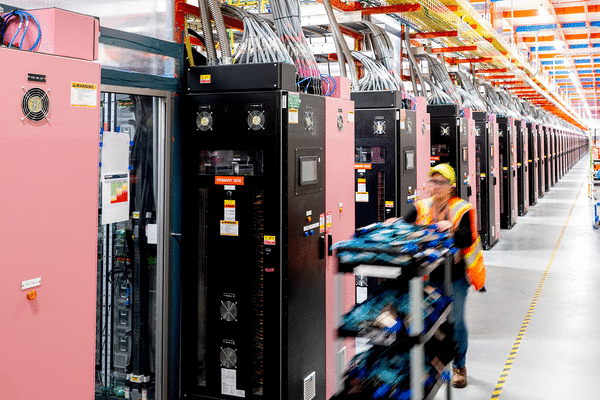
ST. LOUIS — As data center projects have popped up across the St. Louis region, driven by the growth of industrial-scale computing for artificial intelligence, one of the primary concerns raised by residents is about water — as in, will data centers consume vast amounts of the local water supply?
Data centers — essentially huge warehouses for servers and computers — need to cool off all of that equipment, which is powered around the clock by electricity.
To keep the equipment from overheating, water-based approaches often represent the most efficient solutions.
The size of the project can determine the water needs. Medium-sized facilities, for example, may use 1 million gallons of water on peak days, while larger ones could need 8 million gallons, experts say.
In one example, a study published last year found that a Google data center in Oregon consumed 355 million gallons of water in 2021 — representing 29% of the total water consumption in the 16,000-person city of The Dalles and raising concerns on local water stress, particularly amid droughts.
Experts say the issue can be complicated by a lack of transparency. Even when projects have announced estimates or certain approaches to water usage, details can be scarce.
In many cases, companies proposing data centers have vowed that water usage will not be burdensome, touting efficient cooling systems that aim to minimize or even avoid the use of water. They also point to variables tied to local water supplies, such as the condition of local aquifers or plans to draw water from places that they argue would not affect nearby residents.
Costs and fears of impacts on water bills mark their own source of worries for residents. But in some recent deals with cities and counties, companies have pledged to offset costs for utility upgrades needed to accommodate a data center.
Here are some key questions about data centers and water usage:
Where do they get the water?
There are a few ways that data centers are cooled, and they can vary based on local climates — hot or cold, wet or dry.
"Some cooling approaches are basically the 'fan in the window,'" says a recent blog post from Oracle, one of the tech giants building a network of data centers. "They move air through a space and push warm air out. This approach works well in colder climates."
One common alternative is the use of evaporative cooling to remove heat, requiring continuous replacement of water into the system. Another tactic uses "closed-loop" systems that apply the same principles as air conditioners and car radiators on a larger scale; data centers typically use a mix of water and chemicals, such as an antifreeze or an anti-corrosion agent, circulating in a loop.
In the U.S., nearly all of the facilities using water are served by municipal systems.
That poses questions about system capacity and required buildouts. For instance, many systems don’t have enough surplus water to accommodate new large users. And upgrades to weave the facilities into public water systems can be expensive and require years of planning.
Many water utilities are small and easily dwarfed by the scale of plants in question — with 80% of the municipal water systems serving fewer than 3,000 people, says Shaolei Ren, an engineering professor at the University of California, Riverside.
Concerns about water usage by large data centers have been especially heightened in rural areas, where many residents rely on well water.
That’s the case about 80 miles west of St. Louis, in Montgomery County, where a nearly 1,000-acre Amazon data center that now faces a lawsuit from citizens would plan to draw water from far below wells in the area.
The company argues that the project would not have an impact on drinking water. Amazon also says that, through plans to partner with local farmers on irrigation programs, it "will make our presence a net water benefit for the local watershed."
How much is too much?
Some experts caution that overall water usage isn’t always the key figure. They point instead to the peak requirement that a data center uses at its maximum and that a local water system has to accommodate. That typically occurs in the hottest times of the year and at the hottest times of those days.
Sometimes that peak water usage for a plant can match the water needs of a city that’s home to 50,000 to 100,000 people, says Ren of the University of California, Riverside.
Around St. Louis, the pitches for some proposed data centers have vowed the facilities wouldn't use too much water. In Gray Summit, for example, the prospective builder of a data center campus says the site’s closed-loop system would limit its daily water consumption to match that of about 54 homes. (A typical U.S. home uses about 300 gallons of water a day, according to the U.S. Environmental Protection Agency.)
And one proposal in St. Louis now faces a list of conditions from the city's Board for Public Service that includes a requirement the project avoid harming local water availability by using an efficient system.
Amazon says many of its facilities primarily use air for cooling and only turn to water on the hottest days of the year. Regarding its proposal in Montgomery County, Amazon said in an emailed statement that the facility would only use water in limited circumstances.
"Based on the geography of this area, we anticipate this project to use natural air for cooling 93% of the year and will only use water for cooling 7% or less of the year," the company said, estimating that the project would use an average of 50 million gallons of water annually.
Meta, which recently opened a data center in Kansas City, points to a 2025 report it produced that states, "When appropriate, we adjust the level of water risk based on additional local knowledge." It also included figures showing that its data centers withdrew a total of 1.1 billion gallons of water in 2024. One site, in Altoona, Iowa, withdrew about 64 million gallons in 2024, the report says.
Some experts caution that the size of data center projects is escalating so quickly that it diminishes the impact of their efficiency.
“The size of it has gone up so quickly that the water use even in an efficient data center can be quite large on a local scale,” said Eric Masanet, an engineering professor at the University of California, Santa Barbara.
Others worry less about data centers’ on-site water usage because far more of it is used indirectly, in the process of generating the electricity needed to run them.
Alex Newkirk, a research associate at Lawrence Berkeley National Laboratory, says the bulk of water consumption associated with the facilities — more than 80% of it — is linked to power generation. So the effects of data center operations can be tied much more strongly to the power plants that run them, as opposed to the communities they’re in or the water source.
“I spend my time worrying about the electricity," he said. "The water doesn’t keep me up at night."
Where does the water end up?
A lot of water that is used for cooling data centers is lost to evaporation — about 70% to 80%, experts estimate.
But the rest remains in its liquid state and completes the duration of its cycle, often through the closed-loop cooling systems that can be used in the facilities. That water often contains certain chemicals, said Ren, requiring treatment when it’s finally done being used — a task left for wastewater treatment plants. (For example, at least one of the data center projects targeted near St. Louis would add glycol into its cooling water, an alcohol widely used as antifreeze.)
Some data centers are pursuing methods of recycling water or using forms of reclaimed water.
The aspiring builder of the proposed data center in Gray Summit says it would haul water from its closed-loop cooling system offsite for disposal after years of use and reuse.
"It could last a very long time between recharges," even a decade, said Roman Pacewicz, a managing partner for Provident Data Centers, the Texas-based developer behind the project.
Do water bills go up?
Local governments and the companies behind data centers have generally agreed that the companies should shoulder any costs associated with building out a water system. That is the case in Gray Summit, where Provident has pledged to pay for any required upgrades to the municipal water system. The same promise exists in Festus, where city officials say the developer of a local data center would pay for all infrastructure upgrades.
But that hasn't halted resident concerns about costs eventually being passed on to them through higher bills. For example, in Columbus, Ohio, media reports say data center development drove increases of about $10 per month for the city's water customers, among other higher utility costs in the area.
What are the transparency complaints?
Many experts and residents say what they don’t know about data centers could be as important as the things they do know, criticizing the lack of details often offered about proposed plants and operations.
Citing sensitive business information, companies behind data centers often sign nondisclosure agreements, or NDAs, with local officials. That limits the details that are made public about projects, including possibly the name of the company. That has fueled public backlash.
Microsoft, another industry leader developing data centers for AI, announced last month that it would end its use of NDAs, saying transparency was "paramount."
In testimony before Congress in February, Masanet, of the University of California, Santa Barbara, spoke about how information has been kept from the public.
“No other major U.S. energy-consuming sector, nor one which is growing so quickly from economic and infrastructure perspectives, suffers from as many public data blind spots as U.S. data centers,” Masanet said in his testimony.
In an interview with the Post-Dispatch, Masanet said the future of data centers — and how much power and water they will use — is still “unwritten."
“The future can still be shaped," he said. "But we need the data to do it.”
In the St. Louis region, one expert asked to weigh in on multiple data center proposals has been unable to answer questions about how they could affect water users. He cited a lack of details, for example, in Amazon's Montgomery County project and a recent push to develop a data center in St. Charles.
“I can’t give anybody any answers because we don’t have the basic information,” said John Bognar, a groundwater geology expert based in Washington, Missouri.
“It’s so vague that it’s hard to understand what the true requirements are from the perspective of a water supply,” he added. “We don’t know exactly what they’re going to take out where and at what rate.”
©2026 STLtoday.com. Distributed by Tribune Content Agency, LLC.






Comments