Artemis II astronauts break Apollo 13 record, make moving request to name moon craters
Published in Science & Technology News
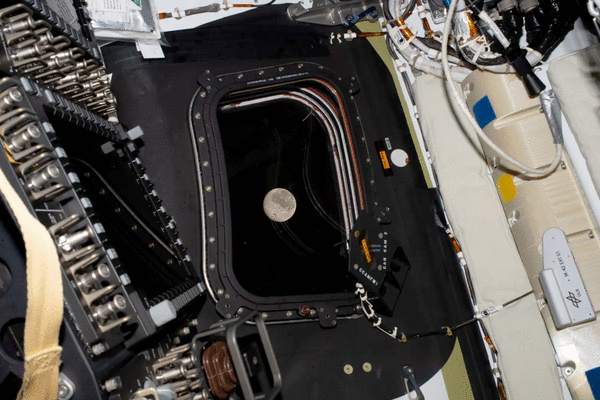
On a day the four crew of Artemis II broke a record set by Apollo 13 for farthest distance from Earth ever flown by humans, they made a request that two new craters be named: one to honor their Orion spacecraft named Integrity, and one the memory of commander Reid Wiseman’s late wife Carroll.
The Orion spacecraft and its four passengers ventured into the moon’s gravitational influence Monday, and at 12:57 p.m. Eastern time, surpassed the 248,655 miles traveled by the 1970 flight by Apollo 13’s Jim Lovell, Fred Haise and Jack Swigert.
The new record holders are Wiseman and fellow NASA astronauts Victor Glover and Christina Koch along with Canadian Space Agency astronaut Jeremy Hansen.
“As we surpass the furthest distance humans have ever traveled from planet Earth, we do so in honoring the extraordinary efforts and feats of our predecessors in human space exploration,” Hansen said. “We will continue our journey even further into space before Mother Earth succeeds in pulling us back to everything that we hold dear, but we most importantly, choose this moment to challenge this generation and in the next to make sure this record is not long lived.”
Hansen took the next moments to announce their request for the new potential names for a pair of “relatively fresh craters on the moon that have not been previously named.”
“We spent a bit of time this morning looking out the window, and we’re able to see them now, both with our naked eye and through the long lens. And so we feel this is a good time to send this down,” he said.
The first suggestion, located on the far side of the moon near the Orientale basin, was to be named Integrity, which is the name the four astronauts had named their Orion spacecraft.
“The second one, and especially meaningful for this crew, is a number of years ago we started this journey, and our close knit astronaut family, and we lost a loved one,” Hansen said, his voice breaking up over the communication relay.
It’s located on the boundary between the near and far side of the moon as viewed from Earth.
“So at certain times of the moon’s transit around Earth. You can — we will be able to see this from Earth. And so we lost a loved one. Her name was Carroll, the spouse of Reid, the mother of Katie and Ellie. ... it’s a bright spot on the moon.”
Carroll Taylor Wiseman died after a battle with cancer in 2020.
“Integrity and Carroll crater, loud and clear. Thank you,” replied Mission Control.
Since launching last Wednesday from Kennedy Space Center, the spacecraft has been under Earth’s dominant pull. But at 12:41 a.m., the moon took over that role.
“We noticed we entered the lunar sphere of influence about an hour ago and sure enough we are now falling to the moon rather than rising away from Earth,” said Koch on Monday morning. “It is an amazing milestone.”
Koch said the crew were able to see both a crescent Earth out the side hatch view and the moon out another of Orion’s windows at the same time.
“Definitely by far the moon is bigger than the Earth,” she said.
The crew will continue their approach as they slingshot around the far side of the moon. Orion still has an additional 4,105 miles to tack onto the new record as they whip around Earth’s satellite into Monday night.
During their wake-up call Monday, the Artemis II astronauts were played a recorded message from Lovell, the commander of Apollo 13 and crew member of Apollo 8, who died in 2025.
“Welcome to my old neighborhood,” he said in the recording. “I’m proud to pass that torch on to you as you swing around the moon and lay the groundwork for missions to Mars. ... It’s a historic day, and I know how busy you’ll be. But don’t forget to enjoy the view.”
Right ahead of that milestone, Hansen commented on the clarity of Orion’s view.
“It is blowing my mind what you can see with the naked eye from the moon right now. It’s just unbelievable,” he said.
The crew will take observations all afternoon, coming within 4,070 miles from its surface at 7:02 p.m. They will have a view of the landing sites of both Apollo 12 and Apollo 14, but will be getting views of parts of the moon that have never been seen before by human eyes.
“We have educated guesses based on what we know about the lunar surface, especially the far side ... but we don’t know what to expect.” said Kelsey Young, the Artemis II lunar science lead. “This is exploration ... While we have imagery, amazing data from orbiting spacecraft, it’s these nuanced observations that we’re lacking. This is discovery. We’re asking questions that we don’t always know the answer to, and that’s some of the value of what these Artemis missions bring.”
Sarah Noble, the Artemis lunar science lead for NASA, said the four astronauts had excited for the job, and had become “little emissaries ... bringing the science out to the masses.”
“We spent a considerable amount of time over the last year or two, training them to be geologists,” she said. “We’ve had them classroom training. We’ve taken them out into the field to see some actual rocks. We’ve given them lots of homework.”
She hammered home that their view is invaluable.
“The human eye is just a fantastic instrument, and we’re hopeful that they’ll be able to see things like, subtle color differences, subtle texture differences, things that we don’t necessarily see in our images,” Noble said saying NASA has plenty of camera images. “The point is to use their eyes and their brains to get new things that we we haven’t seen in our images.”
After the fly-by, Orion will continue to arc away from the Earth before gravity pulls it back to the planet, reaching a new milestone distance of 252,757 miles.
Basically Orion has been heading away from Earth since Thursday when it performed its translunar injection burn, and as the moon came around on its Earth orbit as Orion got into its vicinity, it started to pull it closer, but not strong enough to have it enter lunar orbit. As the moon passes by, Orion then gets sucked back by Earth’s gravity.
“it’s the interplay of those two gravity fields that really drive this beautiful dance of the spacecraft,” said Lori Glaze, NASA’s acting associate administrator for NASA’s Exploration Systems Development Mission Directorate.
The astronauts armed with multiple cameras plan to take thousands of pictures of 35 target areas of the far side of the moon.
Because the Earth will be blocked from view during this operation, Orion will be out communication for about 40 minutes.
At 7:25 p.m., the crew will be back within Earth’s view after coming back around the opposite edge of the moon.
Another unique event late Monday will be a solar eclipse from the crew’s perspective when the sun will pass behind the moon between 8:35 p.m. and 9:32 p.m.
The crew will have another four days back to Earth before a targeted splashdown Friday evening off the coast of San Diego in the Pacific Ocean to complete the 10-day journey.
Wiseman was enamored with the view over the weekend as Orion got closer to the moon discussing some of the lunar features with Mission Control in Houston.
“Not one for hyperbole, but it’s the only thing I could come up with. Just seeing Tycho, there’s mountains to the north. You can see Copernicus, Reiner Gamma. It’s just everything from the training, but in three dimensions, and absolutely unbelievable. This is incredible.”
“Copy, moon joy,” replied Mission Control.
He weighed in with the gravity of the crew’s place in space.
“This is a magnificent accomplishment to be up here, to see the moon, to see the Earth, and to know that we are between those two celestial bodies,” he said. “You can see it when you look out the window. The Earth is almost in full eclipse, the moon is almost in full daylight, and the only way you could get that view is to be halfway between the two entities. It’s just it is truly awe inspiring up here.”
During a media call on Sunday and acknowledging Easter, Glover gave his perspective on his view of the planet.
“In all of this emptiness, this is a whole bunch of nothing, this thing we call the universe. You have this oasis, this beautiful place that we get to exist together,” he said. “I think as we go into Easter Sunday thinking about all the cultures all around the world, whether you celebrate it or not, whether you believe in God or not, this is an opportunity for us to remember where we are, who we are, and that we are the same thing, and that we’ve got to get through this together.”
--------
©2026 Orlando Sentinel. Visit at orlandosentinel.com. Distributed by Tribune Content Agency, LLC.






Comments