Trump vows to fight invasive carp in Great Lakes, but Illinois federal funds remain frozen
Published in Science & Technology News
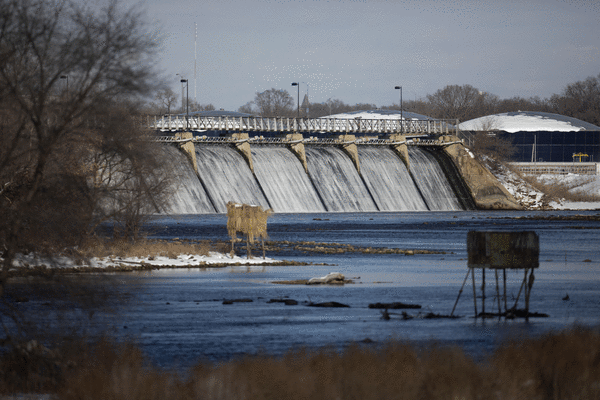
CHICAGO — A recent pledge by President Donald Trump to protect the Great Lakes from invasive carp comes as his administration continues to withhold federal funding for a key Illinois project designed to stop the spread into Lake Michigan.
Illinois officials say they welcome the president’s public support but are urging immediate action. State leaders, including Gov. JB Pritzker and Democratic Sen. Dick Durbin, are calling on the federal government to release funding to begin the Brandon Road Interbasin Project, a critical barrier system near Joliet aimed at preventing carp migration.
“Illinois has always done our part, and it is past time President Trump does his,” Pritzker said in a statement Friday.
Trump’s comments, in which he described the species as “rather violent and destructive,” followed a meeting last week with Michigan Gov. Gretchen Whitmer, where he pledged to address the ecological and economic risks posed by the invasive fish. He also called on governors across the Great Lakes region — including Pritzker — to “join into the fight.”
Pritzker argued in his statement that Trump’s recent comments “distort the truth,” noting that the U.S. Department of the Interior froze more than $13.6 million in funds for three other carp mitigation projects in addition to the Brandon Road project in December 2025.
Pritzker added the president had issued a memorandum last May committing $225 million to Illinois to help protect the Great Lakes from invasive carp after pressure from the state but has since failed to follow through on that promise.
This funding pause has halted progress on the long-planned improvements at the Brandon Road Lock and Dam, a chokepoint at the Des Plaines River designed to block invasive species from reaching the Great Lakes.
Invasive carp, believed to be native to China, were introduced to the United States in the 1960s to control vegetation in aquaculture operations and sewage ponds. Flooding in the 1980s and 1990s allowed the fish to escape into the Mississippi River basin, where they spread rapidly through connected waterways and have since moved north toward the Great Lakes.
Silver and bighead carp pose the greatest ecological threat because they have no natural predators in U.S. waters, allowing their populations to grow unchecked. Their rapid reproduction and ability to outcompete native species for food can disrupt entire ecosystems, making their potential arrival in the Great Lakes especially concerning.
The $1.15 billion mitigation effort at Brandon Road represents decades of coordination among Illinois, Michigan and federal agencies to prevent that outcome.
Pritzker said Illinois and Michigan are the only Great Lakes states to direct funds toward the project but would welcome the “full force of all eight Great Lakes states” to support mitigation efforts on this regionwide threat.
Fishers contracted by the state of Illinois have removed over 78 million pounds of invasive carp from waterways, said Pritzker’s office. But he and other Illinois lawmakers warn that if invasive carp establish populations in the Great Lakes, the consequences for the region’s ecosystem and fishing industry could be severe.
“If the Trump administration does not deliver needed federal funds, then they are betraying every American who relies on this water,” Pritzker wrote in Friday’s statement. “It is imperative that President Trump uphold his stated commitments to stop the invasive species threatening our Great Lakes and release the funds needed to resume construction on the Brandon Road Interbasin Project.”
Durbin echoed those concerns in his Senate floor speech last week, urging the administration to lift the funding freeze.
“If this fish ever becomes commonplace in the Great Lakes, it will destroy it as a fishery and change it forever,” Durbin said.
He added that without federal funding, the U.S. Army Corps of Engineers cannot continue its work on the project.
“I believe this is a serious threat to the future of the Great Lakes,” Durbin said. “I am happy to have the president on board, but we need him to act immediately to help us move forward.”
____
©2026 Chicago Tribune. Visit at chicagotribune.com. Distributed by Tribune Content Agency, LLC.






Comments