NASA moves forward with Artemis II tanking test that could set up moonshot mission
Published in Science & Technology News
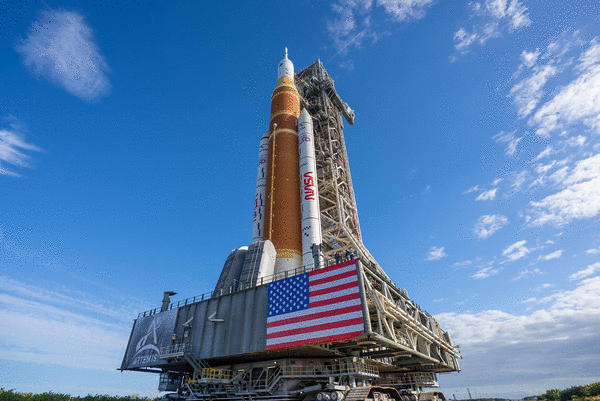
NASA is set to begin fueling 700,000 gallons of cryogenic propellant on the Space Launch System rocket at Kennedy Space Center on Thursday as its moved ahead with a test countdown of the Artemis II mission.
A live stream of the rocket at KSC’s Launch Pad 39-B began before 10 a.m. as teams, after getting the green light from Artemis launch director Charlie Blackwell-Thompson, began chilling down the liquid hydrogen (LH2) and liquid oxygen (LOX) lines that will feed what has proved to be problematic fuels into the SLS rocket’s core and upper stages. NASA was posting test updated to its Artemis II blog.
Once chilled, NASA will begin to load propellants using a slow fill process that will transition to a fast fill later in the day leading up to a series of simulated countdown tests that will begin at 8:30 and could last through 12:30 a.m. Friday.
It’s part of NASA’s second go-around at what’s called a wet dress rehearsal that simulates the processes that would be performed on an actual launch day.
The first wet dress rehearsal on Feb. 2, though, saw an LH2 leak in the umbilical propellant line from the ground systems into the base of the core stage. While teams were able to mitigate the leak and get all 700,000 gallons of propellant into the rocket, the leak rate jumped up over safe thresholds during NASA’s attempt to run through the final 10 minutes of the countdown.
Teams have since replaced valves on the ground equipment as well as switching out a filter that caused issues last week during a check of those fixes, with NASA managers hoping the fueling operations don’t serve up a similar headache.
LH2 leak issues also plagued several test runs and launch attempts for the 2022 Artemis I flight, so it was somewhat of a surprise to see similar issues return after three years of hardware fixes and procedure adjustments ready to be used.
If tanking is successful during the day, NASA will proceed with its attempt to complete what it could not during the first test run.
That includes doing a run down through what is called terminal count, which happens at T-10 minutes, holding the count at T-33 seconds and resetting the clock back to T-10 minutes and running through it again to just under T-30 seconds.
The closeout crew will also venture back to the launch pad during the countdown to run through the steps needed as if they were safely closing the hatch on a live crew.
The four astronauts set to fly on Artemis II won’t be at the pad for the test. NASA’s Reid Wiseman, Victor Glover and Christina Koch as well as Canada’s Jeremy Hansen, remain in Houston and could go into quarantine once again on Friday, which would be two weeks out from the first potential launch date of March 6.
NASA won’t announce an official target launch date, though, until it completes the wet dress rehearsal and goes over the test run data.
The mission looks to send the quartet in the Orion spacecraft launched atop the SLS rocket for a 10-day mission that will take them out past the moon and back.
It’s a test mission to prove Orion can support humans for future missions. Artemis III looks to return humans to the surface of the moon for the first time since the Apollo 17 mission in 1972.
----------
©2026 Orlando Sentinel. Visit at orlandosentinel.com. Distributed by Tribune Content Agency, LLC.






Comments