This Fort Lauderdale middle school is growing a mangrove forest to fight flooding
Published in Science & Technology News
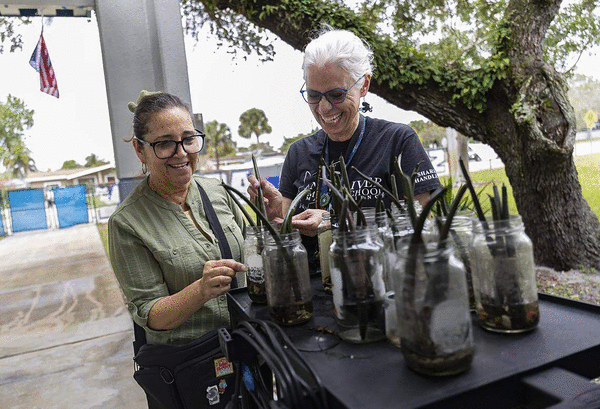
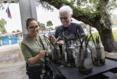
MIAMI — Nearly every sunny windowsill at New River Middle School is occupied by a reused jar filled with a handful of pebbles, an inch or two of water and a few slender, brown, pen-like tubes.
They’re baby mangroves — propagules, to be exact — and they’re the future of this Fort Lauderdale school’s campus.
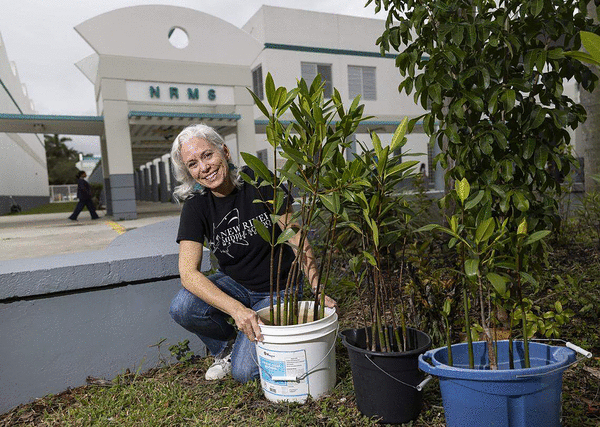
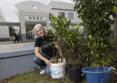
Mangroves are everywhere at New River Middle. Beyond windowsills, teenage red mangroves in old paint buckets are clustered by the pickup and drop off area, and they line the borders of the school’s garden.
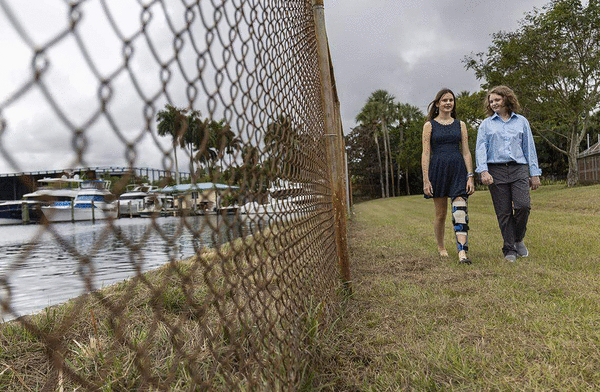
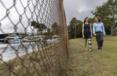
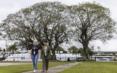
But one place they’re conspicuously absent is the shoreline of the New River, which borders the campus. On rainy and high tide days, the track and baseball field nearby can get submerged in ankle deep water as the river overtops the old seawall.
For years, students, teachers and administrators have been working on transforming the riverfront into a living shoreline, with a mini forest of mangroves instead of a leaky, low-lying concrete seawall.
The goal is to build a mini-forest of mangroves that buffer the campus from waves and high tides, help clean the water and provide a habitat for the manatees, tarpon and other wildlife that are regularly spotted in the area. And the dream is a riverfront filled with mangroves, a waterfront open air classroom for the students to use during the school week and the public to use on weekends and summers, plus a floating boardwalk ringing the whole thing for the community to experience nature.
“The whole idea is that it really is a model for living shorelines in the community and it’s also community accessible,” said Elizabeth Fahy, a 20-year veteran teacher and magnet coordinator at New River, a marine science magnet, who spearheaded the project initially.
The project has been underway since 2018, and there are now submerged concrete planter boxes in place as a future home for some mangroves, but there’s still a long way to go.
Permitting for the project began in 2018 and is mostly wrapped up, and the first submerged planters were installed in the summer of 2024, thanks to grants from the state of Florida. So far, the estimated cost for the entire project is about $3 million. The school still needs about $2 million to get it across the finish line — including the heavy lifting of bursting the seawall to create the inland lagoon that will host the mangroves.
Administrators hope that this year they can secure the money they need to finish the job. On Feb. 7, the school is hosting its fourth annual event showcasing student projects and fundraising for the shoreline, titled “Mission Possible: Sharks in Action.”
“My saying is, I’m not retiring until it happens,” Fahy said. “We’re all pretty invested in it, and hopefully it will get the right person who says ‘I can contribute to this’.”
A school-wide mission
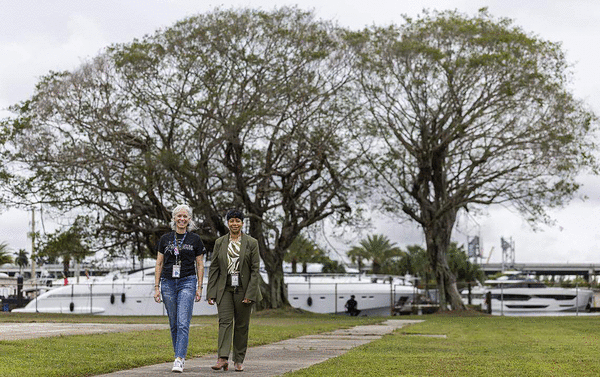
Lezondra Harris, the principal of New River Middle, said she “bought into the vision from the moment I got here.”
She said she’s proud of how the teachers have used this project to motivate the students and delighted by how enthusiastic the students are about bringing mangroves to their campus.
“What we are seeing from them now comes largely from what we are teaching them,” Harris said. “They’ve adopted this vision for the future that’s all about ‘how can I help the environment?’”
But the students are taking matters into their own hands. Beyond just growing some of the mangroves , students at New River have banded together to try and drum up community support for the project, particularly the members of the middle school’s Eco-Sharks club, overseen by Grisel Berrios, the school’s STEM teacher.
It was Berrios’ idea to have students address the Fort Lauderdale City Commission last year to drum up support for their “magical mangroves” initiative.
“Our goal is to be out there with our kids,” she said. “But they got up and did it.”
Nate Buck, a 12-year-old seventh grader, said it was a little scary at first to approach the commissioners with no script, just a passion for mangroves and the project. But Buck, a fixture on the school’s debate team, said it helped when he thought of it like one of his improvisational debate assignments.
“It felt like a little warmup,” he said, to the debate competition he had the next morning.
The commissioners were charmed, but the real win was when a representative of a local homeowners’ association invited the students to attend their next meeting to discuss the project. The HOA presented the students with a $250 check to help the project cross the finish line. And more importantly, the students got another lesson in working with different groups to collectively accomplish a goal.
“It was shocking to see how we were heard immediately,” said Eleonara Mariani, a 13-year-old eighth grader.
Bringing the living shoreline to life on campus would be a win not just for the animals and plants that would call it home, Mariani said, but the students who’d have a whole new hands-on classroom right in their backyard.
“We go on a lot of field trips to see the environment, so this would really help visualize what we mean by biodiversity,” she said. “Being able to see the mangroves absolutely helps us cement that learning.”
©2026 Miami Herald. Visit at miamiherald.com. Distributed by Tribune Content Agency, LLC.






Comments