Environmentalists push back against US EPA plan to extend coal plant closings
Published in Science & Technology News
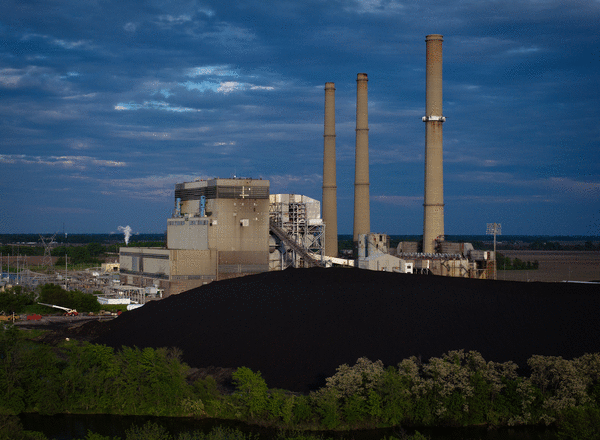
The U.S. Environmental Protection Agency is facing strong public opposition to its proposed plans to extend closure deadlines until October 2031 for 11 coal plants across the country — three of which are in Illinois and one in northwest Indiana.
But many environmental experts, including Earthjustice senior attorney Mychal Ozaeta, say the proposal caters to the coal industry rather than protecting communities.
In November, the U.S. EPA proposed a deadline extension that would allow sites including Baldwin, Kincaid and Newton power stations in Illinois and Schahfer Generating Station in Wheatfield, Indiana, to remain open for an additional three years.
Baldwin and Schahfer plants are considered major polluters, and Baldwin is the nation’s largest emitter of sulfur dioxide, among other pollutants.
There are 13 coal ash impoundments at the 11 sites, all of which are unlined and leaking toxic contaminants into nearby groundwater, said Ozaeta. Coal ash, the hazardous byproduct of burning coal, creates a slurry of carcinogenic heavy metals including arsenic, mercury, chromium and lead.
“These 13 are the most dangerous coal ash ponds in the U.S. because they’re leaking,” Ozaeta said. “They’ve been doing so for decades.”
Ozaeta was among dozens who spoke during Tuesday’s public hearing, expressing concerns over the Trump administration’s rollback plan. Many speakers said this proposal would set a dangerous precedent for a country that should be moving beyond its reliance on fossil fuels.
In 2018, the EPA was directed by the D.C. Circuit Court of Appeals to strengthen the federal Coal Combustion Residuals Rule and require the closure of unlined, leaking coal ash impoundments across the country.
Thirteen years later, the EPA is now seeking to extend the closure deadlines for these sites and further evade closure and cleanup for utility companies, said Ozaeta.
“The longer that these units are allowed to continue to evade closure and cleanup, the increased risks of these ponds and the contaminants that they’re leaking into the groundwater and potentially the waterways, and the increased risk of harm to human health and the environment,” Ozaeta said.
In Illinois, three sites would be allowed to continue operating until 2031: Kincaid, which is south of Springfield, and Baldwin and Newton power stations in southern Illinois.
For a state with some of the highest numbers of coal ash ponds, this decision threatens to reverse years of progress as Illinois has made strides away from reliance on coal-fired power, according to Cate Caldwell, senior policy director of the Illinois Environmental Council.
“Communities throughout our state, particularly in downstate regions and near river systems, live in close proximity to coal ash disposal sites that threaten groundwater and surface water resources,” Caldwell said. “Every additional year that unlined, leaking coal ash ponds remain open increases the risk that these contaminants will migrate further into aquifers, rivers and drinking water supplies used by Illinois families.”
As Illinois tackles an already mounting backlog of closure delays at its 72 coal ash sites, Caldwell said this latest EPA proposal to extend the lives of Kincaid, Baldwin and Newton plants signals a move in the wrong direction when it comes to coal pollution.
“The agency should not be asking coal companies how long they would like to continue dumping toxic waste,” Caldwell said. “It should be enforcing closure requirements that are already long overdue.”
But the EPA argued this deadline extension would resolve concerns of grid reliability as the country transitions beyond fossil fuels.
“This extension will promote electric grid reliability by allowing a small subset of baseload coal-fired power producers to continue operating for an additional three years beyond the Biden Administration’s disastrous attempt to pick winners and losers and destroy the coal industry,” said an EPA spokesperson in a statement.
During Tuesday’s hearing, Cecilia de Robertis, EPA deputy director of Waste Information, said the U.S. Department of Energy has warned that certain regions of the country would experience power grid issues if the closures were to occur in 2028, when previously required.
But Ozaeta said this is an unsurprising yet insufficient justification from the EPA.
“We’ve seen EPA attempt to paint this picture of the energy crisis to extend the life of these old, expensive coal plants,” Ozaeta said.
The EPA, Ozaeta said, hasn’t sufficiently proven the connection between grid reliability risks and extending timelines for these coal sites.
During Tuesday’s hearing, the sole supporter of the EPA’s ruling change was Indiana Department of Environmental Management Commissioner Clint Woods, who said he believes the EPA’s extension proposal is a necessary step to ensure reliable, affordable energy in Indiana.
The Northern Indiana Public Service Company’s R. M. Schahfer Generating Station is on the EPA’s list permitting it to remain operating until 2031, despite having an original Dec. 31 retirement date.
Last month, just two days before its original retirement date, the DOE ordered the Indiana plant to remain open to help power data centers in Jasper County.
Local advocates expressed their concerns over the decision to keep the Schahfer plant open during the hearing, including Ashley Williams, executive director of Just Transition NWI, an Indiana nonprofit advocating for clean energy transitions.
“Like every community, Wheatfield deserves to thrive,” Williams said. “Instead, it’s being sacrificed again for utility greed.”
In her testimony Tuesday, Williams highlighted that the Schahfer plant is considered a superpolluter and remains an ongoing environmental hazard for the community of Jasper County.
“Utilities see time as a commodity to be bargained over,” Williams said. “For my neighbors in Jasper County, time is minutes and restless nights they spend worrying about the toxins in their children’s bathwater. Time is the slow, irreversible seepage of coal ash into the aquifers that waters their crops. And they’re out of time.”
The EPA has extended the public comment period until Feb. 6 before finalizing the rule.
_____
©2026 Chicago Tribune. Visit chicagotribune.com. Distributed by Tribune Content Agency, LLC.





Comments