SpaceX defends airspace safety ahead of Florida Starship launch plans
Published in Science & Technology News
ORLANDO, Fla. — With plans to launch the massive Starship from Florida next year, SpaceX defended its commitment to airspace safety after a Wall Street Journal article claimed an explosive mission in early 2025 was a greater danger to some flights than previously reported.
The article published Saturday cited Federal Aviation Administration documents that stated debris from the Jan. 16 launch from SpaceX’s Texas site Starbase, which led to the upper stage disintegrating on its flight path, threatened three airplane flights. The debris field could be seen from Florida, the Bahamas and several Caribbean islands as the broken-up spacecraft streaked across the sky.
The article says the incident forced a JetBlue flight to Puerto Rico to adjust its flight path into a holding pattern, while a private jet and an international Iberia Airlines flight were under fuel emergencies and ventured into the FAA’s keep-out zones.
A similar Starship explosion occurred during a March launch attempt from Texas that shut down air traffic to several Florida airports, including Orlando International Airport.
SpaceX responded on social media calling the article misleading.
“The reporters were clearly spoon-fed incomplete and misleading information from detractors with ulterior motives,” SpaceX posted on X. “At best, it shows a complete lack of understanding of the robust tools used by safety officials to manage airspace, which are well-defined, science-based, and have been highly effective at protecting public safety.”
SpaceX is seeking two launch sites from Florida for operational missions that could fly up to 120 missions a year if approved.
The behemoth rocket is designed to be the first fully reusable rocket, with its Super Heavy booster stage making returns to the launch site shortly after launch and the upper stage potentially landing back at the launch site after at least one orbit of the Earth.
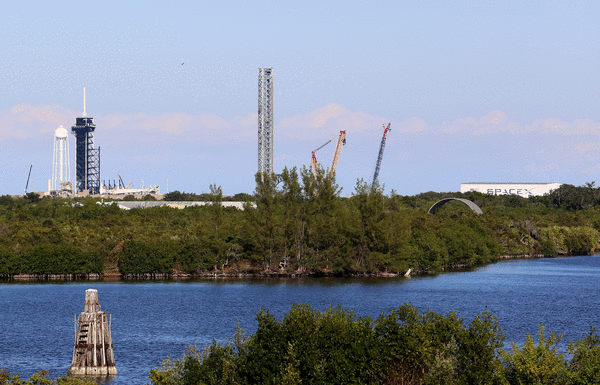
Space Force officials said they were preparing for the first Florida launches to come from the site currently under construction at Kennedy Space Center’s Launch Pad 39-A as early as mid-2026. A second site with two launch towers at Cape Canaveral Space Force Station’s Space Launch Complex 37 would come online later.
SpaceX said The Wall Street Journal article was a disservice to the public, likening it to a false narrative “based on conjecture and unscientific analysis from anonymous sources.”
“To be clear, for every Starship flight test, public safety has always been SpaceX’s top priority. No aircraft have been put at risk and any events that generated vehicle debris were contained within pre-coordinated response areas developed by (Space Force) and implemented by the (FAA),” SpaceX stated.
Already the hazard areas for Starship launches are “conservatively broad,” the company said.
“Any aircraft were appropriately routed in real-time around where debris was contained within the larger pre-coordinated hazard area,” it stated. “SpaceX is committed to responsibly using airspace during launches and reentries, prioritizing public safety to protect people on the ground, at sea, and in the air.”
Safety aside, airspace closure potential and the disruption it could cause have been a major criticism after details were revealed in a pair of environmental impact statements for the KSC and Cape Canaveral launch sites.
Launch operations would close airspace over the Atlantic from 40 minutes to two hours, which could affect the Bahamas and Canada in addition to U.S. routes. That could affect 133 to 400 aircraft during peak travel periods and equates to as much as 8,800 commercial flights a year, although half the launches are expected to fall during overnight hours.
It’s the return flights, though, that could cause bigger headaches for airports in Florida and elsewhere as the upper stage trajectory would be similar to how the Space Shuttle would come back for landings. The west-to-east path could shut down southbound U.S. as well as international air traffic headed for Orlando, Tampa, Fort Lauderdale, West Palm Beach and Miami. It could also affect airspace over Mexico, Central America and Cuba,
Landing approaches would prompt a minimum of 40 minutes and up to one hour of airspace closure, impacting 400 to 600 commercial aircraft during peak daily travel periods, which is from 8,800 to 13,200 per year.
Christopher Oswald, the senior vice president of safety and regulatory affairs for Airports Council International – North America. which represents local, regional and state governing bodies that own and operate commercial airports in the United States and Canada, raised the alarm on the potential delays in a filing for the KSC’s Draft EIS.
His organization said the proposed limits on commercial operations could affect between 900,000 and 2.3 million passengers per year experiencing a collective delay of between 600,000 and 3.2 million hours.
“We calculate that the costs of delays and disruptions associated with the proposed Starship operations would range between $80 million and $350 million annually,” he wrote.
But he was also concerned with existing safety guardrails in place for launches as space and air travel become more intertwined.
“We believe the safety and practicality of using air traffic control initiatives such as ground stops, use of miles-in-trail restrictions, dynamic reroutes, and other air traffic management techniques requires additional review and stakeholder engagement,” he wrote.
SpaceX for now is working with much larger no-fly zones with Starship, which uses a less documented methane-based fuel mixture on launch. It expects those zones will shrink with a higher launch rate and the effect on airspace will diminish, similar to what it has seen with launch operations tied to its smaller Falcon 9 rockets.
“SpaceX will continue to ensure maximum public safety while also working to integrate Starship more efficiently into the airspace,” it stated.
-----------
©2025 Orlando Sentinel. Visit at orlandosentinel.com. Distributed by Tribune Content Agency, LLC.






Comments