At a Silicon Valley summit, robots fold laundry -- and investors open their wallets
Published in Science & Technology News
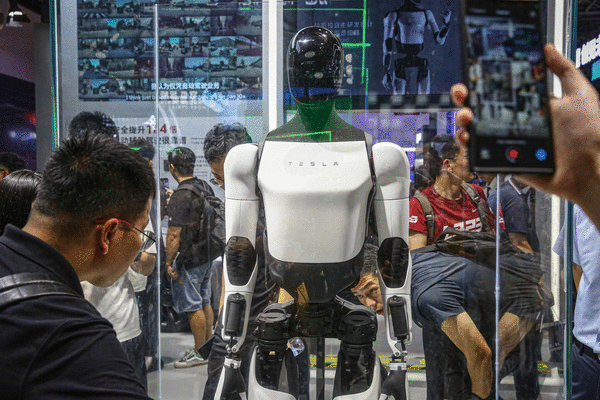
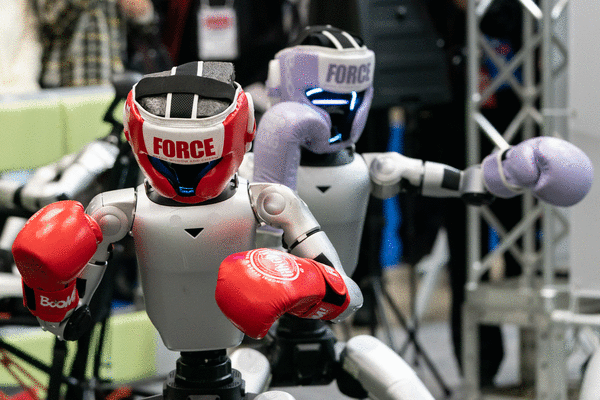
Robots from around the world converged on Silicon Valley to provide a glimpse of a potential future.
Two robots picked up T-shirts with orange-tipped claws, then neatly folded and piled them. A cute companion robot with bright eyes used its mechanical hands to make a heart. A small robot wearing a bear hat threw punches and a blue-green robot, resembling an anime character, moved its head and arms.
A robot designed to look like a child and teach had something to say.
“By teaming up, humans and robots can solve big problems like making education more accessible, caring for people and protecting our planet,” said Codey, a robot from Mind Children, a Washington-state startup.
The robots and roughly 2,000 people were part of the two-day Humanoids Summit, held last week at the Computer History Museum in Mountain View. Humanoid robots differ from standard mechanical robots already in use in many industries as they resemble people and mimic their movements.
The event brought together robotics companies in the United States, China, Japan and elsewhere.
It featured speakers from Google, Disney, and Boston Dynamics, as well as products from California startups such as Weave Robotics, Dyna Robotics and Psyonic.
California venture capital firm ALM Ventures organized the summit. Investors are making bigger bets on robotics companies, intensifying the competition to place AI into physical forms that interact with people in the real world.
As of early December, VC deals in U.S. humanoid robotics companies totaled nearly $2.8 billion in 2025, up from $42.6 million in 2020, according to PitchBook data. Investments in California humanoid robotics companies — roughly $1.6 billion — accounted for the majority of that funding.
Figure, a San Jose-based AI robotics company that developed a robot to do dishes, laundry and other household tasks, announced in September that it had surpassed $1 billion in funding and was valued at $39 billion.
Companies have developed robots to lift heavy objects in warehouses, support customers in stores, assist doctors, fight on the battlefield and entertain visitors in theme parks.
Startups are building components for robots, such as hands, sensors, and cameras. And tech moguls have made some bold predictions about the future.
Elon Musk said this year that Tesla’s humanoid robot Optimus will “eliminate poverty,” be more productive than humans and boost the global economy.
Still, robots are a long way from living up to the hype, say some analysts who are skeptical about whether businesses and consumers will even find them helpful.
“They’re impractical. They are limited in functionality. They’re not nearly as clever as they demo,” said Bill Ray, an analyst and chief of research at Gartner.
There are also concerns that robots will take people’s jobs and invade their privacy.
Bot builders say their products are designed to help humans, not replace them.
Modar Alaoui, founder and general partner of ALM Ventures, said he thinks robots will take off first in manufacturing. The firm launched a $100 million early-stage fund, with part dedicated to humanoid robots.
“It’s the dull, dangerous, boring, mundane tasks that need to be done every day,” that robots will take over, he said. “And that also happens naturally, because of the organic, natural transition from just smart automation to highly intelligent automation.”
The Humanoids Summit showed how robots still have technical limitations. Few of the robots on display were actually autonomous, with many still essentially just doing pre-programmed movements or being puppeteered by humans.
This is just the beginning, say the optimists.
The market for robots that resemble and act like humans is projected to grow. By 2050, the humanoids market is likely to reach $5 trillion and could be twice the size of the auto industry, Morgan Stanley Research estimates. The firm said there could be more than 1 billion humanoids in use by then.
A humanoid robot costs roughly $200,000 in 2024 in high-income countries, Morgan Stanley Research estimates. By 2050, that could fall to $50,000 as technology advances and production increases.
Weave Robotics, the California startup behind the laundry-folding robot, has started placing robots in laundromats. Former Apple engineers Evan Wineland and Kaan Dogrusoz founded the company. It plans to start shipping a new robot, Isaac, to fold laundry and tidy homes next year.
Ahead of the conference, at Sea Breeze Cleaners in San Francisco, one of the company’s robots folded shirts behind a large window facing a sidewalk in the Noe Valley neighborhood.
The strange sight stopped people in their tracks. Curious spectators snapped photos.
The AI-powered robot didn’t fold clothes as fast as humans, but it patiently plowed through the laundry one pile at a time.
The company and Sea Breeze Cleaners teamed up with Tumble, an on-demand laundry-delivery service that uses robots to finish laundry more quickly.
Kay Astorga, who owns Sea Breeze Cleaners with her husband, says putting the robot in their laundromat has helped attract new customers.
Working with the robot has convinced her that she prefers robots —like the Disney and Pixar character WALL-E — that resemble machines more than humans. She doesn’t want the robots to do the things that bring people joy, like baking.
“I don’t want to have a croissant made by a robot,” she said. “I want a shirt folded by a robot for sure. That’s cool with me.”
While California companies such as Figure and 1X Technologies are building flashy home robots with human-like bodies and legs, Weave Robotics’ laundry-folding robot doesn’t need a whole body. That keeps the cost of the robot under $10,000 to install and “extremely low cost to continually operate,” Wineland said.
The company is in talks with other businesses in manufacturing and hospitality, he said. It plans to deploy a third robot at a laundromat in Walnut Creek in the new year, he said.
Its upcoming home robot, named after the science fiction writer Isaac Asimov, will cost more because it will be mobile with wheels and have other premium features. The company envisions that people will be able to talk to the robot and issue commands via an app.
Some robots are doing dangerous tasks that workers might not want to do.
Agility Robotics, an Oregon company with an office in San Jose, has been deploying its robot Digit in warehouses and for manufacturing and logistics.
“You have a lot of manual labor that involves very heavy moving of objects and people can get cut. People can get hurt,” said Pras Velagapudi, chief technology officer at Agility Robotics.
Standing on two legs, the blue-green robot has claw-like grippers rather than hands and can lift up to 35 pounds. Companies such as e-commerce giant Amazon have used the robot for repetitive tasks such as picking up and moving empty totes.
Agility charges businesses for the labor provided by their robots. The company, like others in the industry, needs to build a cage or guardrail around the robot for safety.
California startups are also working to improve parts used by robots and, sometimes, even by humans.
Back at the summit, the booth of San Diego startup Psyonic featured a selection of robotic hands on various arms that resembled Doctor Octopus, a character in the Spider-Man series. The startup is known for its bionic “Ability hand,” used by both robots and humans with missing limbs. Sensors within the hand allow people to sense touch when they grip an object.
Aadeel Akhtar, the chief executive and co-founder of Psyonic, said that as a child, he met a girl with a missing limb while visiting Pakistan with his parents. That inspired him to work on bionic limbs. The company secured funding through equity crowdfunding and on the TV show “Shark Tank,” and is also developing prototypes for arms and legs.
Seeing a robot in the future, he anticipates, will be more common.
“It’s going to be more integrated in society,” he said. “It’s not such a novel concept anymore.”
©2025 Los Angeles Times. Visit at latimes.com. Distributed by Tribune Content Agency, LLC.






Comments