Chicago Tribune sues Perplexity AI for copyright infringement
Published in Science & Technology News
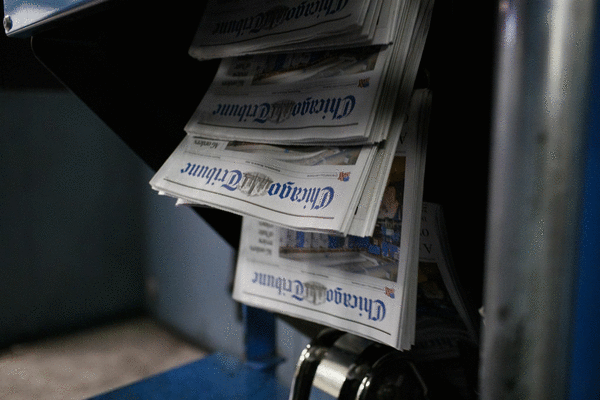
The Chicago Tribune filed a copyright infringement lawsuit Thursday in New York federal court against Perplexity AI, alleging the California-based startup has been unlawfully profiting off the newspaper’s content in building its AI-driven search engine.
The complaint challenges the unauthorized use of often fully reproduced Tribune reporting to provide answers on the Perplexity AI platforms – both a chatbot and newly launched search engine – essentially bypassing the need to link to the newspaper’s website.
Using large chunks of the Tribune’s original reporting – sometimes inaccurately – diverts traffic away from the newspaper’s website, threatening its business model of paid subscriptions and advertising, the lawsuit alleges.
“Perplexity’s GenAI Products generate outputs that are identical or substantially similar to the Chicago Tribune’s content,” the lawsuit states. “Upon information and belief, Perplexity has unlawfully copied millions of copyrighted Chicago Tribune stories, videos, images, and other works to power its products and tools.”
A spokesperson for Perplexity AI did not immediately respond to a request for comment Thursday.
Founded in 2022, Perplexity AI is a generative artificial intelligence company that bills itself as the “world’s first answer engine,” with a chatbot delivering complete responses that in many cases obviate the need to go to the source link for more information.
In August, Perplexity made an unsolicited $34.5 billion offer to buy Google’s Chrome browser. Perplexity launched its own Comet browser broadly in October, which like its chatbot, offers full results from sources like the Tribune, encouraging users to bypass the newspaper’s site.
Until recently, Perplexity actually used the phrase “skip the links” as a sales pitch for its AI products, according to the lawsuit.
“By copying the Chicago Tribune’s copyrighted content and using it to create substitutive output derived from its works, obviating the need for users to visit the Chicago Tribune’s website or purchase its newspaper, Perplexity is misappropriating substantial subscription, advertising, licensing, and affiliate revenue opportunities that belong rightfully and exclusively to the Chicago Tribune,” the lawsuit states.
In addition to lifting content verbatim, like many AI platforms, Perplexity is also prone to “hallucinations,” creating inaccurate results and attributing them to the Tribune, which the lawsuit alleges is likely to tarnish the newspaper’s brand and cause “serious damage to its worldwide reputation” as a truthful and accurate news source.
“The Perplexity business model is based on the theft of journalism created by real live journalists at the Chicago Tribune and other publications,” Mitch Pugh, executive editor of the Tribune, said in a statement. “These journalists work each day to serve the public interest, seeking justice and holding power accountable often at great personal and institutional risk. Any accurate information that Perplexity provides to users is based entirely on this work. It is stealing, plain and simple.
“To make matters worse, too often bad information is provided to users and falsely attributed to trusted news publishers like the Tribune. All of us need to seriously examine the ways in which companies like Perplexity are lining their pockets and what public good this unabashed plundering can possibly serve.”
While Perplexity’s “answer engine” AI platform threatens the newspaper’s business model, it has quickly gained traction on the backs of the Tribune and other news sources, according to the lawsuit, achieving a $20 billion valuation and more than 100 million generative search results each week.
The copyright infringement lawsuit against Perplexity is just the latest brought by legacy media against AI companies, including related legal actions by a coalition of 17 newspapers owned or operated by MediaNews Group and Tribune Publishing.
The Chicago Tribune and seven other newspapers filed a lawsuit last year against OpenAI and Microsoft for allegedly using articles “without permission and without payment” to drive their generative artificial intelligence programs. A second lawsuit on behalf of nine more MediaNews Group and Tribune publications was filed last month.
Both cases are ongoing in a New York federal court.
“OpenAI and Microsoft have built their AI products and models on a massive foundation of stolen material,” Frank Pine, executive editor of MediaNews Group, said in a statement. “Even worse, their products are undercutting the business model for news by paraphrasing, plagiarizing and outright regurgitating the news content they have stolen and continue to steal. They must be held to account and forced to pay for news and information they use.”
The Tribune lawsuit against Perplexity alleges three counts of copyright infringement, one count of false designation and trademark dilution, and one count of trademark infringement. It is seeking undisclosed damages and a permanent injunction preventing Perplexity from engaging in the unlawful use of the newspaper’s content.
©2025 Chicago Tribune. Visit at chicagotribune.com. Distributed by Tribune Content Agency, LLC.






Comments