Gretchen's table: Feed your inner Hemingway these Spanish stuffed peppers
Published in Variety Menu
Depending on where your sandals hit the pavement or sand in Spain, you’ll either love the cuisine — or hate it. Sometimes, it’s both.
At least that was my experience on a trip through Andalusia a few years ago that included stops in Malaga and Marbella on the southern Costa del Sol; the capital, Seville; the dramatic mountain town of Ronda; and the (very) windy beaches of Tarifa, where you can easily while away an afternoon watching kitesurfers perform aerial acrobatics where the Mediterranean Sea meets the Atlantic Ocean.
While my husband and I very much enjoyed the empanadas, croquetas, Iberian ham sandwiches and salmorejo (a thick and creamy chilled Spanish tomato soup), we weren’t as crazy about the seafood we encountered on the beach near the end of the trip.
It’s not that it wasn’t fresh or hyper local — just too fresh in some cases, with eyes, tentacles, bones and organs still attached in keeping with Andalusian cuisine’s embrace of a “nose-to-tail” philosophy of cooking.
I know — I’m a baby! But I have a thing about eating food I don’t easily recognize.
Overall, however, it was a great gastronomic tour of a country whose flavors I have tried to faithfully create on occasion in my own kitchen.
That’s why I was excited to take a test drive through Howie Southworth’s book, “Hemingway's Spanish Table: A Culinary Journey in 60+ Delicious Recipes” (Weldon Owen, $30), after it landed on my desk a few weeks ago.
As much a travel guide as a cookbook, this book takes readers beyond the familiar territory of paella and into the heart of Spain through the eyes of writer Ernest Hemingway.
The American novelist spent a lot of time in Spain, and so deeply loved its culture that he set several of his books there, including “The Sun Also Rises” (1926), “Death in the Afternoon” (1932) and “For Whom the Bell Tolls” (1940).
The writer also famously loved to eat (and drink), and many of “Papa’s” stories and personal letters included vivid descriptions of the braised meats, fresh seafood and tapas he enjoyed while living there.
Southworth follows in Hemingway’s footsteps across Spain with recipes for classic Spanish fare that include everything from gazpacho, roasted suckling pig and ham croquettes to patatas bravas, gambas al ajillo and Basque “burnt” cheesecake. Each includes a look at the dish’s origins, and where you’ll find references to it in Hemingway’s writings.
I was immediately drawn to a recipe for pimientos rellenos, or stuffed roasted piquillo peppers. The sweet and tangy chili pepper with almost no heat is among Spain’s favorite peppers. Used in both sauces and to garnish meats and salads, they also are frequently stuffed with minced meats or seafood and cheeses and served warm as tapas, or appetizers.
Here, the savory filling is made with ground beef emulsified with cream cheese, mayonnaise and egg. The original recipe also calls for cooked crayfish tails — a crustacean fondly recalled by protagonist Robert Jordan in “For Whom the Bell Tolls.” They aren’t easy to find in Pittsburgh. So I substituted shrimp.
The resulting combo, according to my niece Amanda, who I shared them with, was “to die for. So good!”
I had to agree; it’s a perfect two- or maybe three-bite snack. It’s equally perfect as a passed dish for a party, or luxe dinner for two at home.
Pimentos Rellenos
PG tested
Sweet, with little to no heat, the piquillo is the among the most popular peppers in Spain. It comes from the Navarra region and is known for its vibrant color and slightly smoky flavor. It is often used in tapas or as a garnish on grilled meat.
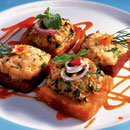
This two-bite surf-and-turf nosh featured in the book “Hemingway’s Spanish Table” is stuffed with cheese, meat and seafood and can be served either as an appetizer or part of a main dish. I substituted easier-to-find shrimp for crayfish tails.
You can usually find piquillo peppers either alongside jarred roasted red peppers and artichoke hearts in larger grocery stores, or in the international/gourmet aisle.
2 tablespoons extra virgin olive oil, plus more for drizzling
8 ounces ground beef
1 teaspoon kosher salt, divided
½ teaspoon freshly ground black pepper
2 cloves garlic, minced
8 canned or jarred piquillo peppers
¼ cup cream cheese, room temperature
2 tablespoons mayonnaise
1 egg yolk
2 tablespoons chopped parsley
8 ounces cooked crayfish tails, peeled
8 slices baguette
Preheat oven to 375 degrees.
Add olive oil to a skillet over medium-high heat. When the oil begins to shimmer, add beef, ½ teaspoon salt, pepper and garlic and saute for 4-5 minutes, until the beef is well cooked.
Remove from the skillet and drain.
Place peppers on a plate and pat dry with paper towels.
In a mixing bowl, whisk together cream cheese, mayonnaise, egg yolk, parsley and remaining ½ teaspoon salt. Fold in seafood and cooked beef.
Using a small spoon, fill each pepper with the beef and seafood mixture and place on a greased baking sheet. (You may end up with more filling than you can use in 8 peppers; I ended up stuffing 10 peppers.)
Transfer to preheated oven and roast for 15 minutes. For the last 5 minutes of roasting, add baguette slices to toast.
Remove the stuffed peppers and toast from oven. Place the peppers atop the toast and, optionally, secure with a toothpick.
Drizzle with olive oil and serve hot.
Makes 8 tapas.
— adapted from “Hemingway’s Spanish Table” by Howie Southworth
©2026 PG Publishing Co. Visit at post-gazette.com. Distributed by Tribune Content Agency, LLC.







Comments