
The Greener View: Staghorn Ferns
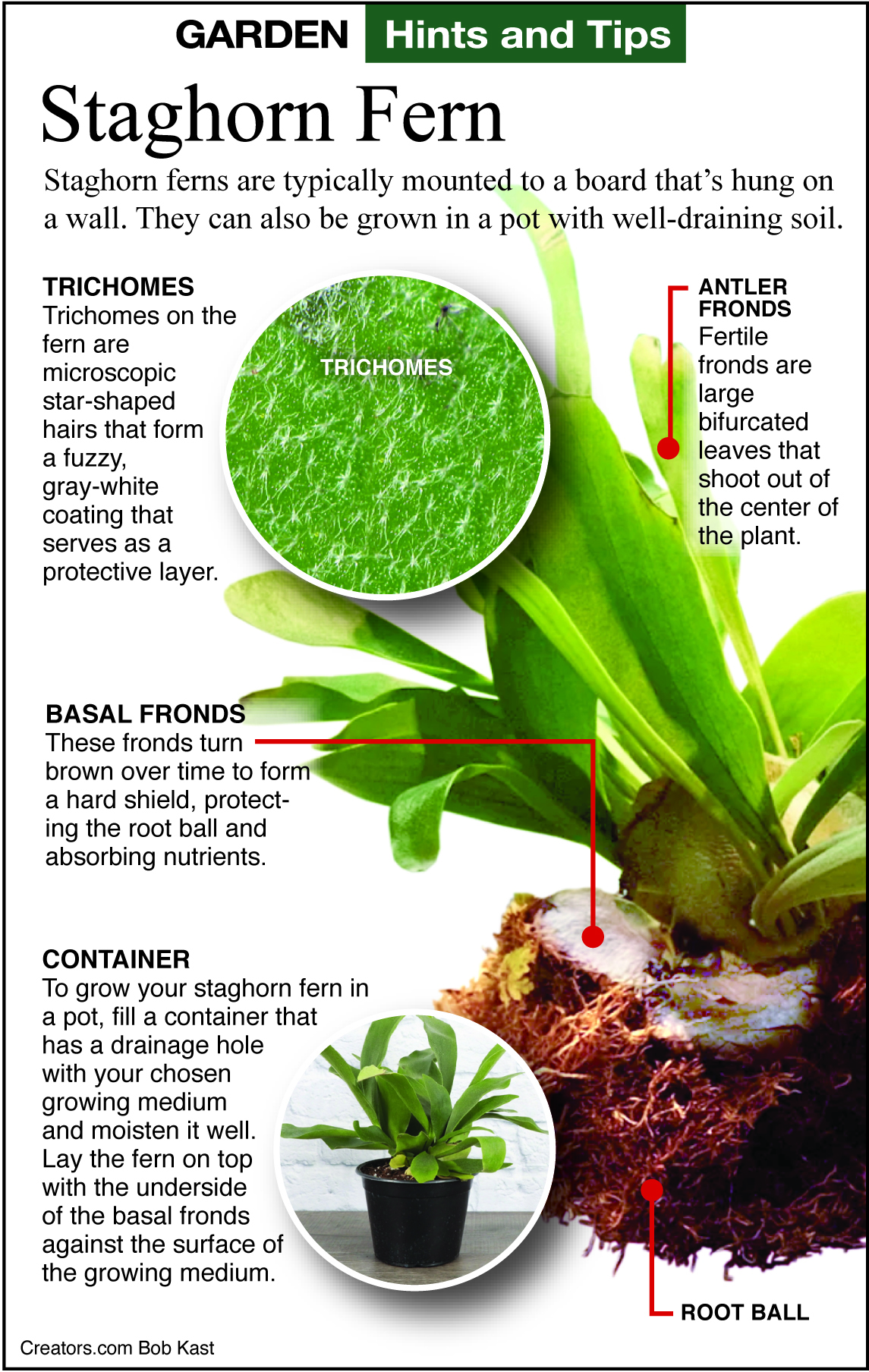
Q: I received a staghorn fern as a Christmas present. It is on a small wooden board. I don't have any place to hang it. Can I put it in a pot? What kind of soil should I use?
A: Your fern is the most commonly grown of the 18 species of staghorn or elkhorn ferns: Platycerium bifurcatum. All 18 species are called staghorn or elkhorn ferns. They are found in Africa, Asia, Australia, and one species is from South America. The bifurcatum species is native to rainforests of Java, New Guinea and eastern Australia. They have become naturalized in Florida and Hawaii, where they are becoming invasive.
They grow from short rhizomes and produce two kinds of fronds. We may call these leaves, but true leaves don't grow flowers. A fern frond is kind of a hybrid between a leaf, a stem and a flower. The fertile fronds may produce brown patches of spores, which is sort of like a leaf growing a flower. The infertile fronds form a base shield that starts green and eventually dries to a brown papery covering over the roots and rhizomes. It protects them from drying out, and it collects rainwater. Don't take it off, even when it turns brown.
The specific epithet of bifurcatum means that the fertile fronds of this species keep splitting in two. In some species, the fronds are long and skinny without much branching, and in one species, the fronds are huge like elephant ears. In some species, the fronds point up to form a crown shape; in some they hang straight down; and in some species, they do both.
Staghorns are epiphytes, so they grow on trees in the jungle. They like bright light but not direct sunlight during the hot afternoon. They are unusual as ferns in that they can tolerate not being watered for several days at a time. Indoors in the winter, they can go for a week without watering. They do absorb water through their leaves, so when you water them, you should get the leaves wet. The surface of the leaves may look like they have a silvery dust on them. Do not wipe it off. These are trichomes, which are like little hairs on the fronds. They protect the plant from too much sunlight, and they help absorb rainwater. Most staghorns prefer 70s and 80s, but these bifurcatums can survive a night of light frost.
They can be fertilized in the summer with a diluted liquid fertilizer or with slow-release pellets. Some people will throw banana peels on top of the plant. This mimics the idea of dead leaves being collected by the plant in its natural habitat. The dead organic matter needs to be broken down by bacteria and fungi before a plant can use it, so the banana peel will feed the plant in about a year. In the meantime, it will attract fruit flies to your plants. The plant and your garden will be better off if you compost the banana peel and feed the fern with a bit of compost.
Small staghorn ferns can be grown in pots or as Kokedama balls. Eventually, though, they will probably need to be repotted. They can grow on a wooden plank like yours or in a wire hanging basket. They can grow 3 feet across and can become very heavy. If you have one on a wooden plank and the sterile fronds start growing over the sides, don't try to unmount it; just install the small plank onto a larger plank. If the rhizome has created new small offset plantlets, they can be cut off to start new plants as long as they have some roots of their own.
They can grow in hanging baskets lined with moss or coconut coir. I like to grow them in a mix of pine bark and potting soil with a covering of sphagnum moss. If you can gently remove it from the wooden board, go ahead before replanting it into a pot. Or you can trim as much of the board away from the shield frond and plant it with a little of the board still attached.
I recently posted a video of moving a staghorn fern from a small pot to a larger basket and a fern going from a Kokedama ball onto a board. Check it out on the Greener View YouTube channel.
========
Email questions to Jeff Rugg at info@greenerview.com. To find out more about Jeff Rugg and read features by other Creators Syndicate writers and cartoonists, visit the Creators Syndicate website at www.creators.com.
Copyright 2026 Jeff Rugg. Distributed By Creators.






Comments