
Eric's Autos: 2025 Ford Bronco
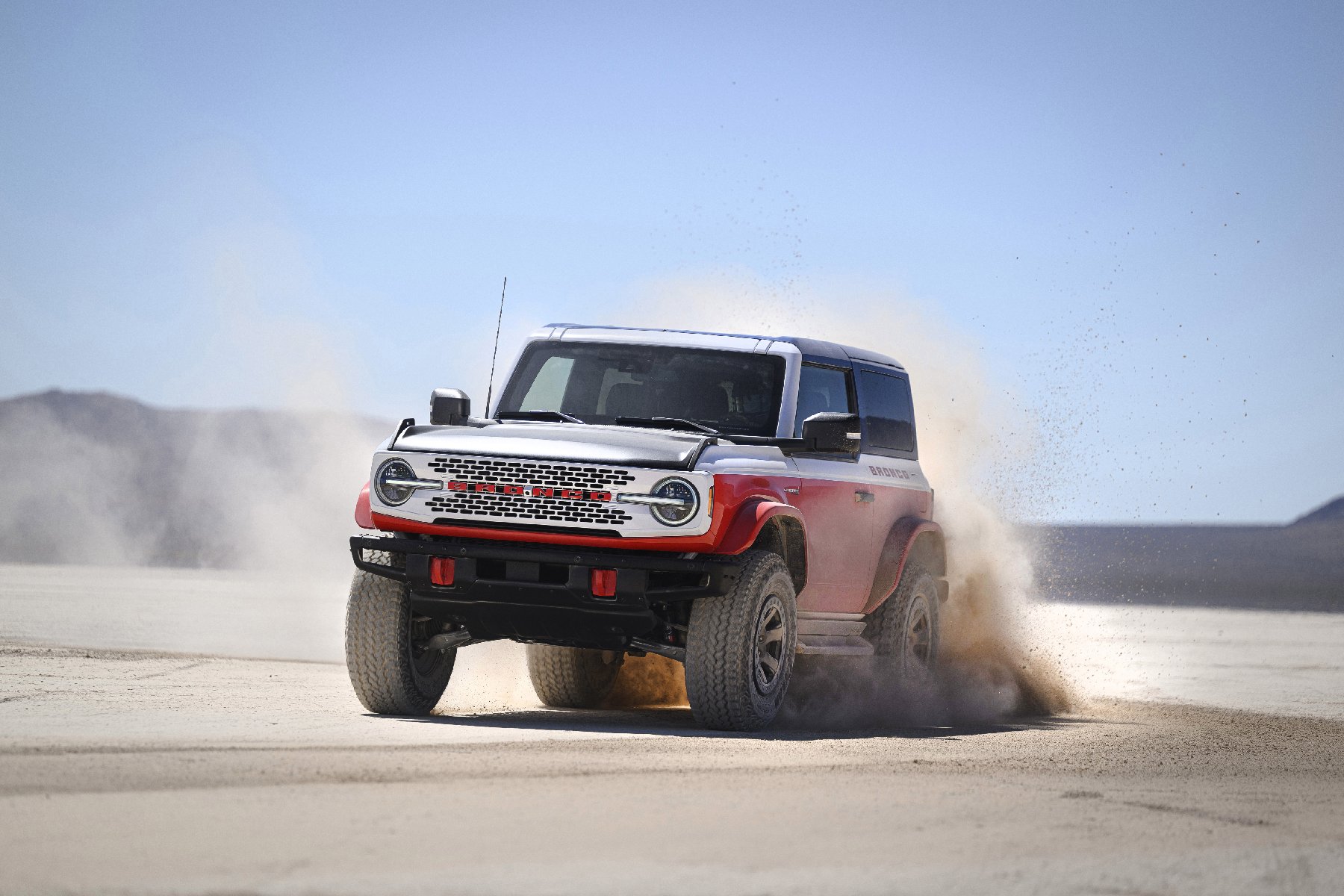
There are lots of SUVs on the market -- but very few 4x4s. What's the difference? Well, it's the difference between a professional fighter and a guy who hits the bag at the gym on weekends. Both throw punches. One of them hits harder.
As with professional fighters, there are only a few 4x4s in the ring.
One of them is the Ford Bronco.
What It Is
The Bronco is a 4x4 rather than an SUV -- which means it is made specifically to be capable of taking on unpaved roads, deep water and rugged terrain generally. Unlike most SUVs, which offer four-wheel drive, the Bronco comes standard with it, and it's different from the systems found in many SUVs because it has two-wheel-drive High (rear-wheel drive) and 4WD High selectable ranges, as well as automatic 4WD and 4WD Low. Most SUVs have automatic 4WD, and some do not come with Low range gearing.
The Bronco also offers something else no other SUV on the market in this country is even available with: a manual transmission.
Ford also offers the Bronco in two- and four-door body styles, and you can get a soft top or a removable hardtop. There are three engines to pick from too, ranging from the standard turbocharged 2.3-liter four-cylinder to the optional twin-turbo 2.7-liter V6 and top-of-the-line 3.0-liter turbocharged V6.
Prices start at $38,995 for the Base two-door with the 2.3-liter engine and your pick of either the seven-speed manual or the available 10-speed automatic.
The Big Bend ($40,420) is next. It adds a full-size spare mounted on the rear (swing-out) door and leather trim inside.
The Outer Banks ($47,940) comes standard with the automatic plus running boards and 18-inch wheels with all-terrain tires. This trim is eligible for the optional 2.7-liter twin-turbo V6, which is available as a standalone option ($2,145). This engine comes only with the automatic.
The Badlands ($49,585) swaps out the 18-inch wheels and all-terrain tires for a set of 17-inch wheels and 33-inch knobbies, plus a heavier-duty suspension with Bilstein shocks, rock rails and skid plates, plus wiring for auxiliary switches to control winches and such.
The Heritage ($51,475) is essentially a cosmetic package that hearkens back to the original Bronco of the '60s with white hardtop, plaid cloth interior and graphics unique to this trim.
The Stroppe Edition ($75,635) gets everything you'd get with the Badlands plus the 2.7-liter V6 as standard equipment and the Sasquatch package that's optional with the Badlands. The Sasquatch package bundles 35-inch knobbies, a lifted suspension, locking front and rear axles and high-mount fender flares.
The Raptor iteration is the most expensive ($79,995) off-road-capable and most powerful Bronco. It is the only Bronco that comes with the 3.0-liter V6, and you also get 37-inch beadlock knobbies on 17 wheels, Fox off-road shocks, a heavier-duty rear axle and an electric decoupling front sway bar (to allow greater wheel articulation) plus all the stuff that comes with the Sasquatch package.
The Bronco's only real rival is the Jeep Wrangler, which is also available in two- and four-door body styles and is also a 4x4 rather than an SUV.
What's New for 2025
The Stroppe Edition is new; the previously available Everglades and Wildtrak trims have been retired. There's a new March Gray matte paint option and a factory wrap option, along with some minor equipment changes.
What's Good
-- Very much like the classic Broncos of the '60s in that this rig is designed to go anywhere you dare.
-- Though it doesn't come with a V8 like the classic Broncos of the past, its standard four makes more power than any of the classic Bronco's V8s.
-- Available with a manual transmission.
What's Not So Good
-- Only the standard engine is available with the manual; you also have to move up to the more expensive trims to be able to get the optional 2.7-liter V6.
-- Though extremely capable, the Bronco's 4WD relies on electronics to engage/disengage the ranges.
-- Jeep Wrangler's MSRP is thousands less, and you get a standard V6 as well as a standard manual transmission.
Under the Hood
The Bronco's standard engine is a turbocharged 2.3-liter four-cylinder that touts 300 horsepower and 325 foot-pounds of torque. This is a lot more of both than a 1970 Bronco's 289 V8 conjured -- which was all of 205 horsepower.
The classic Bronco also came standard with a manual transmission, but it was just a three-speed, with no overdrive gearing. The Bronco's standard manual has seven, including overdrive -- allowing for comfortable highway speed driving. Without overdrive, a classic Bronco was very uncomfortable on the highway -- unless you kept your speed down to around 60 mph. Even then, you were not far from a classic Bronco's top speed.
You can also opt for a 10-speed automatic; this box can be dialed in (literally) via a rotary knob controller on the center console that lets you adjust shift timing and firmness, depending on the conditions.
You also can opt for a V6 in all but the Base Bronco trims; it's a small one -- just 2.7 liters -- but it touts 330 horsepower and 415 foot-pounds of torque. The power comes not so much from size or cylinders but from boost. This engine has two turbos. It massively outguns the Jeep's V6, which is the only engine you can get in the Wrangler unless you can afford to spend $100,000 for the Rubicon 392 version or want a turbo-hybrid four drivetrain called 4Xe; the latter only offers 270 horsepower.
If the 2.7-liter V6 isn't strong enough for you, the Raptor's 3.0-liter turbocharged V6 ought to be. It makes 418 horsepower and 440 foot-pounds of torque. Equipped with this engine, the Bronco is rated to pull up to 4,500 pounds.
All Broncos come standard with a 4WD system that can be set for 2WD High, 4WD High, 4WD auto and 4WD Low range via push buttons located inside the drive-mode ring on the center console. Front, center and rear locking differentials are available or standard -- depending on the trim/packages you buy.
On the Road
The Bronco is interesting before you even drive it -- because it is so interesting to look at, especially the variants with three-tone paint jobs. But the really interesting thing is much deeper than that -- and you have to go for a drive to understand that. Open the door -- which feels heavy and solid rather than thin and flimsy -- and sit down and look out through the nearly vertical front glass over the scalloped hood with the grab handle things on either side. If you close your eyes -- and don't look at the LCD dash display -- it's not at all difficult to imagine that you're getting ready to drive a '70 Bronco rather than a brand-new one.
Then you get going and realize that while the visuals are an excellent conjuring of the early '70s, the drive is updated in all the right ways. There is power -- and acceleration -- for openers. The old Bronco was under-engined, even when it was equipped with its available V8. It was great for slow-trekking fire roads, but on the road it was very clear you were driving a 4x4. The thing was geared for slow-motion tenacity, not high-speed cruising, much less on-road cornering.
This Bronco is adept at all three.
At the Curb
The Bronco's existence proves it is possible to design a new vehicle that is both visually (and otherwise) interesting as well as compliant. Though the new Bronco looks like it time-traveled from 1970, it meets all 2025 federal "safety" standards, outside and in. Yet it doesn't look like a compliance mobile, and that is hugely compelling if you're weary of the way compliance pressures have made almost everything new look as if they were all stamped out of the same mold, then given different badges as they left the factory.
Like its main rival, the Bronco is available with two or four doors -- and with a removable hardtop or a soft top, as you prefer.
The two-door version is 173.7 inches long; the four-door version is 189.4 inches long. The chief difference -- other than length and whether there are two or four doors -- is how much room there is in back and for cargo. The two-door has 35.7 inches of backseat legroom and 20.6 cubic feet of cargo with the backseats up. Fold them down and the available space increases to 52 cubic feet. The four door has a bit more legroom -- 36.3 inches -- and a lot more room for cargo: 38.3 inches with the backseats in place and 77.6 cubic feet with them out of the way.
The two-door Wrangler is significantly shorter than the two-door Wrangler; it is 166.8 inches long and has only 12.9 cubic feet of cargo capacity with its rear seats up, and it maxes out at 31.7 cubic feet. The four-door Wrangler is about the same overall size as the four-door Bronco and comparably spacious for passengers and cargo. But both versions of the Jeep lack an engine upgrade that isn't a six-figure upgrade. The 4Xe plug-in hybrid is only an upgrade if you value this variant's electric-only (for about 22 miles, fully charged) capability.
The Bronco's cargo area is accessible via a swing-out rear door or via a lift-up rear glass section; each can be opened separately, as you prefer. A nice touch that people who like vehicles like this will love are the not-hidden pinch welds that can be seen when you open the doors or the rear liftgate. The spot welds on the integrated roll bar are ruggedly visible too.
The Rest
It speaks to the Bronco's serious retro demeanor that even the tested Stroppe Edition comes standard with manual-adjust seats. There's a grab handle you pull to move them forward and back. It's simple, and that's good -- because simple is less likely to break, and even if it does, mechanical is simpler to deal with in a pinch than electrical.
The Bottom Line
SUVs and crossovers are as common as minivans were not too long ago, which is why this 4x4 stands out like SUVs used to, before they became (effectively) the modern minivan of choice for most.
Here's a very different choice, for once.
========
Eric's latest book, "Doomed: Good Cars Gone Wrong!" will be available soon. To find out more about Eric and read his past columns, please visit the Creators Syndicate webpage at www.creators.com.
Copyright 2025 Creators Syndicate, Inc.






Comments