Promised a 'battery belt,' where are the factories entering 2026?
Published in Automotive News
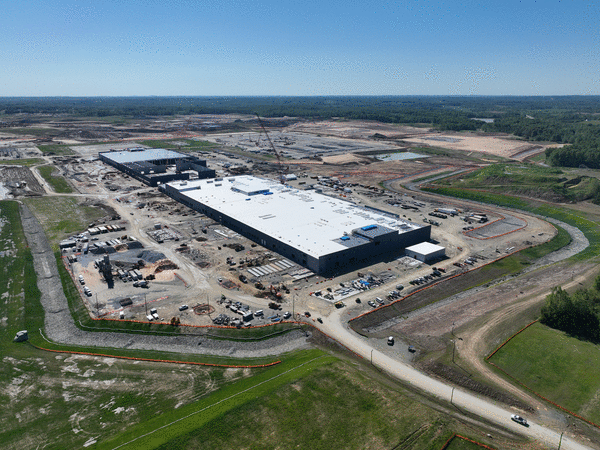
Between 2021 and 2024, North Carolina welcomed a parade of lithium-ion battery factory projects promising to hire hundreds, if not thousands.
They were from companies you know, like Toyota, and ones you might not, like Forge Nano, Green New Energy Materials, Dai Nippon Printing and Epsilon Advanced Materials. Each was to be their manufacturer’s first U.S. battery facility, and North Carolina supported them with tax incentives, to be realized once these battery and battery component makers reached their respective hiring goals.
Then in August 2024, North Carolina officials celebrated another massive battery headline when the California startup Natron Energy committed to create 1,000 jobs at a future $1.4 billion sodium-ion battery “gigafactory” on a long-dormant site in rural Edgecombe County.
“I know that we’re walking through a door that will transform this amazing place that I call home in a positive way,” then-Gov. Roy Cooper said during Natron’s introductory event. “North Carolina is becoming the heart of the booming ‘battery belt.’”
The concept of a regional “battery belt” spanning the Southeastern United States came into greater focus when the election of President Joe Biden inspired rosy forecasts on how many Americans would swap their gas-powered cars for more energy-efficient electric vehicles. The Biden-backed Inflation Reduction Act of 2022 encouraged EV sales (through a $7,500 federal tax credit) and stipulated that the lithium-ion batteries powering these vehicles be U.S.-built.
Southern states drew an outsized number of the incoming battery projects, offering a cocktail of local incentives, available workers, available land and relatively cheap energy. Tennessee, Georgia and South Carolina each announced electric vehicle battery plants in the early 2020s, with North Carolina adding its own sizable notches to the belt.
Lithium prices were climbing in December 2021, when Toyota unveiled plans to open a hybrid and electric battery factory on a megasite south of Greensboro, near the small Randolph County town of Liberty. It was to be the Japanese car company’s first foreign battery plant.
This announcement was followed months later by an even bigger jobs deal. The Vietnamese startup VinFast vowed to create 7,500 jobs at an incoming electric vehicle and battery factory in southeastern Chatham County.
Then, within seven months straddling 2023 and 2024, Forge Nano, Green New Energy Materials, Dai Nippon Printing and Epsilon Advanced Materials all said they were coming to various sites across the state. Forge picked the Triangle for a 200-plus-job “gigafactory.” Epsilon identified the coast. Green New Energy Materials and Dai Nippon Printing found locations north of Charlotte.
“We are extremely excited to launch Forge Battery in the Battery Belt,” Forge Nano CEO Paul Lichty said in a statement at the time.
NC battery projects: Delayed, uncertain futures
Now entering 2026, the lithium-ion battery picture looks very different — though Forge Nano’s planned gigafactory in Morrisville looked much the same on the first weekday of the new year: silent, without a car in the parking lot or sign of machinery within.
As manufacturers rushed into the battery sector earlier this decade, actual EV consumer adoption, while increasing, fell below projections. This caused a battery oversupply, exasperated by aggressive Chinese production. Material prices as a result plummeted; a metric ton of lithium today costs less than a quarter of its peak price in late 2022. According to Bloomberg’s strategic research division, lithium-ion battery pack prices reached a record-low in December, at $108 per kilowatt-hour.
Sinking lithium prices may have already contributed to the downfall of the biggest North Carolina jobs project of 2024, Natron Energy’s sodium-ion battery campus. The clear advantage sodium-ion holds over lithium-ion, its abundance, has been undercut by lithium oversupply. “Lithium carbonate prices have crashed by more than 70% over the past several years, negatively impacting the business case for sodium-ion batteries,” S&P Global wrote in June.
In an internal email last September obtained by The News & Observer, Natron officials informed staff their company was going out of business.
Lithium-ion manufacturers whose plans hinge on people driving EVs lost White House allies when President Donald Trump retook office in January 2025. On his first day, Trump rescinded a Biden executive order that called for half of the new cars and trucks sold in the U.S. in 2030 to be emissions-free. With the later passage of his One Big Beautiful Bill, Trump succeeded in removing the electric vehicle tax credit championed by his predecessor.
The emerging Southern battery belt has taken hits. In June, the zero-emissions battery cell maker AESC stopped building a $1.6 billion plant in South Carolina, citing “policy and market uncertainty.” A joint venture between Ford and the South Korean company SK On dissolved in December, with Ford exiting a planned battery site in Tennessee — and SK On expecting to focus more of that plant’s resources on stationary energy storage.
In North Carolina, the status of the battery belt projects are mixed, though there are some similar signs:
—Epsilon Advanced Materials has delayed the launch of its 500-worker graphite anode material plant near Wilmington from 2026 to 2028, with CEO Sunit Kapur citing “regulatory requirements, customer alignment, and current market conditions” in an emailed statement.
—The Japanese lithium-ion battery pouch producer Dai Nippon Printing had committed to creating 352 jobs at a new plant 50 miles northeast of Charlotte in the unincorporated Davidson County community of Linwood. Production would focus on lithium-ion battery pouches to power EVs. Dai Nippon, under its state incentive grant agreement, said it would hire starting this year and through 2029. In an emailed statement, company spokesperson Yusuke Kitagawa wrote, “We are monitoring trends in the EV market and will move forward at an appropriate time. We regret that we cannot disclose further details at this stage.”
—In January 2025, Forge Nano spokesperson Will McKenna told The News & Observer his Colorado company planned to open its Morrisville facility this year, when it would make niche EV batteries for aerospace and defense applications. The factory currently appears unoccupied. Forge representatives did not respond to multiple emails requesting a site update for this story.
—VinFast has delayed its promised North Carolina vehicle factory until at least 2028 — four years later than the company’s initial timeline — as VinFast has shifted resources to Asia following lowly North American sales. Under a previous agreement, North Carolina will gain the right to purchase the Chatham County megasite from the automaker starting in July.
Battery Belt wins
North Carolina’s embrace of the battery belt has already delivered investments, jobs and batteries. Near the end of 2025, Chinese-backed Green New Energy Materials installed machinery into its battery component separator factory north of Charlotte, in the unincorporated town of Denver. “They are hiring, planning for production and hope to begin operations early in the first quarter of 2026,” wrote Kara Brown of the Lincoln County Economic Development Association in an email.
Toyota has delivered North Carolina’s biggest battery splash to date, shipping its first car batteries from Randolph County last spring. The site currently employs around 2,500 workers and runs four hybrid battery production lines. Toyota officials foresee the local headcount exceeding 5,000 by 2034 as it expands to 14 lines.
Each line can be made to produce hybrid, plug-in hybrid or all-electric vehicle batteries. Toyota has prioritized hybrids over fully-electric cars — both globally and at its North Carolina factory — a decision executives say has been profitable as the EV market softened.
“We’ll follow market demand,” said Don Stewart, president of Toyota North Carolina, following a plant opening celebration in November.
North Carolina will keep itself open to businesses that support fuel efficient vehicles, Gov. Josh Stein said during a Dec. 3 press conference on the state economy. “I’m still bullish on electric vehicles, plug-in hybrids, hybrid cars,” he said. “Clearly, the market has dipped a little bit. The demand isn’t quite as high as what initial expectations were.”
©2026 The News & Observer. Visit at newsobserver.com. Distributed at Tribune Content Agency, LLC.






Comments