Chicago family sells home after 116 years: 'This house has known us, kept us, and loved us'
Published in Lifestyles






CHICAGO -- When Joseph Slajchert first bought a workers cottage at 29th and Emerald, the automobile was on its way to replace the horse and buggy.
But it wasn’t quite there yet.
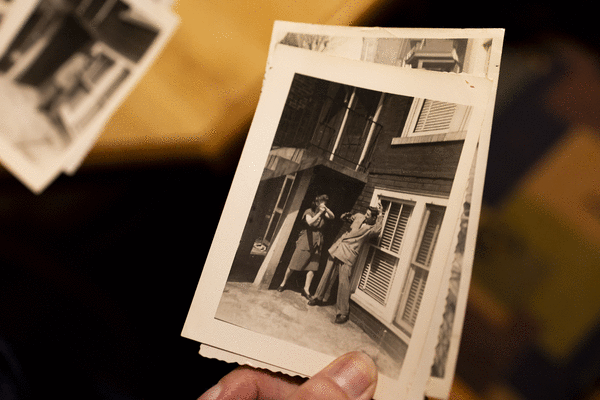
The year was 1910. A black-and-white photo from around that time in Bridgeport shows five children wearing their Sunday best on the front steps, the boys in dapper caps.
Generations of the Slajchert family stayed in the home for another 116 years, through two World Wars, global pandemics, an endless series of tragic fashion trends, the rise of the Internet and the onset of self-driving cars.
Now the family is saying goodbye and selling the property after the home’s last matriarch, Antoinette “Toni” Sorich, died last summer. She was 91.
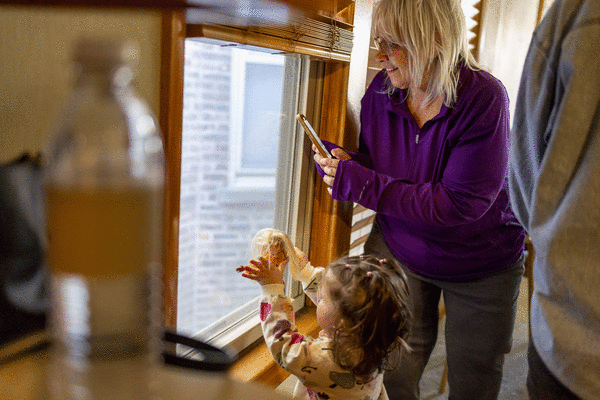
It’s a natural next step for the family and the home, but for the family’s descendants, it’s bittersweet. Antoinette Sorich and her husband, Stanley, raised six children in the five-bedroom workers cottage. The parents slept in the living room. From their kids, 15 grandchildren, 11 great-grandchildren and one great-great-grandchild grew to know its walls.
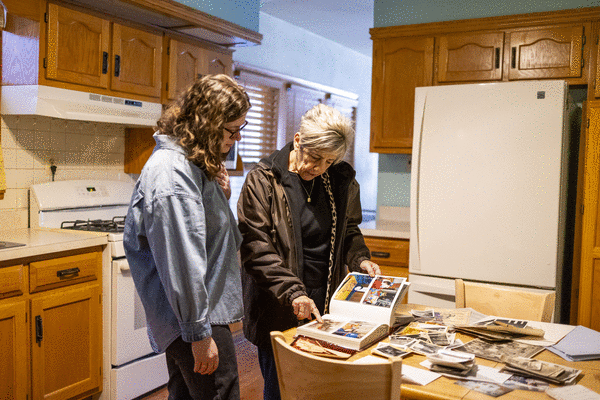
“I know it’s just a building and home is where your mom is and she’s not here anymore, but it’s pretty special,” daughter Patti Sorich Parker said recently from the family kitchen. “It’s pretty special to have what we had for all those years, many, many years, and we’re very, very lucky.”
The family has spent the past few months working through the sale and processing memories. Antoinette’s granddaughter, Stephanie Sorich, who has a tattoo of the home on her arm, wrote an essay about the home that she read at Antoinette’s funeral, saying the “house on Emerald Avenue is saturated with the lives and history of my family.”
“I can feel it when I walk in the front door: the house knows me, as it knew to expect me some twenty-seven years ago from conversations about cribs or due dates over coffee in the little kitchen,” Sorich wrote. “Like the glue carefully applied to the old wallpaper my grandfather put up in the living room, or the hinges on the oak cabinets that house the Pyrex plates I could draw from memory, we have seeped into the bones of the house.”
“Over one hundred years this house has known us, kept us, and loved us,” she added.
It’s hard to know how many Chicago families have owned their homes as long as the Sorich clan. Citywide, more than 60% of all single-family homes have been sold at least once since 2000, according to the Institute for Housing Studies at DePaul University.
Bridgeport has long been a multiethnic community and a haven for multigenerational families and their businesses. The neighborhood dates back to the 1830s, when white settlers began building small homes along the South Branch of the Chicago River. Irish immigrants helped build the Illinois & Michigan Canal linking Chicago and the Great Lakes to the Mississippi River. It was named for a low bridge on the river. Five mayors, including both Daleys, called the neighborhood home.
The White Sox have been there since at least 1910. Schaller’s Pump, a legendary Bridgeport tavern previously believed to be the city’s longest-running bar, closed in 2017 after operating for 136 years.
Bridgeport Ald. Nicole Lee, 11th, said the neighborhood has social organizations and churches that tie the community together.
“It speaks to the strength of the community’s ability to support one another,” she said.
Cook County Commissioner John Daley said it’s normal for families to stay and it’s normal for them to eventually move. He has personal experience with that. His father, Richard J. Daley, was the city’s mayor from 1955 to 1976. He built a bungalow in the 1930s and raised seven children there. John is the last one left in the neighborhood.
“I’m one of seven. Six family members with my brothers and sisters have decided on their own to move on,” John Daley said. “That’s a personal decision. The community is as strong as ever.”
Of Antoinette and Stanley’s grown children, Kris Sorich is the last one who still lives in Bridgeport.
“People like this neighborhood for what it has to offer because it is a family neighborhood,” she said.
The Sorich family is Italian-Croatian. In addition to raising their own, the home was also a way station for newly arriving Croatians. Their phone number was shared in the Croatian community and Stanley’s father, Božo Sorich, would take calls from people looking for a place to stay.
Long after Božo died in 1977, the phone would ring with people asking for him, family said.
The Sorich family’s recent history in the home on Emerald Avenue dates to roughly 1961, although the details are a little murky.
Before moving into the house, the family lived in a nearby apartment on Parnell that burned down. Not long after, Antoinette moved into the family home on Emerald. The building on Emerald, which was constructed in 1885, was already old, first-born Mary Lynne Shaw recalled.
“The kitchen cabinets were all metal,” Shaw said. “It hadn’t been remodeled in a long time.”
Antoinette’s husband, Stanley “Stash” Sorich, was a tradesman who worked for the city as a painter. Family lore says he painted Richard J. Daley’s office green.
At home, the walls were originally plaster and he redid them with drywall for his wife, although Shaw recalled it was a bone of contention because he took his time painting it. “H e had such a big family he’d take side jobs on the weekends,” she recalled. “He didn’t have time.”
After moving into the home, the family kept growing. Antoinette and Stanley raised Mary Lynne, Patti, Sue, Sandi, Kris, and Steve. That made for a tight space.
One photo of the kitchen shows 13 people hanging around a small table. The family shared a small poem about “Antoinette’s Kitchen” that includes the lines:
“We’re at the kitchen table and it’s crowded as hell / And every single person’s got a story to tell / Everyone is talking — Will anyone listen? / How I love all the voices in Antoinette’s kitchen!”
At times, it could be a little overwhelming. Kris said she remembers coming home from school to find her mother sitting in the recliner, smoking a cigarette.
“Just like the calm before the storm,” she said.
Stanley would arrive from work at 4:30 p.m., throw the little kids over his shoulder, and take them inside. At 5 p.m., the children were all expected to be home for dinner. He would use a bell to call them in.
The family had a backyard swimming pool and would invite the neighborhood to hang out. Stanley would jump off the roof into the water, a spectacle his children remember.
“That was a showstopper,” Kris said.
For a time, Sorich cousins rented an apartment next door and would hang out the side windows playing with Barbies. Their parents would fill the washing machine in the kitchen with ice and use it as a beer cooler.
Aunt Agnes lived in the basement at one point. On Sunday afternoons after church, they’d go down to the basement and she would play Alvin and the Chipmunks singing Beatles hits as she made kiddy cocktails and sprayed perfume. She would have a highball.
Sue Sorich Sabo remembers sitting on the front porch with her future husband, Mike, and his cousin. Dad came out and blasted them with a fire extinguisher. He was protective of his girls.
Mary Lynne remembers laying out her clothes on the bed and taking a shower before heading out for a neighborhood dance. When she got out, the clothes were gone. One of her sisters had taken them for the party.
Stanley Sorich died in 2012. He was 81. Some things changed in the coming years. The children would take turns coming over and staying with Antoinette. After Stanley’s death, she didn’t much like having everyone over at once. She preferred to spread them out.
During COVID, one of the daughters said she must be bored because the world closed down. Antoinette looked up from her iPad and said, “I’m not bored.”
The home’s prospective buyer, Carlos Loyo-Albino, is 23. The house was around 117 years old when he was born — nearly the same amount of time the family lived in it. Loyo-Albino grew up in McHenry County and is studying at UIC. He told the Tribune he likes the nearby park.
Carlos told the Tribune he looks forward to living in the home and potentially raising a family.
“1885 is crazy. That’s like owning a piece of history,” he said. “I think it’s important to preserve that history.”
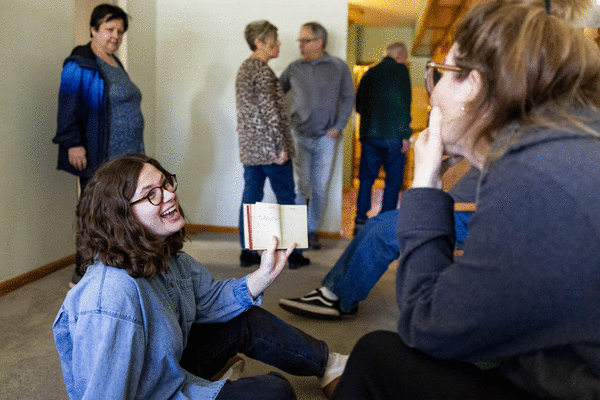
Sitting in the kitchen weeks before the sale, with four of his sisters at his side, Steve Sorich said he wishes the next generation at the home well.
“I just hope that whoever buys the house that they feel our spirit,” he said. “There’s a lot of love here.”
©2026 Chicago Tribune. Visit at chicagotribune.com. Distributed by Tribune Content Agency, LLC.




















Comments