Her Rich Goodwill account is TikTok famous for the stuff she finds in suburban trash
Published in Lifestyles



CHICAGO — Claudia von Thrift — which is not her real name, but we’ll get to that — wants to make something clear. She is not one of those don’t-buy-anything-this-Christmas people. She is not looking to take an activist stance against conspicuous consumption. “I am as bougie as they come,” she said, reaching into her utensil drawer and pulling out a very expensive silver knife. She owns several of these, she said. She does buy lavish things. She will not apologize for spending extra money on anything she won’t need to replace.
She went into a closet.
She emerged with a plaid winter trench coat from Burberry, the kind that would cost the month’s rent for a very nice apartment. A couple of decades ago, when Claudia von Thrift was in high school in Glen Ellyn, she wore this coat all the time. Her family had serious money. She drove their BMW because her father wouldn’t let her drive one of his Porsches. She is bluntly disarming about her background. Her family was extremely wealthy, and for a while, Christmas — she waves her hands above her, as if conjuring a rain of a palatial, old-world opulence — meant tens of thousands of dollars of presents.
Her eyes go wide as she says this; she’s not exaggerating.
All of this is important to know if you’re going to understand why Claudia von Mallinckrodt, 35, a pretty well-off tech sales professional and Hinsdale resident with two kids and a husband who works in private equity, transformed this year into Claudia von Thrift, a popular influencer with almost one million followers and a compelling, thoughtful and even shocking purpose: She wants to show you what her rich neighbors throw out.
She wants to show you the original paintings they leave in the trash, the new children’s bikes they set on the curb for anyone to take, the perfectly clean Ralph Lauren blankets, the high-end strollers, the air fryers, the Pottery Barn rugs, the West Elm home furnishings, the Crate & Barrel loungers, the Vineyard Wine sweaters. One morning at her house, she showed me a $400 artificial Christmas tree from Target she had pulled off a curb the day before. It was still in its box. Beside it were plastic tubs of garland.
Her videos, which she posts on Instagram and TikTok as The Rich Goodwill, are not shaming or accusatory. She doesn’t zoom in on enormous homes themselves. She focuses on their trash and steers away from larger points about sustainable living and unchecked consumerism and the vast divide in social classes around Chicago. But if your algorithm lands on her videos with any regularity, it’s hard not to feel those things.
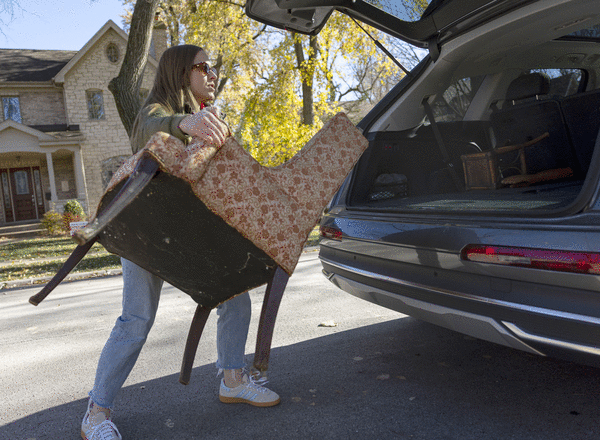
She hunts around the western suburbs whenever she finds time. She leaps out of her car and inspects anything by the side of the road that appears promising. If it seems almost new — she tends not to restore or refurbish anything — she loads it into her SUV, then posts a video online and tells her followers: If you want this, DM me. Then she just gives it to them. She never charges them. She’s even shipped things on her own dime.
She calls it “rehoming.”
Her mother, she says, has bugged her: “She gets ticked off — ‘You’re giving away things and you could resell them online for $100 or more.’ But number one, I don’t need the money, and number two, I tell her, ‘You don’t understand Mom, bear with me.’ When I started showing her checks I was getting from TikTok, she said, ‘OK, I get it.’” Since spring, Claudia von Thrift has made more than $20,000 from TikTok alone.
She says she is making a point about buying less and that she doesn’t want your stuff in a landfill, contributing to environmental collapse — she’s just not going to say it outright.
The roots of all this, after all, are personal — almost superhero-origin-like in their drama.
“My family had a number of tragedies, all at once,” she explains. Her parents got divorced and her father lost his company during the mortgage implosion of 2008, then more money when other businesses went south. “You think the worst is over, until my dad’s house burned down.” According to von Mallinckrodt, there was no insurance bailout. She was at Pepperdine University in Malibu when her mother called: The house was gone, they’d lost almost everything, including the dogs. The family went on food stamps.
“I remember going into a community center to get meals and my sister recognized people, so we’re walking through with our heads down. We were not able to buy food, yet at the same time, I never wanted people to know we had no money. So about then, I started to spend a lot of my time trying to find nice things that cost way less. That tends to make you notice just how nice some secondhand things actually are. Even if I did buy new, I was making sure it was like 80% off. I was trying to cover up my shame.”
By the time she and her husband moved to Hinsdale a couple of years ago, she was astonished at the prosperity by the side of its roads, among recycling bins and leaf bags. Claudia von Mallinckrodt doesn’t say this in a self-aggrandizing way. She’s not self-righteous. She knows she was comfortable once, temporarily less comfortable, and now comfortable again. She says it because she wonders if her neighbors know how cavalier they can be with what they own. “That experience made me notice how much beauty and usefulness can still exist in things others overlook,” she says.
But mostly, she says it because she can’t believe her luck.
Before we went curb shopping, we sat beneath a $700 West Elm chandelier she found and kept for herself. In the next room was a large painting someone had left out, its price tag ($2,100) still attached. Beside it were a trio of thin, decorated Christmas trees she found. Upstairs in the kids’ room, an elegant velvet rocking chair — another find. Mondays are trash days, so she goes out every Sunday. She always finds something.
She’s often told to hunt on the North Shore, in Lake Forest and Winnetka and Wilmette, but she’s fine in Hinsdale, which often ranks among the top 10 wealthiest suburbs in the nation, ahead of the North Shore. Before I can even ask, she answers the obvious:
“I don’t really know why people leave stuff like this on their curbs. I don’t, not really. People read so many different things into this. It’s very debatable. Are people guarding their stuff instead of taking the time to donate it? I would bet eight out of 10 times, they’re hoping for someone like me to come along and just take it. But what if it isn’t picked up, right? I do see things marked as trash, with a $4 trash sticker attached (for oversized trash items). I meet homeowners who say, ‘You saved me from buying a sticker.’ Are people so rich that they don’t take time on this nitty-gritty? Or are rich people just constantly changing their styles because they can afford it? Probably that, too. Some of it is generational — they don’t feel as sentimental about stuff that was passed down. You see a lot of toys because their kids are going through phases. They could find a way to donate that, except that also takes time. I assume, in their hearts, they want someone to have it, and they’re doing a good thing. Or maybe that is a whole other conversation.”
She’s short and speaks in a loud, confident voice and has pale blue eyes and comes off slightly intense, though totally ready for primetime. She has heard she has some haters in town, locals who don’t like seeing their homes flash by in the backgrounds of her videos. She suspects some of that hate has come from just how quickly she’s taken off.
Last year, while on maternity leave, she found herself driving daily to a nearby Goodwill known for high-end luxury items — “the rich Goodwill.” In January, back at work and mourning those hunts, she started to stop for curbside finds and film the results. Her first videos were nothing special, images of her treasure with a text narration. But she liked it so much she wondered if she could be an influencer, so she watched a 20-minute video about social-media algorithms, and she began putting herself in her posts. Her videos, which were getting about 1,000 or so views, began getting 700,000 views. Then 3.9 million views. Then 6.2 million. She’s since been contacted by at least two TV production companies, and she’s starting to get recognized in the supermarket.
On a bright Sunday morning, before heading out on another hunt, a car backed into von Mallinckrodt’s driveway and popped its hatchback. Layla Judah, a follower from Gurnee, had arrived to pick up a child’s plastic water table. She’s becoming a regular. “Claudia is just super cool,” she said, sounding like one of the many comments on von Mallinckrodt’s videos. “You kind of get a high off this!”
“You do!” von Mallinckrodt said.
A few minutes later, we set out.
And immediately passed Judah, who was inspecting a new curbside toy a block away. “That’s so great,” von Mallinckrodt said, looking delighted. “I want to destigmatize this.” That said, von Mallinckrodt herself still gets nervous. She prefers to stop at homes that don’t have any residents in front. She doesn’t want to be confronted. She works quickly.
She drives slowly.
She leaned forward in her seat and scanned her head at every intersection. She’s stop and go, stop and go. After college, before moving back to Illinois, she worked as a private investigator. You can see those chops. “You train yourself to pay attention. You notice stuff on the curb casually, but once you’re actively paying attention, you start to see everything.” We stop at a pair of upholstered chairs; she loads the one less worn into her SUV. We continue, haltingly. She takes long, quiet moments, then continues on.
“For a while my neck hurt,” she said. “The constant swiveling. But I’ve built a muscle.”
She spots a rolled-up rug between boxes.
She jumps out and bends and inspects the back of it. “Oh my god! Pottery Barn! That seals the deal.” She shoulders the rug and slides it into the trunk of the SUV. Her 3-year-old son hums to himself in the back and watches the curled rug poke over the seat.
We drive past stacks of cardboard and rows of leaf bags.
“OMG!” she shouts.
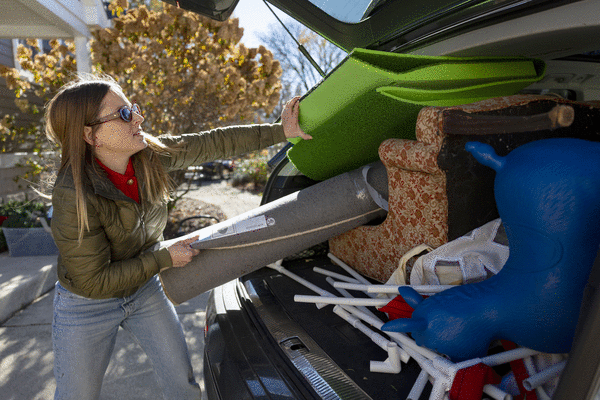
Ahead of us is a children’s firehouse, its large fabric facade fitted onto a metal framework. She pulls in front of its house. The garage door is open. People are home. She gets nervous. She speedwalks to the trash, inspects and reports, “Crate & Barrel!” She pulls fabric off of frame, tears down the metal poles and bundles everything into her arms and walks to the car. She looks like a bank robber with her arms full of loose cash.
“Whoo!” she shouts.
She’s breathless, so excited that she’s forgotten to film herself. That firehouse, she’ll give her children for Christmas. They’ll be getting several curbside finds. She sits for a second, then pops open her door and returns for two rubber toy animals. She loads them in, too. She can’t help herself, she explains. She figured the hunt would take hours, but within 20 minutes, the car was packed and we headed to her house for unloading.
She draws out the rug and uncurls it in her backyard.
“People ask if I’m afraid of bedbugs, and no, I’m not — I mean, you see where these rugs come from.” She studies it. There’s a small hole in the center, the width of a pole. She pulls out her phone and turns on the camera and tells her followers this is a Pottery Barn, and there is a hole, but know what? Just put something over that and you’re good.
“Just let me know if you want it.”
©2025 Chicago Tribune. Visit at chicagotribune.com. Distributed by Tribune Content Agency, LLC.




















Comments