Trump health plan asks Congress for drug, insurance legislation
Published in Health & Fitness
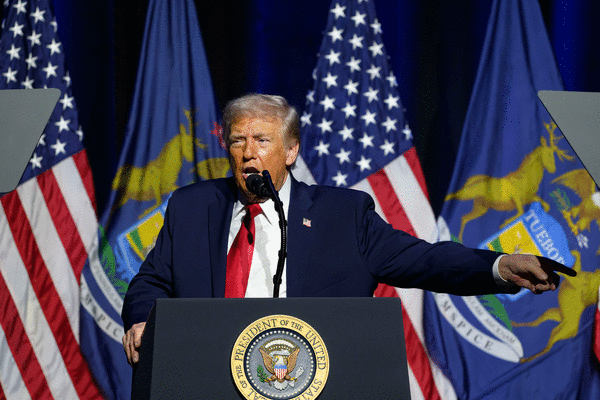
WASHINGTON — President Donald Trump on Thursday released a health care plan that calls on Congress to end negotiations over Affordable Care Act subsidies and instead enact bipartisan legislation on drug and health insurance costs.
Trump’s proposal, which he calls “The Great Healthcare Plan,” touts the potential to lower drug prices and insurance premiums, increase price transparency for health services and add accountability from insurance companies. It does not call for extending the enhanced subsidies that expired last month, a priority for Democratic and some Republican lawmakers.
The plan is largely framed in broad strokes, rather than seeking support for specific legislation already introduced. Officials said they did not expect to enact the plan via budget reconciliation, which would potentially remove the need for Democratic support.
On drug costs, it largely asks Congress to codify the Trump administration’s earlier deals with pharma companies for “most-favored nation pricing,” or prices in line with those of other developed countries, and move more prescription drugs into over-the-counter status to make them more affordable.
For health insurance premium prices, the plan seeks legislation to curtail payments to insurance companies and instead “send that money directly to eligible Americans.” That’s likely a reference to health savings accounts, which several Republicans have favored over extending the enhanced ACA premium tax credits.
A concept of a plan
Trump, starting in his first term, has promised to release a health care plan to improve upon or displace the ACA, President Barack Obama’s signature 2010 health care law.
During months of unsuccessful negotiations over the expired ACA premium subsidies, Republicans and Democrats have periodically called on Trump to negotiate. Trump has largely stayed out of it, telling reporters last weekend that he might veto legislation to extend the tax credits if Congress were to pass it.
Trump administration health officials on Thursday criticized lawmakers for inaction and essentially told Republicans to stop trying to extend the subsidies, despite ongoing bipartisan negotiations in the Senate to do just that.
“The real question is, how do we get past lazy lawmaking and actually start to address the underlying problems, not just throw more taxpayer money at issues,” Centers for Medicare and Medicaid Services Administrator Mehmet Oz said on a call with reporters. He said the administration believes the framework will help Congress write legislation that will address health care affordability challenges.
“Leadership has been debriefed,” Oz said. “There will be ongoing conversations, and we hope to be able to support with specific language for the legislation.”
A senior White House official said the plan’s broad framework allows Congress to have more leeway to shape a more flexible solution and does not endorse any specific existing legislation. Administration officials have spoken with allies on Capitol Hill and think most elements would have bipartisan support and can move forward in 2026.
The same official said that Congress has been too focused on the ACA and this plan attempts to steer them to focus on broader health affordability issues.
Subsidy talks
A bipartisan group of senators led by Sens. Bernie Moreno, R-Ohio, and Susan Collins, R-Maine, has been scrambling to finalize a compromise bill on the expired subsidies before the end of the month.
Senators said before they were set to leave Thursday for a weeklong recess that they’ll look for a way to extend the tax credits despite the White House plan and snags in the discussions over whether to include abortion restrictions in the proposal.
“I’m not giving up, because I think what we have to do is respond to the immediacy of the situation that we have now,” Alaska Republican Sen. Lisa Murkowski said just after the plan was released.
She acknowledged that talks seemed to have “paused,” but she said they were going to continue work on the proposal. She said some Democrats appear willing to use the expired tax credits to campaign on as the midterms approach rather than coming up with a short-term extension now.
“I refuse to accept it, because it means that we’re just willing to leave people hanging so that we can support political points, and that’s not what it’s about,” Murkowski added.
Moreno welcomed the president’s health care plan Thursday afternoon. He said the exclusion of the tax credits in that plan doesn’t affect his group’s negotiations, instead pointing the finger at Senate Minority Leader Charles E. Schumer, D-N.Y., for not backing anything other than a three-year extension.
“He wants a political issue, it seems like,” Moreno told reporters. “So I need to hear some affirmative commentary from the Democrat leader that he would support an extension with reforms. If the answer is no, then it doesn’t seem like we’re gonna have a deal.”
He said that he would need that confirmation for talks continue while the Senate is in recess.
Sen. Peter Welch, D-Vt., said he spoke with Trump on Wednesday to pitch an extension of the tax credits. Welch said he underscored that the plan would help people like farmers who rely on ACA coverage, and that the group is planning to include the health savings account provisions that the president backs.
But he said abortion language is still the sticking point in the negotiations.
“It’s very clear to me that there’s no place for that issue in these talks,” he said. “But that’s not clear to some of my colleagues. That’ll doom it.”
____
(Jacob Fulton contributed to this report.)
©2026 CQ-Roll Call, Inc., All Rights Reserved. Visit cqrollcall.com. Distributed by Tribune Content Agency, LLC.









Comments