Rep. Brian Fitzpatrick criticizes Speaker Johnson as Pa. swing district Republicans join Democrats in ACA subsidies vote
Published in Health & Fitness
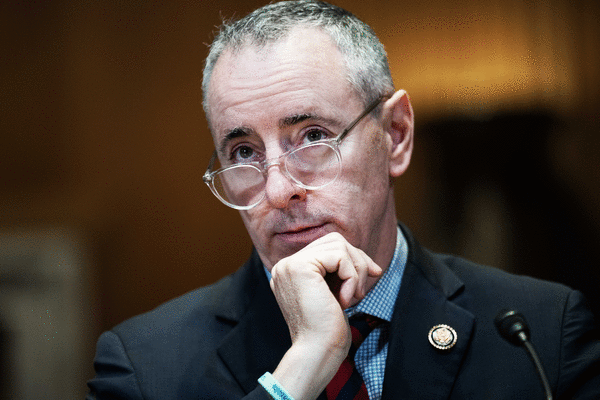
U.S. Rep. Brian Fitzpatrick accused some of his Republican colleagues of being “intellectually dishonest” about the Affordable Care Act, hours before he and other Republicans broke party lines to pass a bill to restore recently expired healthcare subsidies.
The Democratic-led bill passed the House by a vote of 230 to 196 after Fitzpatrick and eight other Republicans backed a discharge petition the previous day, in the latest rebuke of Republican House Speaker Mike Johnson.
The bill now heads to the Senate, where its fate is uncertain.
Fitzpatrick, a moderate Republican who represents purple Bucks County, was one of 17 Republicans to cross the aisle Thursday to back the legislation that will restore healthcare subsidies after insurance premiums spiked this month, following their expiration at the end of last year. The bill extends the subsidies, enacted in 2021, for another three years.
He said some of the pushback “unfortunately, is ideological” as he explained frustration with other members of his party, including Johnson.
“I’ve made the point to them many times over,” he said. “You are entitled to criticize something, provided that you have a better alternative … I’ve been hearing a lot of talk out of my colleagues for a long period of time without any concrete plans.”
He noted that the expiration of the subsidies could lead to a rate increase for everyone if fewer people have coverage as a result, not just the approximately 8-10% who qualify for the subsidy, for whom the credit is “everything,” he said.
The issue could be an important one in congressional races later this year if lawmakers don’t resolve the matter, which was also one of the main sticking points during last year’s government shutdown.
Fitzpatrick is one of three swing district Republicans in Pennsylvania who backed the effort, along with freshman GOP Reps. Ryan Mackenzie and Rob Brenahan. All three are being targeted by Democrats in the fall.
A fourth swing district Republican in the state, U.S. Rep. Scott Perry, was among the legislation’s detractors.
Perry shared a video Wednesday to social media of President Donald Trump accusing Democrats of being “owned” by insurance companies.
“These companies are thriving, not hurting,” Perry said in a post accompanying the video. “Subsidies are direct cash transfers from the Treasury (YOU) to their bank accounts. But they’re worried that their money tree is going to be chopped down, so now they’re threatening to pass off higher costs to consumers to keep their profits high.”
Janelle Stelson, a Democrat who is seeking a rematch against Perry after narrowly losing to him in 2024, criticized the GOP incumbent’s opposition to the bill.
“Forcing Pennsylvanians to pay an average of 102% more on insurance premiums is unacceptable,” Stelson said, noting the average increase to plan costs on Pennie, the state’s insurance marketplace. “Some Republicans in Pennsylvania are working across party lines to try to help their constituents, but Congressman Perry is again refusing to do anything.”
About 90% of people who bought insurance through Pennie for 2025 qualified for some amount of tax credit, but with the expiration of the enhanced tax credits this year the cost of health insurance through Pennie and other ACA marketplaces has skyrocketed.
About 1,000 people a day are dropping their Pennie health plans, deciding the coverage is too expensive, according to Pennie administrators. A total of about 70,000 people who bought Pennie plans in 2025 have dropped their coverage as of the end of December, said Devon Trolley, Pennie’s executive director.
Philadelphia area residents are expected to pay, on average, more than twice as much in 2026. Philadelphia’s collar counties are seeing more moderate cost increases, ranging from an average 46% price hike in Chester County to a 70% average increase in Delaware County.
Fitzpatrick had released his own legislation last month, but he chose to support the Democratic bill after his proposal failed to get traction. He said he expects some of his ideas, including income caps and anti-fraud provisions, to be amended into the legislation in the Senate.
Fitzpatrick said he met with several Senate Republicans on Thursday who said that the successful discharge petition “really breathed new life into their negotiations” after the upper chamber failed on its own compromise attempts.
“They just said, short-term, try to rack the number up as high as you can get, because the more crossover votes we can get, the stronger message it’ll send to the Senate majority leader that they need to move something quickly,” he said.
Fitzpatrick warned that more discharge petitions could be coming in the House if Johnson doesn’t change his leadership approach.
The healthcare vote comes just weeks after the House voted to discharge and then pass a bill to release files related to Jeffrey Epstein, after Johnson had slow-walked the legislation.
“It’ll keep happening if bills that have the support of 218 members of the House are not given floor time,” Fitzpatrick said.
_____
©2026 The Philadelphia Inquirer. Visit inquirer.com. Distributed by Tribune Content Agency, LLC.






Comments