Trump rural health grants come with clawback threat to states
Published in Health & Fitness
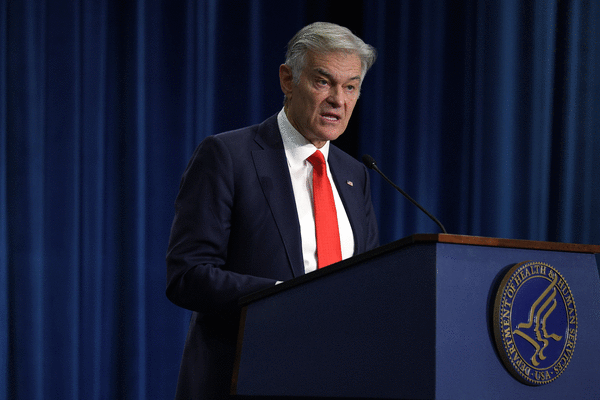
The Trump administration is announcing awards to states from a rural healthcare fund, with the threat that some of that money can be clawed back if jurisdictions fail to embrace policy initiatives backed by the president.
The discretionary grants for 2026 range from $145 million to $281 million for states, according to Mehmet Oz, the head of the Centers for Medicare and Medicaid Services. Oz said Monday the award decisions were made by “subject-matter experts” from both within and outside the federal government following a review of applications from states.
Oz said that while half of the $50 billion fund was “equally distributed” to all states, the decisions announced Monday pertain to the $25 billion discretionary half of the fund. The law authorizes grants through a five-year period from fiscal years 2026 through 2030.
The discretionary amount is being handed out to states based on a calculation of their rural population and existing healthcare infrastructure to serve that population, accounting for 50% of that tally; policy actions taken by the states, accounting for 20%; and initiatives those jurisdictions proposed to bolster rural health services, which impacted 30% of the award calculation.
If states fail to embrace some healthcare policies promoted by the administration, however, the amount set for their 2026 grants could be clawed back and they could see future allocations reduced. Senior administration officials briefed reporters on the awards on condition of anonymity, however, it was not clear what exact policies would be considered in that determination.
The administration has taken steps to promote its healthcare agenda, including an order by President Donald Trump to reinstate a presidential fitness test and moves to allow states to prevent food benefits from being used for unhealthy foods and drinks — efforts which Oz alluded to on Monday, in addition to measures on medical licensing and insurance regulation.
States will be forced to undergo a re-scoring process every year with the Office of Rural Health Transformation, according to an administration official.
“The rural parts of this country have fallen tragically behind in many areas, and part of the reason for that, we believe, were that systems that had been designed 50, 60, 70 years ago to support healthcare in rural parts of the country are no longer functioning at the pace and at the efficiency that one would have expected,” Oz said.
Monday’s announcement comes as the administration moves to address one of Trump’s looming political vulnerabilities — the growing concerns among voters over healthcare access and costs. Trump has sought to assure the public in recent weeks that he is tackling the cost of living more broadly, with polls showing mounting anxiety over his economic agenda and its impact on Americans’ pocketbooks.
Healthcare poses a particular challenge with costs set to spike for millions of Americans in 2026 with subsidies under the Affordable Care Act slated to expire at year’s end and Congress deadlocked over how to address the issue.
The president’s signature tax-and-spending package earlier this year also cut about $1 trillion from Medicaid, the public insurance program for low-income and disabled people. Those cuts are expected to result in 11.8 million people in the U.S. losing their health insurance over 10 years.
Combined, those changes could result in fewer patients and less revenue for hospitals across the country. Lawmakers approved the $50 billion fund amid worries over the impact the Medicaid cuts would have on hospitals in rural areas where voters comprise a key element of the president’s base.
____
(With assistance from Magan Crane.)
©2025 Bloomberg L.P. Visit bloomberg.com. Distributed by Tribune Content Agency, LLC.





Comments