Why even unsubsidized Californians could pay more for health insurance
Published in Health & Fitness
SACRAMENTO, Calif. — At first glance, it sounds like a problem that shouldn’t exist.
Since Congress allowed enhanced federal health insurance subsidies to expire, you might expect only people who receive those subsidies to be hurt. After all, Californians who don’t receive federal premium subsidies already pay full price for their coverage.
But research from the University of California shows that assumption is wrong. Because Congress failed to act, everyone who buys insurance on California’s individual market will pay more, including roughly 740,000 Californians who receive no subsidies at all.
The reason has nothing to do with politics and everything to do with how insurance works.
In the individual insurance market, premiums aren’t set person by person. They’re set for a pool — and who’s in that pool changes when coverage gets more or less affordable.
In an email interview, Miranda Dietz, the interim director of the UC Berkeley Labor Center, said subsidies help keep the pool of enrollees broad.
Keeping healthy people in the mix
When coverage is affordable, she said, a wider range of people pay for coverage, including young and healthier California residents. When premiums rise, those most likely to keep paying are people who are older or sicker, even if it forces painful tradeoffs on housing, food and other basic necessities. Younger healthier people are more likely to gamble that they won’t need coverage.
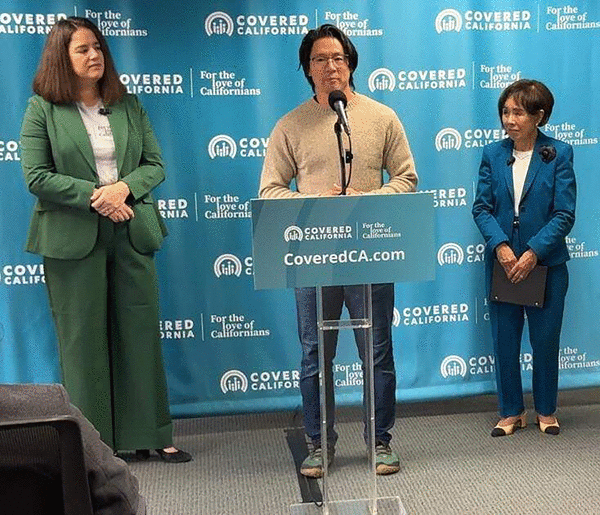
Covered California CEO Jessica Altman said insurers raise premiums to cover the higher expected claims and unsubsidized consumers feel the full impact of that.
That’s why Dietz and other UC researchers projected that if the enhanced subsidies vanish, unsubsidized Californians would still see premiums rise. They estimate unsubsidized enrollees will pay about $253 more on average next year due to that worsened risk mix. That’s an average of 3.4% more than it would have been if those healthier enrollees had bought coverage.
This increase pales next to the premium hikes that subsidized enrollees will experience. Covered California estimates that more than 1.5 million individuals earning less than $62,600 a year could see their average monthly premiums soar by $97 to $182 on average.
Subsidized Californians who are closing in on retirement will be hit with premium hikes of $186 to $365 a month, on average. That’s nearly half a million people between the ages of 55 and 64.
Right now, people are going to the Covered California website to check prices because they have heard its more affordable, Altman said, and they are leaving disappointed because Congress has not approved the enhanced subsidies. It’s difficult, she said, to get these disillusioned consumers to return.
What’s the takeaway?
When people opt out of coverage, Altman said, the consequences ripple well beyond the health insurance market. Uninsured Californians are more likely to delay preventive and primary care, allowing manageable conditions to become medical crisis.
Many ultimately show up in emergency rooms — the most expensive place to get care — or rely on providers who struggle to absorb unpaid bills. Those costs don’t disappear. They get shifted to the rest of the system.
“Maybe they get to Medicare, and all of a sudden they have health care again,” Altman said, “and our system is paying for costs that could have been avoided had they gotten care today.”
Health insurance policies also set a maximum out-of-pocket cost for consumers, Altman said. For instance, in Covered California’s silver plans sets this limit at $9,800 for individuals and $19,600 for families.
“It really provides this cap on how much you would have to spend in the case of a catastrophic health event,” she said. “That’s a big change that came with the Affordable Care Act. Before the ACA, a lot of coverage people bought for themselves or their families ... could have quite the opposite (limits), meaning insurance companies would have an annual or lifetime cap on how much they would cover.”
By subsidizing premiums, the federal government doesn’t just help individuals afford insurance, Altman said, but it stabilizes the insurance pool, supports a healthier workforce and keeps costs from rising for everyone else.
Congress returned home for the holiday, allowing the enhanced subsidies to expire on Dec. 31. Altman and UC researchers said that because of that, the bottom line was straightforward: Fewer people would be able to afford coverage. The pool of enrollees would get sicker, and premiums would rise, even for the Californians paying full price already.
The House and Senate are in recess until early January.
____
©2025 The Sacramento Bee. Visit at sacbee.com. Distributed by Tribune Content Agency, LLC.









Comments