Editorial: Republicans need to get serious about health care
Published in Health & Fitness
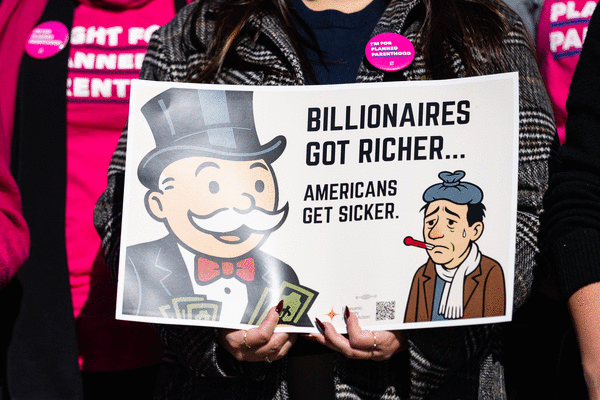
When the longest government shutdown in U.S. history ended recently, Republicans mostly got what they wanted: A spending bill was passed, the government was reopened and Democrats’ main demand — a deal to extend expiring Obamacare subsidies — was deferred. Now Republicans must deliver on a health care compromise, lest millions of Americans get stuck with big bills come January.
At issue is the expiration of COVID-era benefits for Affordable Care Act enrollees. When the ACA passed in 2010, lawmakers included a provision that would help reduce monthly costs: subsidized premiums for beneficiaries earning less than 400% of the federal poverty level (about $45,000 at the time). During the pandemic, Congress increased such assistance and expanded it to higher earners. The Inflation Reduction Act extended those changes until Dec. 31.
Letting the enhanced subsidies expire will be disruptive. On average, enrollees’ out-of-pocket premiums will double. Older, relatively higher earners will be among the hardest hit. According to one analysis, premiums for a 60-year-old couple earning $85,000 would climb by $1,883 a month, or $22,600 annually. While lower earners may see milder increases — monthly payments could rise to, say, $15 from zero — experts worry that higher premiums will push healthier people to drop coverage, further increasing costs for those who stay enrolled. Perhaps 4 million people will become uninsured.
Neither party wants to see that happen, least of all before midterm elections next year. Yet extending the subsidies permanently as Democrats wish — at $350 billion over a decade — is likely a nonstarter. Beyond the large sum, critics object to the flow of payments, which go straight to insurers. With taxpayers footing the bill, health plans have done little to contain costs. Consider that premiums on ACA exchanges have risen almost twice as fast as the employer-based market since 2014. A temporary extension, as the White House appears to support, would do little to resolve this.
Ideally, any compromise would soften the shock of lost subsidies while slowing the growth of federal spending. The first is best achieved by eliminating the subsidy cutoff at 400% of the poverty line. Economists have long disliked benefits cliffs, which penalize work and higher pay, and the cost of eliminating the threshold would be relatively modest. (Expenditures per enrollee shrink as incomes rise.) Lawmakers could offset the additional spending by increasing enrollees’ share of premiums for the highest earners — lowered to 8.5% of household income during the pandemic — while restoring assistance for lower earners to pre-COVID levels.
Republicans haven’t been notably serious about health care in recent years, but some reasonable proposals are emerging. One would direct funds previously earmarked for insurers into tax-advantaged health-savings accounts. Once consumers gain control over their dollars, the thinking goes, insurers would be forced to compete for their business and lower costs. As currently envisioned, the idea will be difficult to implement before the deadline. It’s also too narrow, applying only to ACA plans with the lowest premiums and highest deductibles. But a revised version that ensured funds can be used more liberally would be a step in the right direction.
Beyond the immediate negotiations, lawmakers should be thinking bigger about how to restrain costs. Paramount should be giving consumers more choice, including those in the much larger employer-sponsored market. Gradually allowing more flexibility to pick a health plan — be it short-term coverage or a public option — should increase competition and improve care without destabilizing the market. A program that’s easily executed and avoids immediate disruption (such as eliminating the cliff) might be supplemented with such reforms in the future.
For now, a bipartisan agreement that extends and reforms subsidies would be the right thing for taxpayers and enrollees alike. Without a longer-term plan, though, America’s soaring health care costs threaten to become one more crisis in the making.
____
The Editorial Board publishes the views of the editors across a range of national and global affairs.
©2025 Bloomberg L.P. Visit bloomberg.com/opinion. Distributed by Tribune Content Agency, LLC.








Comments