Why Baz Luhrmann can't help thinking about Elvis
Published in Entertainment News

LOS ANGELES — Baz Luhrmann's startling new movie about Elvis Presley began, the director says, with an accident.
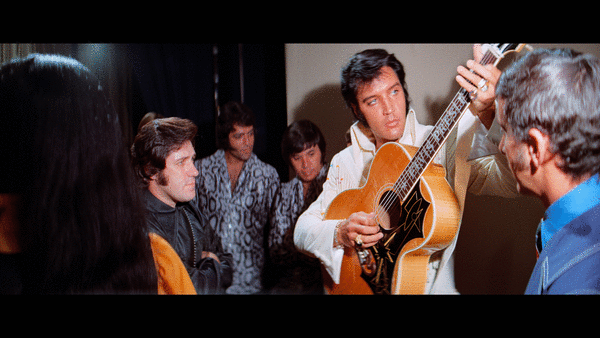
As he was making 2022's "Elvis" — his Oscar-nominated biopic starring Austin Butler as the King of Rock 'n' Roll and an outlandishly accented Tom Hanks as Presley's domineering manager, Colonel Tom Parker — Luhrmann's researchers happened upon dozens of half-century-old film reels stored in an underground salt mine in Kansas. The footage, which MGM shot for a pair of Elvis concert movies in the early '70s, showed Presley onstage and in rehearsal for the residency at Las Vegas' International Hotel that marked his return to live performance after years of working in Hollywood.
Luhrmann didn't end up using the archived material in "Elvis." But the discovery left him with a choice, he says: "I had the power and the muscle to either put it back into the vault and let it rot or do something with it."
What he did with it is "EPiC: Elvis Presley in Concert," which opened last week in IMAX theaters and will expand to wide release Friday.
Part concert film and part documentary, "EPiC" traces Presley's journey to the International's gilded showroom — a gig Luhrmann says only happened because Parker was "a super-addicted gambler" — and on to his first tour since the late '50s. Like all of Lurhmann's movies — among them 2013's "The Great Gatsby" and 2001's "Moulin Rouge!" — it's an ornate visual spectacle, with wild colors and frenzied editing (the latter by Luhrmann's longtime collaborator Jonathan Redmond).
But the real attraction is Elvis himself: the perfect hair, the bedazzled jumpsuit, the dark eyes beaming pure sex. Given the increasingly crummy movies on which he'd been squandering his talent, it's a revelation to see how electric he could still be when he got in front of an audience, the force of his charisma razing everything in his blast radius. "EPiC" wisely forgoes talking heads in favor of keeping the camera's gaze on Elvis, though the film is narrated with excerpts from a previously unheard interview in which Presley discusses his life and career.
As an intimate and immersive cinematic experience, the result is up there with Brett Morgen's trippy 2022 David Bowie doc "Moonage Daydream" and "Get Back," the Emmy-winning 2021 Beatles docuseries by Peter Jackson (who lent Luhrmann a hand in restoring MGM's footage from "Elvis: That's the Way It Is" and "Elvis on Tour").
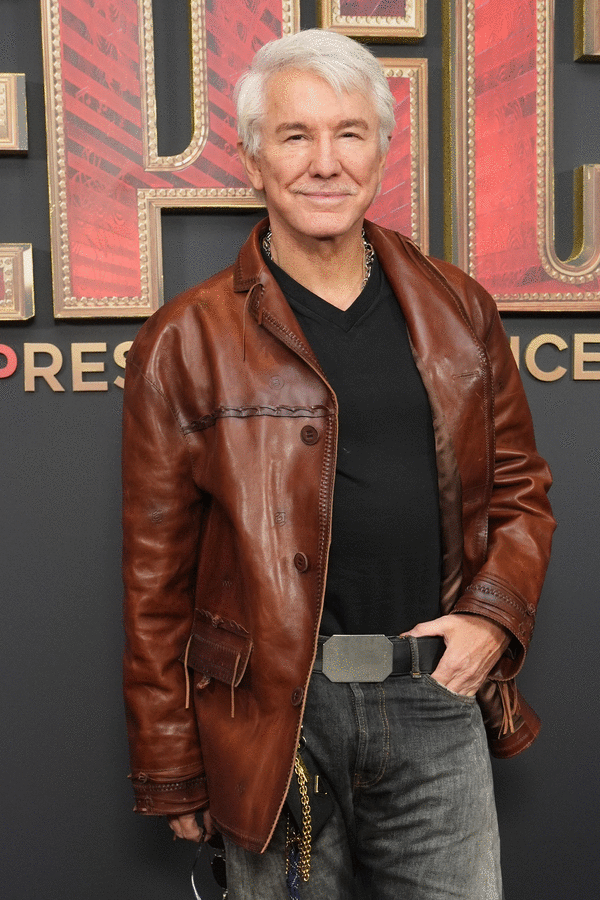
"It's a bit like a dreamscape," Luhrmann, 63, says of the movie as he sits in a suite at the Four Seasons in Beverly Hills near the end of a recent press junket. Wearing aviator shades and an Elvis T-shirt under a velvety jacket, the director has been answering questions about "EPiC" all day; after our chat, he'll head to the TCL Chinese Theatre to answer still more at the film's Los Angeles premiere. Yet he seems genuinely psyched to be talking — talking yet again — about the King, whom he reckons was in something of a bubble by the time he got to Vegas in 1969.
"He was the highest-paid actor in Hollywood and he felt he reigned supreme," Luhrmann says. "He didn't realize the world was passing him by." While Presley was filming "Tickle Me" and "Clambake," the Beatles and Bob Dylan had happened; now one of rock 'n' roll's architects was at risk of looking passé compared to the countless younger acts he'd inspired.
The performances in "EPiC" challenge that idea: Accompanied by the TCB Band and the background singers of the Sweet Inspirations, Presley's voice soars through a richly melodramatic "You've Lost That Feeling Loving" then burns with attitude in a mash-up of "Little Sister" and the Beatles' "Get Back"; "Suspicious Minds" drives toward an ecstatic climax, Presley and drummer Ronnie Tutt egging each other on as the song's groove keeps picking up steam.
As thrilling as "EPiC" is, this is more or less the same period of Presley's career covered by last year's "Sunset Boulevard" box set, which included hours of rehearsal tape from the singer's preparation for the Vegas residency. "Sunset Boulevard" itself followed two recent docs on his so-called '68 comeback special, Sofia Coppola's movie about Presley's ex-wife Priscilla and the latest book by Elvis biographer Peter Guralnick (not to mention Luhrmann's "Elvis," which raked in more than $280 million worldwide, according to Box Office Mojo).
Does is it ever feel — nearly 49 years after Presley's death at age 42 — as though there's simply too much Elvis content out there?
"Not to the fans," Luhrmann says. What about to him? The director says he wouldn't want to comment on that. "There's good stuff and there's quick knock-off stuff," he says. "I think it's about the quality of the stuff, isn't it?"
In Lurhmann's view, what distinguishes "EPiC" is that it centers the singer in his own voice. "Elvis stuff is always somebody telling you about him," he says. "The colonel was always trying to restrain him from speaking." Here, in contrast, "Elvis comes to you and he tells you his story," he says. "He sings you his story."
Luhrmann took some creative liberties to achieve a kind of emotional truth. In a funky rendition of "Oh Happy Day," for instance, the director augments the Sweet Inspirations' original backing vocals with the newly recorded voices of a gospel choir from Nashville.
"When Elvis was a kid, he used to sneak into East Trigg [Baptist Church in Memphis] and watch Mahalia Jackson with a Black gospel choir," Luhrmann says. "So that was a bit of fantasy. We're fulfilling Elvis' dream."
That said, the director points out that "there's not a frame of AI in this film." He's not afraid of the technology. "AI has its function. But what AI does is perfection, and human beings are imperfect," he says. "When you see Elvis in this film — the way he moves, the vibrations of him, the fact that no one knew what he was gonna do onstage — it's his imperfection that makes him so compelling."
Part of what's empowered Luhrmann to make important decisions about Presley's legacy is his close relationship with the singer's family, including Priscilla; her and Elvis' daughter, Lisa Marie (who tragically died just two days after attending the 2023 Golden Globes in support of Lurhmann's biopic); and Lisa Marie's daughter, Riley Keough.
Still, he denies feeling territorial in any way about the singer. He's heard people joke that "I'm the Colonel Tom Parker that Elvis should've had," he says with a laugh. "I'm not sure about that. I feel like I'm a curator of the material, but I can't wait to train up someone younger and say, 'You go and take this.'"
The thing about icons, he adds, is that their lives and work are endlessly interpretable by any number of inheritors. "The point is that you'll never get rid of it," he says. "Average artists sort of get forgotten but iconic artists transcend time and place."
Who's the closest thing we have to Elvis right now?
Luhrmann smiles. "I'm not gonna say who's the closest, but if Taylor [Swift] puts on a show, she really puts on a show," he says. "Harry [Styles] is about to go out again, and Harry really puts on a show."
Having spent years thinking about Elvis, Luhrmann has mostly moved on to another larger-than-life figure in Joan of Arc, about whom he's making a movie for which he's "building medieval France," as he told Variety this week. ("It's gonna take time," he added.)
Yet even now he's not quite finished with the King. Luhrmann says he'd like to put "EPiC" in Las Vegas' Sphere, just a mile or so from where Elvis triumphed at the International. He's even started to ponder how the movie could be expanded to fit the venue's enormous wraparound screen à la Sphere's theme-park-like take on "The Wizard of Oz."
Says the director: "I don't think there's a screen too big for Elvis."
©2026 Los Angeles Times. Visit latimes.com. Distributed by Tribune Content Agency, LLC.










Comments