50 seasons of 'Survivor,' and the constant that is host Jeff Probst
Published in Entertainment News
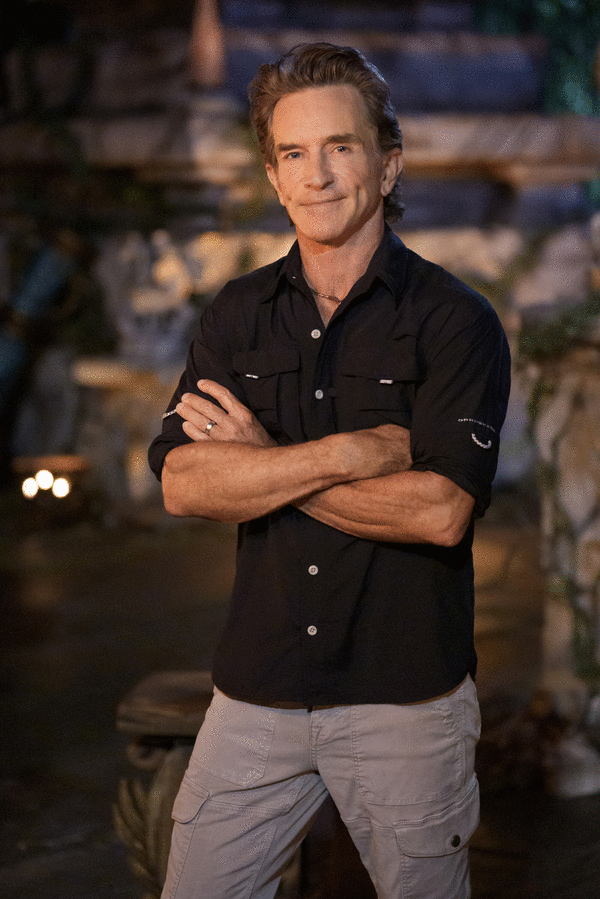
SEATTLE — Long before he became the face of one of the most successful reality competition series ever, Jeff Probst educated Seattle residents on car electrical maintenance.
In a 1992 clip from KIRO’s Northwest Car Care Show," an early-30s Probst wears a salmon-colored polo and stands in front of the Marymoor Park windmill before outlining ways to keep up with a car’s electrical system. “Survivor” superfans will notice some parallels in the segment: how a young Probst looks confidently into the camera, the way he gesticulates as he explains a concept, then rests his hands on his hips.
The Seattle clip is an early look into the Probst millions recognize now as host of “Survivor,” the CBS reality show that will premiere its 50th season on Wednesday. Probst, who grew up in the Seattle area and started his career here, is synonymous with the show that’s outlasted (and outwitted, and outplayed) any TV counterpart.
“Jeff Probst is 'Survivor,'” said three-season “Survivor” competitor Kelley Wentworth, who lives in the Seattle area. “I can’t imagine anyone else being slotted into that host role and then doing what he does, because he is very, very good at his job.”
Probst was born in Wichita, Kansas, and moved to Bellevue with his family as a teenager. He graduated from Newport High School, where he was a reporter for The Seattle Times’ youth page, writing about cruising (“cruisin’ consists mainly of a car and two to three people to cruise in it”) and senior traditions. He took classes at Seattle Pacific University but never graduated.
"Seattle is really where everything started for me," Probst said to The Seattle Times in an email.
His dad was a Boeing executive, and helped Probst get his first job in the aviation giant’s film department, as a production assistant making marketing and training videos. He knew nothing, he recalled in a 2012 Television Academy Foundation interview, but pushed buttons on editing machines and did offline editing. He moved up to writing and producing videos, which involved hiring a host and paying him $500.
“I thought, ‘You got $500 for reading the words I wrote? And you just put on a suit?’” he said in the interview.
He hosted the next video, he said, and then got an agent — Lola Hallowell, whose legendary eponymous talent agency worked with hundreds of Seattle actors and models from 1968 through the 1990s. In Seattle, Probst began working on corporate training videos, sometimes for free in exchange for gear, and then would direct music videos for bands. He learned to direct or tell stories while using his hosting skills, he recalled, and felt natural in front of the camera.
His first official hosting gig was on KIRO’s "Ernst Home and Garden Show," where he appeared with Seattle gardening expert and former Seattle Times contributor Ciscoe Morris.
“For four years, Saturday mornings, I would talk about poinsettias and putting good soil in the ground,” Probst said in the 2012 interview. “I had no idea about gardening. I still don’t.”
He moved to New York and hosted an FX show called “Backchat,” worked as an “Access Hollywood” correspondent and hosted “Rock & Roll Jeopardy!”
In 1999, Probst was driving in Los Angeles traffic when he heard producer Mark Burnett on the radio talking about a new show called “Survivor,” where people would have to fend for themselves on an island. He met with Burnett, who later recalled in a New York Times interview that he appreciated Probst being a relative unknown. Burnett said choosing Probst as a host was his greatest decision, and second was having him be a showrunner.
"Survivor: Borneo" premiered in May 2000 with 16 castaways chosen from more than 6,000 applicants competing for $1 million. The show quickly became a phenomenon, and along with watching castaways eat (and call each other) rats, viewers took note of Probst.
“With those dimples and pearly whites, he seems better suited to be just another pretty boy on ‘The Young and the Restless,’” an Associated Press reporter wrote of the show’s first four episodes. “But on ‘Survivor,’ Probst quickly proved to be more than an emcee with a Banana Republic expense account.”
Fifty seasons — and 26 years — later, Probst remains the show’s constant as it has evolved through different locations, tribal makeups and gameplay, as well as changes in how fans watch the show. Viewership of the early seasons dwarf recent seasons, but the show has millions of multiplatform watches, a dedicated fan base and hundreds of former players. Castaways have gone on to host successful podcasts (too many to name), win Emmys (Mike White, seasons 37 and 50) and serve as Washington’s attorney general (Nick Brown, Season 2).
Probst, too, has grown up with the show, Wentworth said.
“He does care about the show when you’re out on the island,” Wentworth said. “You can even see it in the production at challenges. If you’re doing something that we were told not to do, he will definitely call you out.”
Mike Jefferson, who competed in Season 24 and lives in Marysville, called Probst a good person who seemed genuine, even when Jefferson admits he was “kind of a jerk to him” during the long days when he was tired and hungry.
“He’s got the coolest job in the world,” Jefferson said.
Seattle-area castaways have a specific approach, Probst said, with an adventurous streak, comfort with uncertainty and "a lot of playfulness." They're willing to lean into the experience, he added, rather than play it safe.
"It’s similar to the feeling you get when you see Mount Rainier on a clear, sunny day," he said. "There’s just nothing quite like it. That same spirit for seizing the day shows up in the way they play."
Neither Wentworth nor Jefferson said Probst mentioned their Washington connections or his time in the Seattle area during their seasons. Seattle connections may come up during casting, Probst said, but his relationship with players shifts once the game starts.
Discerning viewers might notice a few Washington references. During a Season 45 episode, Probst described a challenge as something “you might do at a carnival for laughs while you're having a scone.” Viewers took to social media and questioned Probst — scones at a carnival? We’ll assume he was talking about a Fisher Fair Scone, a staple at Washington fairs and, yes, carnivals.
As for "Survivor" and its enduring legacy, Probst also had a Seattle-specific answer: They approach each season the same way the Seattle Seahawks approach a season.
"And in that way, 'Survivor 50' is our Super Bowl," Probst said. "This is a big celebratory season for us and if we’re lucky maybe we'll have the same success the Seahawks did and deliver a winning season for our fans!"
CBS hasn’t outlined "Survivor’s" plans beyond the show’s 50th season, or whether that will include Probst. And what would "Survivor be without Probst?
“I feel like the show could probably still go on,” Jefferson said, “but it would never be the same.”
———
‘Survivor 50: In the Hands of the Fans’
The 50th season premieres with a three-hour episode at 8 p.m. ET Feb. 25 on CBS, and streams on Paramount+ (live if you’re a Premium subscriber, the next day if you’re an Essential subscriber).
———
© 2026 The Seattle Times. Visit www.seattletimes.com. Distributed by Tribune Content Agency, LLC.











Comments