Column: Inside the Green Mill, the Malört and stories flow in a new movie
Published in Entertainment News
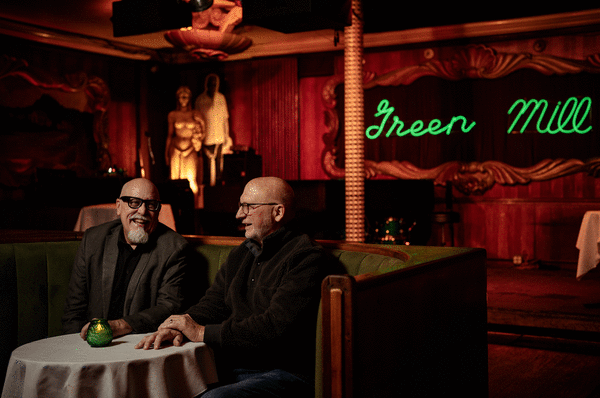
CHICAGO — In the colorfully vibrant world of taverns, saloons, bars, dives, night clubs or whatever it is you call those places where people gather to get drunk, watch TV, play pool, fall in love, talk to strangers, listen to music or otherwise seek shelter from life’s storms, the Green Mill has always held a special place.
Part of that no doubt is due to its longevity, for it has served as an Uptown oasis since opening in 1907 as Pop Morse’s Roadhouse and three years later becoming Green Mill Gardens, thus making it now the oldest nightclub in the city operating under the same name.
But an even greater reason is that, for the last 25 years, it has been, as my former colleague, critic Howard Reich wrote, “an unstoppable force for jazz in Chicago, giving unknowns a chance to try out their stuff and established South Side masters … a North Side beachhead.”
Still, it is possible, likely I suppose, that most of you reading this have never walked through the door at 4802 N. Broadway, and so it gives me pleasure to invite you inside via a new movie, “The Green Mill: A Real Chicago Joint,” that will be having its premiere at 8 p.m. Feb. 10 at the Davis Theater (4614 N. Lincoln Ave.).
The hourlong film is directed and produced by Paul Carr, a filmmaker and writer of some note but more personally attached here since he worked as a Green Mill bartender.
A native of the Midwest, Carr hitchhiked around the country before landing in Chicago and attending Columbia College, determined to become a writer. He fell in love with the city and worked various jobs (including at the Mill as a bartender from 1986 to 1995). His first film grew from a stage play, “Busted City,” produced in both 2008 and 2012 by Prop Thtr. The movie version, which he describes intriguingly as “about a bookie ring taking bets on the ’83 mayoral election,” was released in 2015. Then came such films as “Casual Criminals” and “Hitchhiking to Mars.”
He founded and runs Busted City Productions, and to make this latest film, he first suggested it to Green Mill owner Dave Jemilo, who reacted enthusiastically. They quickly gathered four colleagues, sat them at tables in the club and let the memories flow. And that’s mostly what we see and hear from Jemilo, Carr, jazz musician Brad Goode, bartender and managers Jason Cole and Laura Castro (both from 1994 to now), and former singer and server Katherine Terrell.
The film does not devote much time to the place’s long history, giving viewers just a bit about the “secret” tunnels underneath and mere mention of such long-gone patrons as Charlie Chaplin and that gangster named Capone. “I wanted to capture what the Mill is now and has been in recent years,” says Carr. “It does take us back but not as far back as some of those stories and legends.”
It is interesting to hear Jemilo, a real Chicago treasure, talk of first seeing the place as a kid riding in his father’s taxi cab and of the rougher-than-rough neighborhood and shabby state of the club when he bought it in 1986.
He and the others, who spent more than five hours talking in front of cameraman and editor Nick Schultz, capture some of the particulars of bar’s early Jemilo days, describing the place as “like an old prize fighter who never got knocked down.”
Liberally peppered with profanity and laughter, the conversations introduce us to such notable patrons as Johnny Depp, and over-served Sarah Vaughan, Vince Vaughn, whose car was towed from a lot across the street, Robert Plant and his odd glasses; and Studs Terkel, a neighbor who lived but blocks away, often there in the company of his dear friend, jazz man Bud Freeman.
You’ll hear tales of some of the regulars, including one fellow fond of dumping salt in his drinks; a couple of “ghost stories” and some loving praise for saxophonist Von Freeman’s ability to “transport listeners.”
None of this chatter is regret-filled but rather celebratory, and hearing the names of some performers puts in one’s mind the names of others. Even if we don’t see or hear much from them, it’s impossible not to think of how the Green Mill was the launching pad for Marc Smith’s world-famous poetry slams, and nurtured the careers of Patricia Barber, Kurt Elling, Howard Levy and Frank Catalano.
Carr’s writing and delivery of the narration is smooth and poetic. He creates a suitably moody feel for the film, and exterior footage captures Uptown. There are plenty of good stories and a lengthy revelation near the end when the gang takes credit (justified it would seem) for the dubious honor of starting the city-wide popularity of the vile liqueur Malört.
So, the door at the Mill is there for the opening, seven days a week, and if you need more incentive before heading there, I’ll direct you to my Tribune colleague and friend Robert Loerzel. There is no one who knows more about the Green Mill. His “The Coolest Spot in Chicago” is a marvel.
It is deeply researched and liberally illustrated, fine reading. Near its end he writes, “If the Green Mill isn’t the coolest spot in Chicago today, then it’s certainly a strong candidate for that distinction. It’s also one of the best places anywhere to see live jazz. I consider myself lucky to live just a few blocks away. No matter how many times I’ve stepped through that door, I still marvel at the sensation that I’m entering a nightclub from a bygone area.”
This movie is very of the moment, which was Carr’s intention. In addition to the upcoming Davis screening it is making the film festival route as he explores other ways to get wider distribution. Asked about some recent news that the building that houses the Green Mill and some adjacent properties have been put up for sale by Jemilo, Carr says, “I’ve heard. But I can’t ever see Dave giving up the Mill.”
———
(Rick Kogan is a columnist for the Chicago Tribune.)
———
©2026 Chicago Tribune. Visit chicagotribune.com. Distributed by Tribune Content Agency, LLC.






Comments