'Agatha Christie's Seven Dials' review: Netflix adaptation an enchanting whodunit
Published in Entertainment News
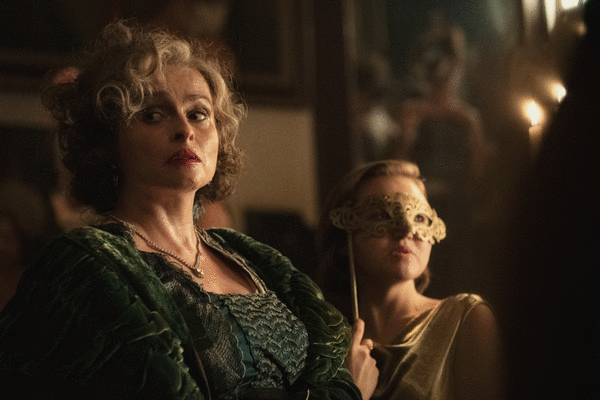



Should you be in need of a diversion involving light murder, extremely well-appointed drawing rooms and Helena Bonham Carter flouncing languidly through scenes saying things like, “These people make my kidneys ache” (for the record, I am always looking for this sort of diversion), Netflix has just the thing for you. “Agatha Christie’s Seven Dials,” now streaming in just three tidy episodes, has all of this and more — and showcases an enchanting lead performance by a rising star.
“Seven Dials” the novel was published in 1929, relatively early in Christie’s long career. (The British mystery-fiction legend, creator of Hercule Poirot and Miss Marple, died 50 years ago this month after writing more than 60 novels, spanning from 1920 to 1975.) It begins as a classic Christie whodunit: A young man is murdered after a lavish country house party in 1920s England, and a young woman who is rather enchantingly called Bundle (she’s really Lady Eileen Brent, and appeared in an earlier Christie novel) becomes determined to solve the crime. But the story quickly becomes larger than that Downton Abbey-ish country house, encompassing secrets and conspiracies and international incidents, and if I told you more I think Bonham Carter would stop me in my tracks with a glacial glare. (Which might be fun, but never mind.)
Mia McKenna-Bruce, in her first lead role (she’s best known for co-starring in the British coming-of-age series “How to Have Sex”), is an absolute delight as Bundle, a wickedly smart young woman who lives in her family’s crumbling pile with her widowed mother, Lady Caterham (Bonham Carter). Bundle, it seems, is looking for a way out, and handsome Gerry Wade (Corey Mylchreest) looks like he might provide that — until he’s found dead in his bed the morning after the party. An inexperienced police officer quickly suggests that it’s suicide, ignoring clues like an odd arrangement of clocks in the room (explaining this away with, “What a gentleman does in his own room, with as many clocks as he chooses, is his own affair”), but Bundle thinks otherwise. McKenna-Bruce, employing an effortless arsenal of knowing side-eye, self-aware posh tones and breezy confidence, makes the character irresistible; we fall a bit in love with Bundle, like the unlucky Gerry, and happily follow her anywhere.
But she can’t quite do the impossible — that is, steal the series back from Bonham Carter, who has relatively few scenes but owns “Seven Dials” as if it were a kingdom over which she’s presiding. (She and McKenna-Bruce are wonderfully cast as mother and daughter; they share expressive saucer eyes and dusky speech tones.) Bonham Carter basically marches through the series, peering out from under enormous hats or a tangled cloud of hair, making pithy observations (one should not, for example, thank the staff for performing a service; “Where would it end?”), smoking operatically and pondering the idea of installing a moat. And just when you think she’s only around for comic relief, she delicately, expertly breaks our hearts with a quietly whispered line — “I have no more capacity for loss” — that reminds us of the shadows under which those in the 1920s lived.
“Seven Dials” has other delights: Martin Freeman’s sly turn as a police superintendent who quickly figures out that trying to stop Bundle is pointless; the golden candlelight of that raucous party; the pleasure of a Christie denouement in which the suspects are gathered up for the purpose of a character announcing, “Someone in this room knows more than they’re telling us.” If the plot gets a little cumbersome, and at least one of the final reveals seems unsurprising, it matters not: This tidy journey of less than three hours is lovely period-movie fun. The final scenes provide a welcome hint that we may not have seen the last of McKenna-Bruce’s Bundle; let’s hope she hurries back.
———
'AGATHA CHRISTIE’S SEVEN DIALS'
Rating: TV-14
How to watch: Netflix
———
©2026 The Seattle Times. Visit seattletimes.com. Distributed by Tribune Content Agency, LLC.











Comments