Don Was will celebrate Bob Weir and play the Grateful Dead's 'Blues for Allah' with his new band at Philly-area show
Published in Entertainment News
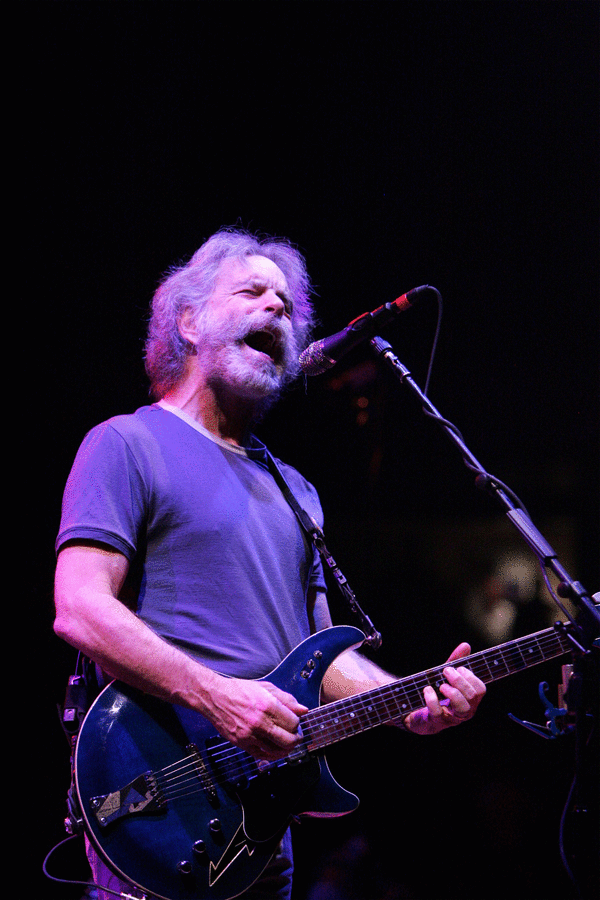


PHILADELPHIA — Don Was’ show with the Pan-Detroit Ensemble at Ardmore Music Hall on Wednesday was always going to be, in part, a tribute to the music of the Grateful Dead.
Along with digging deep into the rugged, funky sounds of their hometown — as the bassist and Grammy-winning producer and his bandmates do on their new album, "Groove in the Face of Adversity" — the date will also include a performance of the Dead’s 1975 album "Blues for Allah" in its entirety.
But now the Dead community is reeling from the loss of Bob Weir, the singer-guitarist who co-founded the Dead in 1965 and became a torch bearer for the band’s music in the decades since Jerry Garcia died in 1995.
So when Was and his eight-piece band return to the Main Line venue where they played in June at the Music Hall’s annual “Unlimited Devotion” Dead celebration, the show will be an opportunity for Philly Dead fans to mourn Weir, who died Saturday at 78.
It will also serve as a celebration of the short-shorts-wearing rhythm guitarist and vocalist who sang many of the psychedelic rock band’s most beloved songs, including “Sugar Magnolia,” “Truckin’” and "Blues for Allah’s" “The Music Never Stopped.”
Was is president of the esteemed Blue Note Records jazz label and the former co-leader of art-pop band Was (Not Was), best known for the hit “Walk the Dinosaur.” His long list of production credits includes Bonnie Raitt, the Rolling Stones, Willie Nelson, Bob Dylan and many others.
He also toured extensively with Weir, playing double bass with Wolf Bros, the band formed in 2018 whose repertoire mixed country and jazz with the Dead’s mystical roots-music blend.
Weir played Philadelphia stages with the Dead or one of their many offshoots over 70 times — including a record 57 concerts at the Spectrum in South Philly before it closed in 2009. His last Philly show was a Wolf Bros gig at the Met in September 2023.
Was learned of Weir’s death shortly before going on stage in Ann Arbor, Michigan, on Saturday, and broke the news to a crowd full of Deadheads.
“I told them the story Bobby told me about the night Jerry died,” Was said, talking on Monday from New York, where he and the stellar Pan-Detroit Ensemble, which includes saxophonist David McMurray and powerhouse vocalist Steffanie Christi’an set to play the Blue Note before heading to Philly.
“Bobby was in New Hampshire with [his side project] Ratdog [in 1995]. He told me, ’You go up there and play, man. The way you deal with grief is you go up there and make some good music for everybody.’
“So that’s what we’re going to do for Bobby. We’re going to play a soulful show, as soulful as we can. [In Ann Arbor] I hung out with the audience afterwards, and everybody had their story about some encounter with Bob over the last 60 years. It was almost like a wake. It might just be that this tour is about bringing some comfort to people who suffered a loss. Even if you’re just a fan. Bobby is like a family member to people.”
Was first saw the Dead in Detroit in 1972. “I always dug them,” he says, “and being a jazz head, I understood the method of improvisation. But I never got in a car and followed them around, so I don’t think you could have called me a Deadhead then.”
You could now, as well as a key player in the enduring band’s long, strange post-Garcia afterlife. In 2015, while producing guitarist John Mayer in Los Angeles, Was introduced Weir and Dead drummer Mickey Hart to Mayer, who was boundlessly enthusiastic about Garcia and the band.
“John waxed eloquent about his love of the Grateful Dead,” recalls Was, 73. “And those guys were just kind of bowled over by it. … And that turned into Dead & Company.”
Wolf Bros formed in 2018, inspired by a dream of Weir’s. The singer and guitarist was a frequent collaborator with bassist Ron Wasserman, who had introduced Weir to Was in the 1990s.
After Wasserman died in 2016, Weir called Was. “He said he had a dream where Wasserman said the reason he had introduced Bobby to me,” said Was, “was so i could take Rob’s place after he was gone. So he asked me if I wanted to start a trio with him and [drummer] Jay lane. And i said, ‘Yeah, of course.’”
Playing with Wolf Bros “changed everything for me,” Was says. Weir was “utterly fearless about suspending self-consciousness and playing freely in the moment without regret.”
“There’s a tremendous allure to those songs, and to play them the way Bobby wanted to, which was with a beginner’s mind every night and just have a completely different adventure with a song every time you play it.”
As head of Blue Note, Was is excited about the young artists on storied home of Herbie Hancock and Wayne Shorter. He name checks Joel Ross, Melissa Aldana, Paul Cornish and Upper Darby native saxophonist Immanuel Wilkins.
“They all have records coming out this year, and they’re all blowing my mind,” Was said. “People who see Immanuel Wilkins will be talking about seeing him the way they talk about seeing Coltrane. They still be listening 60 or 70 years from now.”
On "Groove in the Face of Adversity," Was and the PDE bring a loose, expansive sensibility to a wide range of material, from Hank Williams’ honky tonk “I Ain’t Got Nuthin’ But Time“ to Cameo’s 1978 funk workout “Insane.”
Most powerful is “This Is My Country,” the Curtis Mayfield title track from a 1968 album by the Impressions that stands as a statement of defiant patriotism in the face of oppression. “I realized it’s tragically more relevant now than it was in 1968,” Was said.
“I feel an urgency” about playing with the PDE, “especially after Saturday night,” Was said. “I feel like I’m just starting to crack the code about playing bass. I want to play while I can” — he laughs — “while my fingers still work.”
The PDE sound is more muscular and R&B-powered than the acoustic-based style he played with Weir in Wolf Bros. But Was says they’re connected in not obvious ways.
“When I first started to play with Bobby, I was haunted by Phil,” he said, speaking of bassist Phil Lesh, who died in 2024. “But I can’t play like Phil. Nobody can play like Phil. It was putting me in stylistic limbo. And then I quickly realized the most Grateful Dead thing you can do with a song is be yourself. Be who you are.
“So that’s what our band does. We play like us. In the music business, we tend to think of anything that’s different as a marketing problem. But in fact, being different is your superpower. I’ve tried to impart that to artists on Blue Note and people I’ve produced. To be as different as you can be: That’s the only chance you’ve got!”
———
Don Was and the Pan-Detroit Ensemble at Ardmore Music Hall, 23 East Lancaster Ave., Ardmore at 8 p.m. Jan. 14. ardmoremusichall.com.
———
©2026 The Philadelphia Inquirer. Visit inquirer.com. Distributed by Tribune Content Agency, LLC.






Comments