The cast of 'The Pitt' is just as immersed as the audience in its emergency room setting
Published in Entertainment News
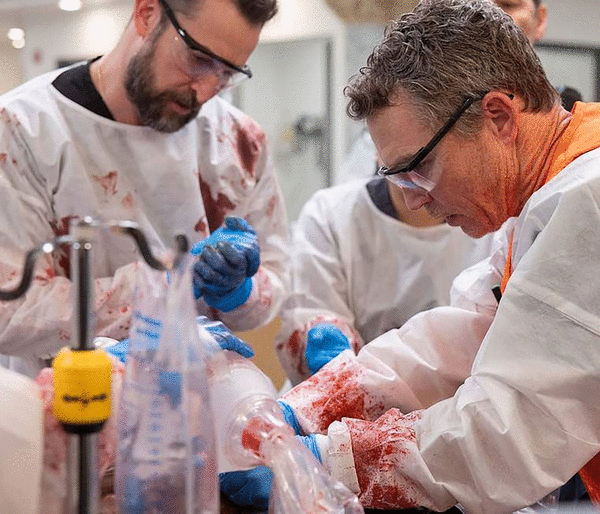
PITTSBURGH — It's common knowledge among fans of "The Pitt" that the show — with its documentary-style cinematography and esoteric language — sets realism as its No. 1 priority.
Many of its situations are made believable through consultations with actual emergency room physicians. The actors are told where to cut, what equipment to use and how to pronounce terminology. Then they shoot the scene in one take, creating an authentic experience for the audience.
But the realism of "The Pitt" goes beyond the show as a final product. Some of the lead actors say working on its Allegheny General Hospital-inspired set makes them feel grounded in an actual emergency room.
That includes Supriya Ganesh, who reprises the role of Dr. Samira Mohan in Season 2. In college, Ganesh scored in the 99th percentile on the MCAT, a test pre-med students take while completing their undergraduate degree.
As an actor, she's auditioned for other entertainment roles as a doctor.
"I would read the script and go like: 'This is dumb.' And it would be hard for me to suspend my own sense of disbelief, so how on earth can I do that for an audience?" Ganesh said during an interview with the Post-Gazette at a media event.
When she first read the script for "The Pitt," it felt more genuine. Ganesh felt there was a logical flow to what she was saying.
"I understood exactly why [Dr. Mohan] was saying what she was saying. Even the drugs were correct, the order of the drugs were correct," she explained. "And it made total sense to give these drugs during an intubation."
Sepideh Moafi, who plays Dr. Baran Al-Hashimi, a new attending physician in Season 2, said she started learning about emergency medicine immediately after getting the role. Though there's no "Being a Doctor for Dummies," she said she read books, watched documentaries and listen to podcasts to prepare.
"I showed up to set and they had a great team of medical advisers and technical advisers guiding us through a short boot camp," Moafi said.
She wasn't hired to be a doctor; she was hired to portray one. That requires being able showing authentic emotion, but Moafi also has to act like she knows what she's talking about.
Shawn Hatosy, who plays the recurring role of Dr. Jack Abbott, said he doesn't fully understand the procedures or language. Still, his role as an attending physician feels somewhat real when he relies on consulting physicians to explain how to do and say things.
"This whole unit, this whole crew, the heads of the departments, the design of the set, it makes you feel like it's really happening," he said.
The writing isn't the only factor that immerses actors into the scene. "The Pitt's" set at Warner Bros. Studios in Burbank, Calif., created by series production designer Nina Ruscio, is built to portray itself — as functional emergency room.
There is a miniscule amount of artificial lighting and it even has closed ceilings rather than the open rafters of a usual set in the entertainment industry, said Taylor Dearden, who plays Dr. Mel King in the show.
It's easy for the cast to immerse themselves in that space.
"As an actor, your job is to create circumstances that are so real that you don't have to act. You're just responding and reacting," Hatosy said. "And in 'The Pitt,' it goes a step further — every single thing on that set is real from the equipment to the machinery to the charts."
Those details — all reviewed and signed off by the show's technical advisers — help the cast believe that they are their characters.
While much of the information Hatosy learns on the show isn't retained, it has given him more admiration for medical doctors and students.
"Stuff goes into my head and I learn it, it's fun," he explained. "And then we go onto the next thing. There's such incredible respect for what they do. Do not trust me with a scalpel or a needle."
Dearden and Ganesh also noted that other shows they have worked on put emphasis on how actors, especially women, look in certain scenes. That can be constricting, Ganesh said.
"It's like three flyaway hairs they're battling and you're like: 'All right,'" said Dearden. "Often on ['The Pitt'], it's like: 'People have flyaways, now go.'"
The cast is made to look how they would in the high-pressure situations, meaning frizzy, shiny and sweaty hair as opposed to aiming for perfection.
"That's really nice. I think especially as women, you have this expectation of how you're supposed to look place on you," Ganesh said. "I think it's really great to lean into what's icky and grimy and real."
"Perfect is wrong for us," said executive producer John Wells. "Emergency rooms are not where you do a lot of things perfectly."
Emergency medicine is more of an investigation. When patients are admitted to the ER, the cause of their symptoms are not immediately clear.
So, "The Pitt" has to exude a sort of urgency in the way the crew shoots and the actors perform.
"The show is meant to be a little raw and to have mistakes in the way in which it's shot," said showrunner and executive producer R. Scott Gemmill. "It's intentionally shot with errors to try and mimic the kind of chaotic feeling you often have."
Because its actors and crew immersed in that chaos during production, the final product audiences see on their screens feels incredibly authentic.
"It's such a dimensional show. I'm excited for people to receive it and to have it be part of the cultural conversation," Moafi said.
© 2026 the Pittsburgh Post-Gazette. Visit www.post-gazette.com. Distributed by Tribune Content Agency, LLC.





Comments