50 years after War's 'Why Can't We Be Friends,' Lonnie Jordan's intention remains
Published in Entertainment News
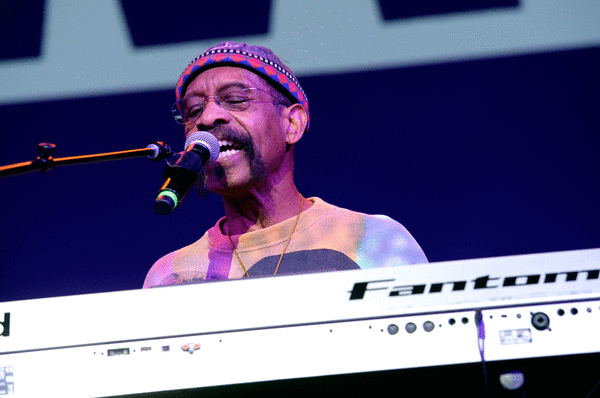
ANAHEIM, Calif. — Fifty years after its release, War’s “Why Can’t We Be Friends?” still feels less like a song frozen in time and more like a question the world keeps circling back to.
When frontman Lonnie Jordan talks about the album today, there is no romanticized nostalgia. What comes through instead is memory shaped by movement, people, and the places War passed through while exploring the question long before it ever reached tape.
The groove itself came first. Jordan remembers sitting at his keyboard and letting the rhythm take shape almost instinctively, but the idea had already been forming years earlier on the road. While touring through Europe and Japan, War began noticing the same pattern repeating itself night after night. Before the band could even take the stage, there were delays caused by tension in the audience, people divided by identity, struggling to coexist in the same space.
“We kept playing this groove backstage over and over,” Jordan recalls over the phone. “Everywhere we went, people had issues with each other. Different territories, different backgrounds. We would be in a holding pattern before going onstage because the audience couldn’t get along.”
Communication, he adds, was difficult in those days, long before cell phones and social media connected everything instantly. “Now people can communicate right away, but sometimes I wonder if that’s a good thing or a bad thing, depending on how you use it.”
Eventually, the repetition of those moments led to a simple realization. “We finally just said it out loud,” Jordan says. “Why can’t they be friends with each other?” At first, that was all there was, a single question sung again and again without explanation. The lyrics came later, shaped by what the band had witnessed not only overseas but also back home. Japan, Jordan notes, was experiencing its own territorial conflicts at the time, just as the Vietnam War was reaching its final and most painful chapters.
“We always wrote from experience,” he says. “From the world.” That approach extended beyond the band itself. Jordan is quick to credit War’s fans as collaborators in the truest sense. “Our fans helped us write these songs,” he says. “If it wasn’t for them, we wouldn’t be here. They put us here, and they can take us out.”
That relationship between artist and audience is part of the reason War’s music has remained so deeply rooted across generations. Decades later, their catalog continues to be sampled, covered, and rediscovered by younger artists, something Jordan speaks about with the utmost humility. The reinterpretations, he says, are an honor and a reminder that messages still resonate even as the world shifts around them.
What has never changed is War’s intention, as Jordan explains, the band has always been careful about how they address the world’s problems. “We don’t want to inject people with negativity,” he says with a laugh. “Negativity can put you in a stressful frame of mind. That can become toxic, create disease, create issues in your tissue.”
Even as War works on new material with longtime producer Jerry Goldstein, that guiding principle remains unchanged. “We want to keep the grooves and the messages, not political, just making people aware of their surroundings without drowning them in it.”
That balance between honesty and uplift continues to define War’s live shows. On Saturday, Dec. 20, the band will take the stage at YouTube Theater alongside Tower of Power and Poncho Sanchez, a lineup that reflects the depth of California’s musical DNA. While Jordan is grateful for the scale of the moment, he admits with characteristic candor that large arenas have never been his preference.
“I don’t favor big places,” he says while chuckling. “I prefer smaller venues that are more intimate, where you can play more than one night and still get the same amount of people in one place.” Still, he recognizes what larger spaces offer audiences, particularly the opportunity to connect not just with the music but with one another. “People are happy to be there, looking at who’s with them, making new friends. That’s a good thing. I can’t be selfish about that.”
Jordan refers to these venues as houses of worship, places where bands act as modern-day troubadours delivering stories and messages that allow people to gather, release, and feel something together. “I just want to see those smiling faces,” he says. “That’s all I want to see.”
At 77 years old, Jordan shows no signs of slowing down, onstage or off. When asked about retirement, he laughs profusely before delivering a line that feels less like a joke and more like a promise.
“I just turned 77,” he says. “And I’ve got another 77 years to go before I retire. Maybe not from the studio, but definitely not in a wheelchair. I’ll be in the studio chair.”
©2025 MediaNews Group, Inc. Visit ocregister.com. Distributed by Tribune Content Agency, LLC.









Comments