Review: 'Rebuilding' a nuanced drama starring Josh O'Connor
Published in Entertainment News


The villain of “Rebuilding” is never shown, and that’s for the better. Embers swirl in the film’s opening titles amid the roar of a conflagration. When the first images appear — a smoky stand of scorched pines, their silhouettes black against the haze — you’re glad the violence and destruction stayed off-screen.
Natural disasters in TV and film are sadly familiar. But what does it look like after the news cameras move on? Wildfires in Colorado and elsewhere may darken our skies, but a figurative cloaking can also occur within survivors’ minds, as we see in “Rebuilding,” which embraces the subject with uncommon heart.
Written by and directed by Telluride-area native Max Walker-Silverman, “Rebuilding” is an elegant and spiritual look at the choices faced by survivors, who are already juggling as many economic and personal crises as anyone else. Walker-Silverman and cinematographer Alfonso Herrera Salcedo step back just enough to see our characters as others might: battered and uncertain, resolute and earnest. But in sympathetic fits, they also jump into their characters’ heads to regard the world as the characters do.
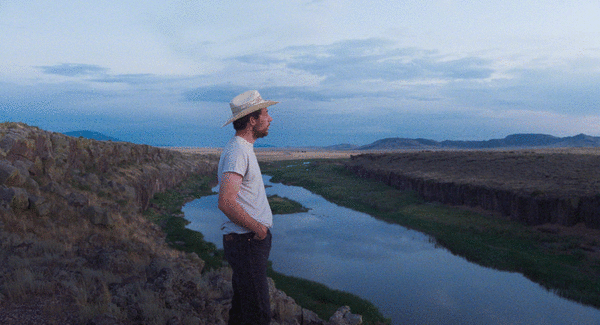
Opening scenes sample the culture and scenery of shooting locations, including Alamosa, Capulin, La Jara and Forbes Park. Anyone who’s been to the National Western Stock Show, visited or worked on a ranch, or otherwise escaped the Front Range for Southern Colorado will recognize the stark beauty of the San Luis Valley.
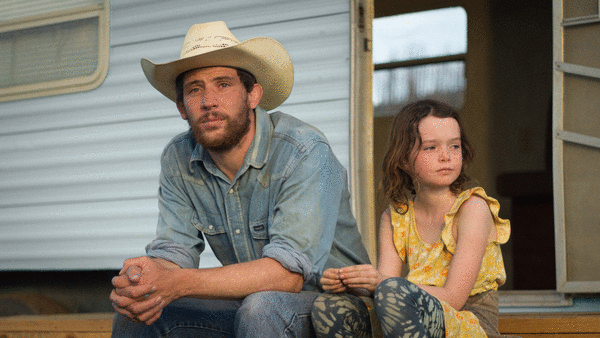
Melancholy trails main character Dusty (Josh O’Connor) as he struggles to right himself after his ranch turns to ash, from setting up a new “home” in his cookie-cutter FEMA trailer to explaining the complicated reality to his daughter, who’s smart beyond her years but also just wants to her dad to stick around instead of potentially moving to Montana for work.
We hear from a radio report that at least 1,000 homes were destroyed in this particular fire, with many more thousands of people displaced. Generational rancher Dusty is just one of them, along with daughter Callie Rose (Lily LaTorre), who stays with him while not with her mother, Ruby (a vigorous Meghann Fahy). It also turns out that Dusty’s new abode shares a scrubby expanse with a half-dozen other displaced families.
Ruby is catalyst for Dusty, pushing him to connect with Callie Rose amid the loss and uncertainty. A low-key but effective Amy Madigan pops in as Bess, Ruby’s mom and ostensible matriarch, who’s on the third act of her own story. She puts pills in her yogurt, as Callie Rose observes, which says more in a line than some screenwriters say in a script. Their family bonds are frayed but still very much visible.
O’Connor, who’s lately starred in films such as “Challengers” and “Wake Up Dead Man: A Knives Out Mystery,” plays Dusty as a lone animal against an even lonelier landscape. But instead of tangling with substance abuse, money schemes or other leaden tropes, Walker-Silverman focuses on Dusty as the locus of a family ranching legacy that, post-wildfire, cannot support animals or crops anymore on its scored acreage. You can feel the weight on his shoulders, but also his drive to lift it.
Dusty is at first blurry in the foreground, his bereftness almost too much to capture despite the defeated body language. Callie Rose, on the other hand, is confident and self-contained, needling Dusty with her precocious wisdom that never becomes contrived or cutesy. They both believe things could go “back to normal” at some point, though somewhere deep within they also know that’s impossible. Sparks of connection arrive as they sit in the back of Dusty’s pickup truck outside a public library at night — the only way for them and other wildfire survivors to access Wi-Fi service.
The sound design is visceral and satisfying, with insects trilling, horses snuffing, and boots in gravel subbing for a traditional score. It fits the scenery: Isolation and vulnerability prompt one rancher-neighbor to opine that the area is simply a desert, despite centuries-long efforts to turn it green. “That’s all it is,” he concludes.
“Rebuilding” is rare in that it resists the pull of grim, prestige-picture drama, which would certainly be justified for the subject matter. Walker-Silverman instead steers toward the wistful and bucolic, depicting beauty and devastation at once. As Dusty begins to dip into fellowship with his other displaced trailer-mates, they share roasted green chiles and casseroles, stories and songs. They’ve all lost something, and are on a similar path of grief. That’s especially true with mom Mali (Kali Reis), who’s trying to support daughter Lucy despite losing her husband in the fire. The spare script gives her and other supporting characters relatable grit in the face of intimidating odds, which are writ large in the massive skies dotted with cloud traffic and blinding sun.
Dusty applies for a loan to rebuild his family ranch, but is met by the Catch-22 of not having a ranch to back it up. Scenes like this are naturalistic to the point of documentary, but so are the campfire nights in the FEMA block, where the mix of multiracial and multigenerational families rings true. O’Connor’s strong, silent-type cowboy feels less like a Western cliche and more like a smart acting choice. And as the rhythms of daily life can’t help but return for him and others, it’s gratifying to see Dusty’s loner shell crack and fall away.
Ultimately, it’s not about realizing what he lost, but what he’s still got. And as he learns in a surprise and deeply gratifying ending, that’s quite a lot.
———
'REBUILDING'
3 stars (out of 4)
MPA rating: PG (for thematic elements, some drug material, and brief language)
Running time: 1:35
How to watch: Now in theaters
———
©2025 MediaNews Group, Inc. Visit at denverpost.com. Distributed by Tribune Content Agency, LLC.











Comments