Brian Platzer, author of 'The Optimists,' reveals his novel's inspiration
Published in Books News
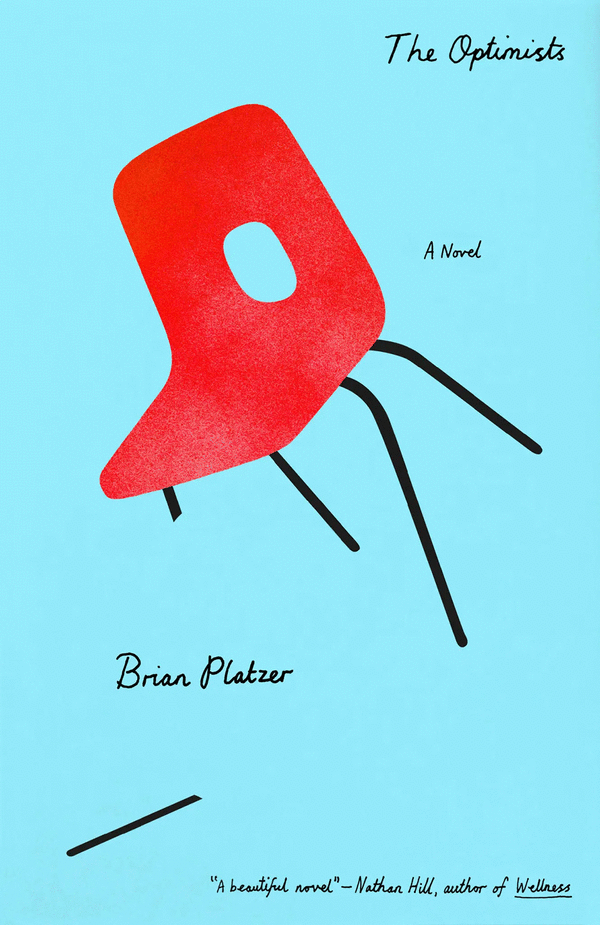
Brian Platzer is a middle-school teacher and author of “The Optimists,” among other books.
He was the education columnist for The Atlantic, and his writing has appeared in The New York Times, The New Yorker, and New York Magazine.
Q. Please tell readers about your new book.
“The Optimists” is narrated by Mr. Keating, a retired eighth-grade English teacher who spent his career perfecting a grammar exam, telling knock-knock jokes, and rooting for the Yankees. He’s trying to tell the story of Clara, the most extraordinary student he ever taught, who goes from kindergarten thief to teenage genius to Silicon Valley celebrity to radical animal-rights activist. While writing Clara’s story, Mr. Keating keeps getting distracted by his own life. His marriage. His preposterously confident head of school, Richard Kingsley Madison IV. His theory that no matter how bad things get, someone has to be putting french fries in someone else’s ears. “The Optimists” is a love letter to teaching, to marriage, and to the idea that jokes can be serious, too.
Q. Is there a person who made an impact on your reading life—a teacher, a parent, a librarian, or someone else?
Mr. Keating was my real-life eighth-grade English teacher. He’s the reason I became a teacher and a writer. He performed for his students the literature he taught and spent more time on our essays than we did. Years later, he mentored me when I started teaching. He became a reverend to officiate my wedding.
I wrote ”The Optimists” in his voice because I missed him and thought you might like to meet him.
Q. What’s your comfort read?
“The Razor’s Edge” by W. Somerset Maugham. The narrator, who claims to be Maugham himself, is confident, smart, warm, sly. Maugham writes about “a man with whom I was thrown into close contact only at long intervals,” and that line gave me permission to tell Clara’s story the way Mr. Keating would have. Jumping around in time. Digressing. Commenting on his story as he tells it.
Q. Is there a book or type of book you’re reluctant to read?
Nonfiction that gives life advice based on science or studies. You know the type: a single psychology experiment extrapolated into a theory of everything. Mr. Keating would have called that “telling instead of showing.” He had very strong feelings about telling instead of showing.
Q. What do you find most appealing in a book?
A first-person voice that guides me through the narrative. Kathy in “Never Let Me Go.” Nick in “The Great Gatsby.” Scout in “To Kill a Mockingbird.” Dave Eggers in “A Heartbreaking Work of Staggering Genius.” These narrators explain what I need to know until I start wanting to know anything they might want to tell me. That’s what I was hoping for with Mr. Keating. Someone you’d actually want to sit next to on a long flight.
Q. If you could ask your readers something, what would it be?
Did you have a teacher who changed your life? And if you did, do they know it?
©2026 MediaNews Group, Inc. Visit ocregister.com. Distributed by Tribune Content Agency, LLC.





Comments