Zelenskyy wants Congress to pressure Putin if Trump can't win deal
Published in News & Features
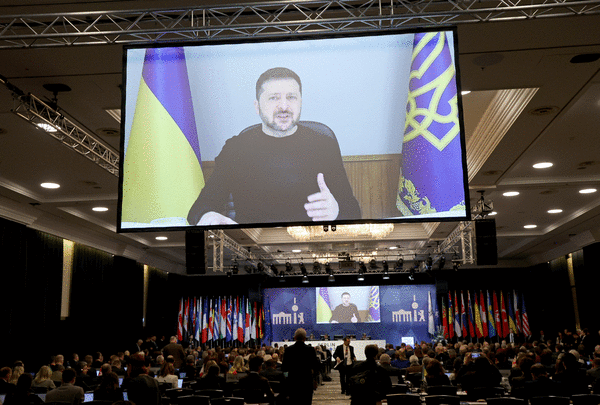
Ukrainian President Volodymyr Zelenskyy will reach out to the new Democrat-controlled U.S. Congress to intensify pressure on Russia if Donald Trump fails to convince Vladimir Putin to end the war by the end of the year.
Ukraine will seek a robust package of U.S. military aid and tougher sanctions on Russia if no peace deal acceptable to Kyiv is reached, Zelenskyy said in an interview with Bloomberg late Monday.
“There must be such a level of support for Ukraine and such sanctions that they send a clear signal to the Russians,” he said. “It’s time to sit down at the negotiating table and end the war.”
The comments are the strongest suggestion yet that Zelenskyy will try to leverage Trump’s latest electoral defeats to push Russia into peace talks. The Republican Party suffered sweeping losses in this month’s midterm elections that gave the Democrats majorities in both the Senate and the House when the new Congress sits in January.
U.S. envoys Jared Kushner and Steve Witkoff are pressing for a peace accord “as soon as possible” and ideally by January, Zelenskyy said. Ukraine risks facing demands for significant concessions, he said, while Putin shows no sign of readiness to end the war.
“There’s a desire to move very quickly, both we and the Russians understand that,” Zelenskyy said. “We understand what the price might be. We very much want peace too, but not at Ukraine’s expense alone.”
The U.S. and Russian presidents discussed Ukraine at talks in China last week, where Trump called Putin “my friend.” He later phoned skeptical European leaders gathered in Berlin to tell them Putin wants to end the full-scale invasion Russia launched in 2022.
Kushner and Witkoff also met with Putin in Moscow and with Zelenskyy in Dublin earlier this month following the first U.S.-led talks between Russia and Ukraine in Abu Dhabi since February.
Zelenskyy urged Ukraine’s allies to step up supplies of interceptors for Patriot air defense systems to deter Russian ballistic missile attacks, as he bemoaned acute shortages and delivery delays.
“Please cover our needs for at least the whole of December,” he said. “Why? Because I’m still counting on being able to find, so to speak, a new approach to the new Congress in January or February.”
Delivery of 48 Patriot missiles is held up because the package still lacks authorization by Defense Secretary Pete Hegseth, he said. Even with this shipment, Ukraine will remain far short of its needs for Patriots, Zelenskyy said.
He previously told Bloomberg that the U.S. has been supplying 12 Patriot interceptors a month since last year — about a quarter of the number promised under President Joe Biden’s administration.
“It’s very unpleasant that amid all the bargaining over how to end the war, Ukraine is facing not only cuts in supplies of Patriot interceptors but also delays in deliveries,” Zelenskyy said.
He also confirmed that restrictions remain in place on Ukraine’s use of SpaceX’s Starshield terminals that provide the military with satellite internet connectivity. Use of the terminals is restricted in Russian-occupied areas, hampering Ukraine’s air-defense, he said.
“America itself is putting itself in a very uncomfortable position,” Zelenskyy said. “Politically, it looks as though it is pursuing the same course as Putin, who wants to force Ukraine to capitulate.”
The defense disputes emerged as Ukraine braces for what many regard as its most difficult winter of the war that’s now in its fifth year. Russia is conducting mass drone and missile attacks targeting Ukraine’s power and heating infrastructure, betting on breaking the population’s morale to secure the victory that has eluded Putin on the battlefield.
While Russia’s advance on the front line in Ukraine’s eastern Donetsk region has stalled, its aerial barrages on cities have grown increasingly sophisticated with wider use of jet-powered drones that are hard to intercept.
“In 2026, Putin has completely changed the course of the war,” Zelenskyy said. “Now his army is waging war against the civilian population. As the previous stage — troops against troops — hasn’t yielded results.”
Beyond energy facilities, Russia has expanded its list of targets to include water supply infrastructure and bridges connecting the two banks of the Dnipro river in Kyiv.
“When someone strikes a sewage facility with a ballistic missile, can you imagine that it could be accidental?” Zelenskyy said.
Ukraine last week destroyed a section of road on the Crimean Bridge that Putin ordered built to connect Russia with the Black Sea peninsula he annexed in 2014. It has also stepped up air attacks targeting Russian oil refineries to try to curtail the Kremlin’s ability to fund the war.
Kushner and Witkoff have floated proposals for Ukraine to cede the Luhansk and Donetsk regions, collectively known as the Donbas, to Russia in exchange for some form of security guarantees from NATO.
With Russian forces mostly in control of Luhansk, Putin wants Ukraine to surrender the remainder of the Donetsk region that his troops have been unable to take in fighting since 2014. Ukraine rejects that demand, saying it would leave the rest of the country vulnerable to a future Russian attack.
Zelenskyy previously said that discussions with allies focused on security guarantees modeled on NATO’s “Article 5” commitment to defend any member facing armed attack.
While he hasn’t ruled out the option, Zelenskyy remains skeptical of how such guarantees would work in practice. He argues that Ukraine needs firm commitments from its Western allies for robust military support and tougher sanctions in the event of a new Russian invasion.
They should also pledge to support Ukraine’s membership of the European Union and provide hundreds of billions of dollars in funding for the country’s military and reconstruction, he said.
Zelenskyy sees full NATO membership for Ukraine as a far more viable solution. He believes key European allies including Germany and France, long wary of the idea, are now more inclined to support it.
“If tomorrow Trump says, ‘I support Ukraine’s NATO membership,’ in my view, Europe will support it as well,” he said.
That’s something Putin has ruled out completely, though Zelenskyy argued it would also serve Russia’s interests.
“If Putin believes that Ukraine is preparing to seek revenge militarily, he should be the one most interested in our NATO membership,” Zelenskyy said.
“Because if Ukraine joins NATO, we won’t be able to regain our occupied territories by force. We’ll lose all our partners.”
—With assistance from Thomas Hall.
©2026 Bloomberg L.P. Visit bloomberg.com. Distributed by Tribune Content Agency, LLC.





Comments