Victims' groups ask California Supreme Court to block Newsom's death row commutations
Published in News & Features



SACRAMENTO, Calif. — Groups representing crime victims, prosecutors and police officers on Monday asked the California Supreme Court to block Gov. Gavin Newsom’s plan to commute the death sentences of more than 500 inmates to life in prison without the possibility of parole.
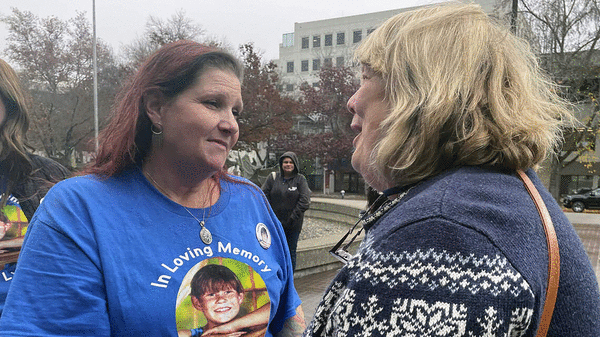
In a lawsuit filed directly with the state’s highest court, the groups said Newsom had ignored a California law requiring 10 days’ notice to victims and prosecutors before sentences can be commuted. Among the plaintiffs were Marc Klaas, whose 12-year-old daughter, Polly, was kidnapped in Petaluma and murdered in 1993, and Sandy Friend, whose 8-year-old son was abducted in Yuba City and murdered in 1996.
“Behind every one of these death sentences are victims, grieving families, and lives forever shattered,” Topo Padilla, president of Crime Victims United, said in a news release. “Many of these families were horrified to learn of the governor’s plans through the news rather than from the very government entrusted to protect their rights.”
California has not executed a prisoner since 2006, when Clarence Ray Allen died by lethal injection in the death chamber at San Quentin State Prison. Executions were initially stopped by lawsuits challenging the state’s lethal injection procedures before Newsom imposed a formal moratorium in 2019 and dismantled the state’s death row.
But prosecutors have continued to seek and win death sentences, which remain legal in murder and some other cases under California law. The state continues to hold some 548 inmates who have been sentenced to death since the 1970s in a process that costs millions annually and entitles them to appeals that can take decades to play out.
Of 204 condemned inmates who have died since 1978, just 15 were executed, two of them in other states, according to the California Department of Corrections and Rehabilitation. The remaining 189 died of natural causes, suicide or other reasons.
Newsom, who leaves office at the end of this year, announced Nov. 5 that he would commute all of California’s death sentences to life in prison without the possibility of parole.
“Many Californians feel that those who commit brutal crimes deserve to die,” Newsom wrote in an open letter to residents. “But as governor, I have concluded that the state cannot morally kill them.”
The move drew praise from opponents of the death penalty. But it also drew immediate pushback from law enforcement and victims’ rights groups, who said the sentences offered justice to families and reassured victims that those responsible would never be released.
The California District Attorneys Association argued that new and proposed criminal justice reforms could eventually allow parole for prisoners sentenced to life without the possibility of release.
“We are asking the court to uphold the law, respect the sanctity of jury verdicts and protect the rights of victims,” said former Sacramento County District Attorney Anne Marie Schubert, who is listed as a lead attorney on the case.
The Supreme Court has not yet said whether it will hear the case, which was filed directly with the justices rather than through the usual appeals process.
The lawsuit’s legal argument rests on a 2011 law requiring governors to give notice to crime victims and prosecutors before commuting a prisoner’s sentence.
The statute, cited by the high court in a 2015 opinion, grew out of a last-minute decision by former Gov. Arnold Schwarzenegger in 2011 to reduce the sentence of Esteban Núñez, the son of former Assembly Speaker Fabian Núñez, who pleaded guilty to voluntary manslaughter in a San Diego stabbing.
Schwarzenegger’s commutation, announced hours before the former actor and governor left office, provoked outrage and led to the passage of new rules.
The high court is already weighing Newsom’s commutations under a different state law that requires the approval of four justices whenever someone convicted of more than one felony seeks a commutation. That requirement would apply to 382 condemned inmates before their sentences could be changed.
The justices are also considering a separate lawsuit that could end the death penalty in California. Filed by the Office of the State Public Defender, the lawsuit argues that capital punishment is applied in a racially discriminatory manner and is therefore illegal.
_____
©2026 The Sacramento Bee. Visit sacbee.com. Distributed by Tribune Content Agency, LLC.






Comments