Ninth Circuit retroactively grants San Jose officer qualified immunity, taps California Supreme Court in 2020 George Floyd protest case
Published in News & Features
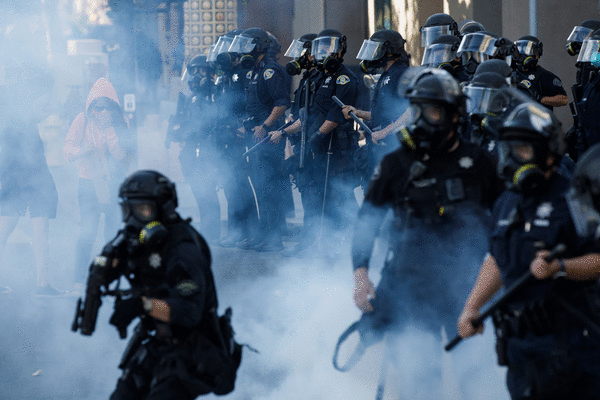
SAN JOSE, Calif. — An excessive force case from the 2020 George Floyd demonstrations in downtown San Jose continues nearly two years after a jury awarded more than $1 million to an injured protester, now that a federal appeals court has granted a police officer qualified immunity even though it agreed he used unreasonable force when indiscriminately firing projectiles into a crowd.
Kyle Johnson, the protester who was hit in the leg by a foam baton round fired by San Jose Police Department Officer James Adgar, claimed injuries that included a large circular bruise on the back of his leg and a blood clot he said diminished his ability to continue an active lifestyle. Jurors found Adgar and the city liable for First and Fourth Amendment violations, a Bane Act violation, battery and negligence.
But a Nov. 2 ruling by a three-judge panel from the 9th U.S. Court of Appeals reverses an earlier district court ruling that denied Adgar qualified immunity, a legal protection that shields government officials from civil liability for their work unless they clearly violate someone’s constitutional rights.
The judges held off on ruling on Johnson’s separate but related claims of civil rights violations under the state’s Bane Act, which protects citizens from interference with their constitutional rights “by threat, intimidation, or coercion.” The panel sent a certified question asking the California Supreme Court to define the Bane Act’s language describing “clearly delineated and plainly applicable” constitutional rights, and whether they are distinct from federal courts’ standard of “clearly established” constitutional rights.
After the original verdict, the city quickly signaled its intent to appeal, leading to the 9th Circuit opinion. Because the city did not appeal the battery and negligence verdicts, Johnson’s $1.3 million award is unaffected. At stake is the amount of legal fees owed to Johnson’s attorneys, which are held up pending the appeal. If the Bane Act claim is rejected, the city would not be liable for the fees; if it is upheld, the two sides and the district court will calculate how much the city owes.
Circuit Judge Richard Paez dissented from Judge Richard Tallman and Judge Mark Bennett and questioned how the panel could unanimously agree Adgar violated Johnson’s Fourth Amendment right to be free from excessive force but still insulate the officer from the liability that a jury declared through its $1.3 million award to Johnson in January 2025.
In the ruling, Tallman distinguished Adgar’s actions at City Hall plaza on May 30, 2020, from a 2012 precedent, Nelson v. City of Davis, which he wrote involved “an entirely peaceful, non-threatening subset of the larger group.” He contends that when Johnson was injured, “hostile actors in the crowd had repeatedly thrown objects at the police, and two such actors were in the subset of the crowd into which Officer Adgar fired.”
He further asserted that the officer “fired in response to a second volley of objects thrown from Johnson’s general area, indicating that the bad actors could reload and return for more volleys, which posed a continued safety concern. Those differences convince us that Nelson does not clearly establish that Officer Adgar’s use of force violated the Fourth Amendment.”
In his dissent, Paez wrote that because the Nelson case “clearly established the unlawfulness of shooting a projectile weapon capable of causing serious and permanent injury indiscriminately into a group of protestors who did not pose an imminent risk to public safety, Officer Adgar is not entitled to qualified immunity.” Paez also criticized the majority for retroactively citing precedents established after the encounter between Adgar and Johnson.
There is no clear timeline on when the state’s high court justices will decide on whether to weigh in on the outstanding Bane Act claim, and the remainder of the 9th Circuit appeal is on hold until they do. If the state court declines to review the matter, then the panel will proceed to decide the issue on its own.
“The Ninth Circuit’s ruling that Officer Adgar is entitled to qualified immunity is a positive development, but the case is not over yet,” San Jose City Attorney Susana Alcala Wood wrote in a statement to this news organization. “Although the two phrases sound essentially identical, California courts have not definitively established whether the ‘clearly delineated and plainly applicable’ standard is in fact identical to the federal ‘clearly established’ standard.”
The lead attorney for Johnson did not respond to multiple requests for comment for this story.
Johnson’s litigation was among a swath of civil rights lawsuits against the city from demonstrators injured by police in downtown San Jose while protesting the May 2020 police killing of George Floyd in Minneapolis. One lawsuit, filed by a group that included a bystander who lost his eye after being hit in the face by a police projectile, was settled in 2023 for $3.3 million. Another high-profile lawsuit covering other nonviolent observers involved a community activist and former police bias trainer who was infamously hit in the groin by a foam round at close range while trying to ease tensions between protesters and police.
SJPD drew national scorn for its heavy and prolific use of less-lethal munitions and tear gas, and the public and political fallout led to reforms including banning the use of rubber bullets and similar munitions as crowd-control tactics.
©2026 MediaNews Group, Inc. Visit at mercurynews.com. Distributed by Tribune Content Agency, LLC.





Comments