Zelenskyy hails progress after Witkoff and Kushner meet Putin
Published in News & Features
Ukrainian President Volodymyr Zelenskyy said progress had been made during a meeting with U.S. envoys in Ireland, hailing a prisoner swap deal and a decision to include Europeans in the next round of peace talks with Russia.
Speaking alongside U.S. negotiators Steve Witkoff and Jared Kushner following a meeting at Casement Aerodrome, a military airport in west Dublin, the Ukrainian leader welcomed a prisoner of war exchange deal.
“This is real result. This is very important,” he said. “We are happy that more than 1,000 of our people will come home.”
Negotiators also agreed that Europe will have a presence at the next round of peace negotiations, Zelenskyy said. “They will have a voice. This is important for us because the war is in Europe,” he said, following the meeting late Thursday.
His comments were echoed by Kushner. “We cannot conclude this deal without the Europeans being at the table,” President Trump’s negotiator and son-in-law said.
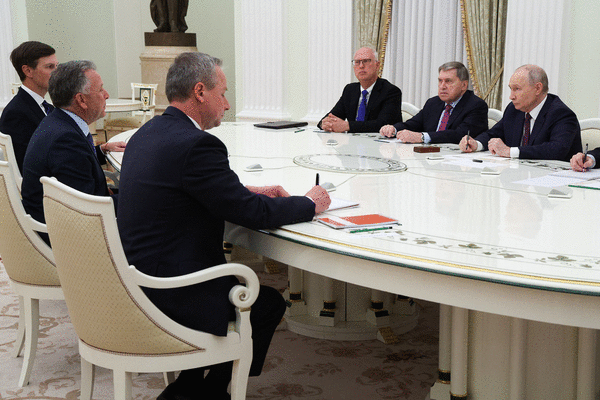
The meeting between the U.S. and Ukrainian sides took place hours after Witkoff and Kushner met Russian President Vladimir Putin in Moscow. However, Russia and Ukraine remained far apart on many issues including territory and security guarantees after the meeting. Neither side had changed positions, according to a person close to the Kremlin, who asked not to be identified discussing sensitive information.
In particular, Russia has been discussing changes to Europe’s security architecture, including troop presence in NATO countries, as a precondition for European involvement in any peace talks.
Some EU officials are open to have initial discussions on European security, according to people familiar with the matter. However, they caution that it should not be used as a delaying tactic and any substantive agreement would be after a Ukraine-Russia peace deal.
Still, several leaders gathering in Dublin for two days of meetings expressed skepticism about Russia’s motives and demands.
“Europe has an established European security architecture,” Costa said following Thursday’s meeting, which Zelenskyy attended. “Russia decided to undermine it by force, culminating in the invasion of Ukraine.”
Estonia’s Prime Minister Kristen Michal dismissed Russia’s fresh push to renegotiate Europe’s post-Cold War security arrangements as “mind games.”
Putin’s latest negotiation bid is a “trap” into which European governments mustn’t fall, he said.
“If Russia is a threat to Europe, then the last thing you do is discuss how to arrange your security architecture with the one who’s threatening you,” Michal said in an interview on the sidelines of the meeting in the Irish capital.
Any direct involvement by European actors in peace talks involving Russia would mark a significant development. Europe has found itself sidelined from the negotiations which have been largely managed by the U.S. and Russia, though European officials have participated in meetings ahead of key talks in Miami, Abu Dhabi and, most recently, on Thursday in Dublin.
Complicating matters is the fact that the European Union is divided about how much it should engage with Moscow.
Similarly, there are mixed views about who should represent Europe at any peace negotiations — and even if a single representative is necessary.
Big powers like Germany, France and the U.K. have at times taken the lead, while the leaders of Norway and Finland recently created their own direct channel to Putin. European Council President Antonio Costa even put out feelers to Moscow on behalf of the EU.
“It’s not about individuals now, but about Putin’s willingness to engage in talks,” German Chancellor Friedrich Merz said Thursday. Currently, he added, “there is clearly a growing willingness on the Russian side to acknowledge that one cannot talk about Europe without Europe.”
Earlier in the day, Zelenskyy told his European counterparts that Ukraine had again detected speed restrictions on Starlink in the temporary occupied parts of Ukraine.
Ukraine relies on Starlink terminals and SpaceX’s satellite constellation to access high-speed internet at frontline positions. Services cut out when a terminal travels faster than 161 kilometers (100 miles) per hour, complicating Ukraine’s ability to use the service to intercept fast-flying Russian jet-powered drones, Zelenskyy said.
The development threatens a repeat of the controversy last month when Ukraine reported similar limitations in its use of the system provided by billionaire Elon Musk’s SpaceX.
EU leaders will meet again Friday in Dublin.
_____
(With assistance from Ott Tammik and Andrea Palasciano.)
_____
©2026 Bloomberg L.P. Visit bloomberg.com. Distributed by Tribune Content Agency, LLC.






Comments