Tribal fishing persists amid Duwamish River's toxic industrial legacy
Published in News & Features
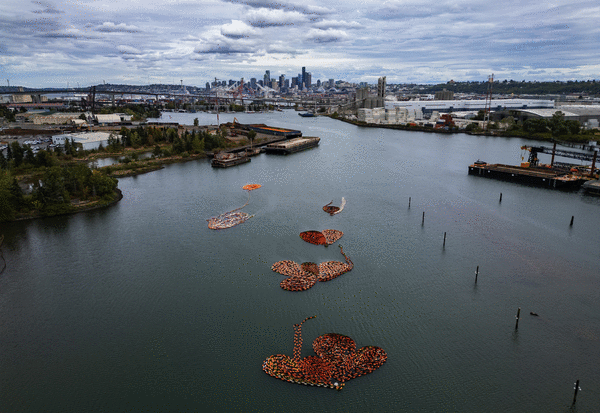
SUQUAMISH, Wash. — Stacks of shipping containers lined the banks of the Duwamish River as Simeon Barker, an officer for the Suquamish Police Department's Marine Division, navigated a boat through the waterway’s industrial maw on an October morning.
On his upper sleeve was a green patch featuring a double-headed eagle design symbolic of The Watchers," who looked out for trouble in a traditional Suquamish tribal story.
Barker's colleague, Bobby Andrews, peered through binoculars to identify passing watercraft by the letters on their hulls: SUN for Suquamish, MST for Muckleshoot. It's the time of year when tribal fishers frequent the river to catch the various salmon species swimming its waters.
"The Duwamish is one of the only places left that we have to fish," said Joshua Bagley, 45, vice chair of the Suquamish Tribe and a lifelong fisherman. "That's why it's so important to us."
The Duwamish River, which empties into Elliott Bay southwest of downtown Seattle, has long served as an economic corridor — first for Indigenous people, then for the region's settlers. Later came manufacturing and other heavy industry that spewed toxic chemicals into the river for decades, leading to a massive cleanup that remains underway.
Today, migratory salmon are the only fish caught in the Duwamish that are safe to eat.
The Suquamish Tribe and the Muckleshoot Indian Tribe flex their rights as two of the select Native American tribes that won a storied legal fight in the 1970s allowing them to fish the river, among other bodies of water. But some tribes, including the river's namesake, remain sidelined.
"I know that the Duwamish people have never been able to reap the benefits — economic benefits — of the river," said Desiree Rose Fagan, who is Duwamish. "Our land has been used, our river has been used, and there's been nothing given in return."
Generations of fishing
In late September, a fisherman sporting bright orange waders grappled with a net on a small boat floating in the middle of the Duwamish River. As far as the eye could see, nets were attached to pilings on the shore. While limited fishing is permitted on the river, only tribal fishers are allowed to catch salmon on the Duwamish using nets.
"Indigenous peoples fish and have fished this river in harmony with the cycles of the seasons for tens of thousands of years," signs installed on a nearby pier read. "Nets have been used to harvest salmon since time immemorial."
It's a sentiment shared by Rob Purser, treaty protection and fisheries director at the Suquamish Tribe. The 69-year-old tribal elder described the Duwamish River as a waterway "that our ancestors have always fished on."
But in the 1960s, state officials sought to restrict Native fishers, who were assaulted and jailed by police for attempting to fish — even though treaties dating back to the 1850s between tribes and the federal government guaranteed them that right.
Then came the 1974 decision by late federal Judge George Boldt in U.S. v. Washington. Over a dozen Washington tribes emerged victorious from the Fish Wars and have since co-managed local fisheries alongside the state government.
Purser remembered fishing on the river for the first time in 1975.
The Duwamish River is a source of both wild and hatchery fish. Through the 1970s and 1980s, Purser depicted the salmon harvests as consistent. Now, "numbers aren't as great as they used to be," he said. "It's been hit and miss."
Salmon fishing season typically kicks off in the summer, starting with Chinook, otherwise known as king salmon.
"The Duwamish used to be probably the largest Chinook river in the Salish Sea at one time," Purser said, though canneries established by settlers overfished the waterway.
"A right to take fish is hollow if there are no fish," said Jason Schaffler, director of the Muckleshoot Fisheries Division. "A price cannot be placed on its cultural significance."
From September onward, the harvest is largely made up of coho and chum salmon.
The Suquamish Tribe's fishers can make a living by selling their catches to Suquamish Seafood Enterprises, a tribal business entity established in 1996. The seafood wholesaler is in Poulsbo.
Purser recognizes that other Natives may not have the same opportunity.
"There's tribes that don't meet the criteria to be federally recognized," he said. "I understand some of their challenges, but most of those folks that are trying to be recognized as a tribe are members of other tribes already."
"A lot of them were combined," Purser added.
For instance, many Duwamish descendants also belong to the Muckleshoot, Puyallup, Tulalip or Lummi tribes.
'What the river has become’
Emerging from the warmth of the Duwamish Longhouse and Cultural Center, about two dozen people accompanied Joselynn Tokashiki, manager of the Heron's Nest outdoor education center for Duwamish Tribal Services. During a brief lull in the afternoon rain, they followed a trail to the river on an eco-tour in September.
Past blackberry brambles and other greenery, the group gathered at a vantage point overlooking Kellogg Island, which was previously referred to as Mud Island. Today, the view of the Duwamish River from the grassy park is framed by towering port cranes, though a Native village once stood nearby.
Fagan's ancestors resided in a village site on the waterway's south end. "We've been here since time immemorial," said Seattle-born Fagan, 42. They hosted salmon ceremonies to honor the river's fish.
However, by the late 19th century, Duwamish longhouses burned.
Industry supplanted the land's original inhabitants. The Seattle Electric Company built the Georgetown Steam Plant close to the river at the start of the 20th century. In the early 1900s, human-made Harbor Island was built in the waterway's mouth.
Over the years, facilities producing asphalt, steel and aluminum products and chemicals sprang up. Municipal sewage dirtied the river. Boeing operated two plants along the riverbank by the 1930s and still maintains a huge footprint along the Duwamish.
The U.S. Environmental Protection Agency has classified 5 miles of the river as a Superfund site, or an extremely polluted location marked for cleanup, since 2001. It put some of the onus on industries for releasing decades of toxic chemicals into the waterway.
Earlier this year, the federal agency announced an agreement — now finalized — that directs Boeing, Seattle and King County to restore the Duwamish River. The project is expected to span a decade, with an estimated cost of around $668 million.
For now, King County advises against eating contaminated “resident seafood” like perch, flounder and crab, with salmon serving as an exception because they spend much of their life elsewhere.
"It's difficult to see what the river has become and the way that it has been used and abused," said Fagan, who lives in University Place, Pierce County. "The wealth of the river was built on the backs of the Duwamish people."
Even today, the Duwamish lack fishing rights — and federal recognition as a tribe. Others, like the Chinook and Steilacoom, are in the same boat.
The Duwamish submitted their petition for federal recognition in 1987. The Bureau of Indian Affairs published a proposed decision denying it in 1996.
The federal office confirmed the group is made up of Duwamish descendants. However, the bureau said the organization has functioned for limited purposes since 1925 — not "continuously since the time of first sustained contact between the historical Duwamish tribe and non-Indians," per a news release. The Duwamish have disputed this claim.
At the very end of former President Bill Clinton's time in office, the tribe was granted recognition. Former President George W. Bush's administration later rescinded it.
"It's painful that our tribe is still not federally recognized, that our treaty rights have not been upheld," Fagan said. "It's hard to be Duwamish, I will say."
In addition to Duwamish, Fagan is of Suquamish, Tulalip, Chinook, Cowlitz and Quinault descent.
Even if the tribe were granted federal recognition, it wouldn’t guarantee fishing rights, explained Kristina Pearson, executive director of Duwamish Tribal Services.
"Unfortunately, recognition and fishing are two separate things," she said.
Pearson, 42, drives the length of the river when she commutes from Bonney Lake, Pierce County, to work in her hometown of Seattle.
"It's always a sensitive time of year, too, when you start seeing the fishermen come out," she said. "It does feel like a punch in the stomach.
©2026 The Seattle Times. Visit seattletimes.com. Distributed by Tribune Content Agency, LLC.






Comments