Gov. Josh Stein touts budget plan. Is NC Senate to blame for lack of teacher raises?
Published in News & Features
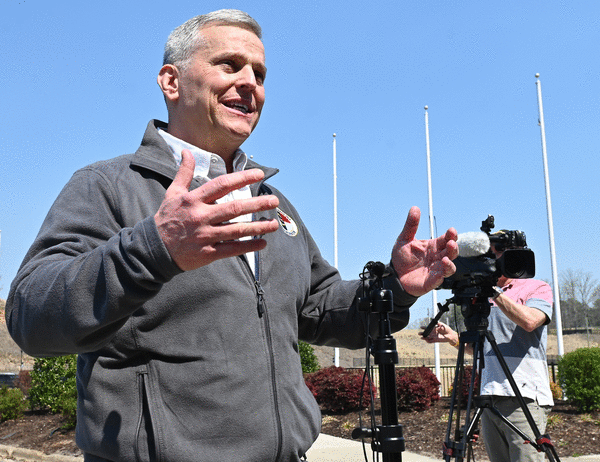
Governor Josh Stein told north Mecklenburg educators Thursday he’s “hopeful” state lawmakers can pass long-awaited teacher pay raises during the legislative session that begins April 21.
“But, then again, I was hopeful they would pass a budget last year,” he added. “And last year, 49 states passed a budget. North Carolina did not.”
Stein, along with Lake Norman-area state Rep. Beth Helfrich, visited Davidson Elementary School Thursday to talk to educators. Stein was there, in part, to promote his “critical needs budget,” which calls for an average raise of 5.8% for teachers.
North Carolina remains the only state to have not passed a budget for this fiscal year, which began in July, as lawmakers maintain a prolonged standoff over tax cuts. Without a budget, the state operates off of the last one passed. That means teachers and other state employees have continued to be paid based on a biannual budget passed in 2023, with no raises from the state yet this year.
The House and Senate disagree on several key issues, and among them is teacher pay. While the House, like Stein, say they’re eager to give educators more money, the Senate is keeping its purse strings tighter.
As a result, combined with increases to health insurance premiums and cost of living increases, teacher compensation dropped 1% this school year, according to the “Highlights of the North Carolina Public School Budget” report released in March by the state Department of Public Instruction.
Teachers and public education advocates’ calls for action are only growing louder. North Carolina Association of Educators is encouraging teachers to call out of work on May 1 for a march in Raleigh to call attention to the cause.
When it comes to how much is enough, Stein said North Carolina has to exceed teacher pay in neighboring states. Right now, North Carolina ranks last in the Southeast for educator pay and 43rd in the nation overall.
“We have to have a budget that meets the needs of our people and invests in them so that we have every opportunity to succeed,” Stein told The Charlotte Observer Thursday.
Teachers at Thursday’s event said the lack of state pay raises have taken a toll.
“It definitely has had an impact,” said Anita Walker, a first grade teacher and single mom. “My oldest son is a senior in high school and potentially going to college soon, so it could definitely benefit my family a lot if we were to pass the budget and get a raise.”
It’s ironic, Walker said, because she initially moved to North Carolina from her native South Carolina in 2000 due to teacher pay at the time.
“So, it’s kind of full circle that now South Carolina has higher pay,” Walker said. “I’m thinking ‘Should I go home?’”
What potential raises are on the table?
The North Carolina House of Representatives and Senate have each passed their own versions of a comprehensive budget, but they remain far from agreement on teacher pay.
Stein’s budget proposal calls for a 13% increase to beginning teacher pay – which currently sits at $41,000 – and an average pay raise of 5.8% for teachers. It also calls for reinstatement of higher pay for teachers with master’s degrees.
The House’s budget includes an average raise for teachers of 8.7%, bringing beginning teacher pay to $50,000 and restoring increased pay for teachers with master’s degrees.
“I can tell you, from the House side … we want meaningful raises,” Republican State Rep. Brian Biggs of Randolph County said April 7. “Education, to me, is not something we can trade off or something we can negotiate.”
The Senate’s proposed raises for teachers, however, are less robust, coming in at an average of 2.3% and bringing beginning teacher pay to $41,510. Its plan does not include increased pay for educators with master’s degrees.
When asked whether he places blame for the budget stalemate with the Senate, Stein didn’t give a “yes” or “no.”
“There are a few issues that are in dispute between the House and the Senate. I believe that we need to set the state up for long-term fiscal success,” he said. “There were definitely elements of the House budget that I thought positioned the state much better than in the Senate.”
In March, long-time NC Senate Leader Phil Berger lost the Republican primary for his seat by 23 votes to Rockingham County Sheriff Sam Page. That could mean different dynamics in the chamber as Berger nears the end of his tenure.
Charlotte-Mecklenburg Schools plans
Charlotte-Mecklenburg Schools leaders are assuming the state will pass a 3% raise based on past years’ data, and they’re creating the district’s budget based on that assumption.
CMS Superintendent Crystal Hill plans to ask the county to fund a 5% average increase to teacher supplements, which is additional local money allocated to beef up the teacher pay provided by the state. Supplements in CMS currently range from about $8,000 to $14,000.
Hill told the CMS school board in March that increases to supplements and pay increases from the state are both necessary to make CMS competitive in the job market.
“We have to have both … because it is more expensive to live in Charlotte-Mecklenburg than in, for example, some parts of Union County,” Hill told board members March 24. “So, I’ll continue to ask for 5% (supplement increases) even if the state raises the pay … We want people to live here, not just work here.”
_____
©2026 The Charlotte Observer. Visit charlotteobserver.com. Distributed by Tribune Content Agency, LLC.





Comments