Bring back the grizzly bear to California? Bill to study the effort advances
Published in News & Features
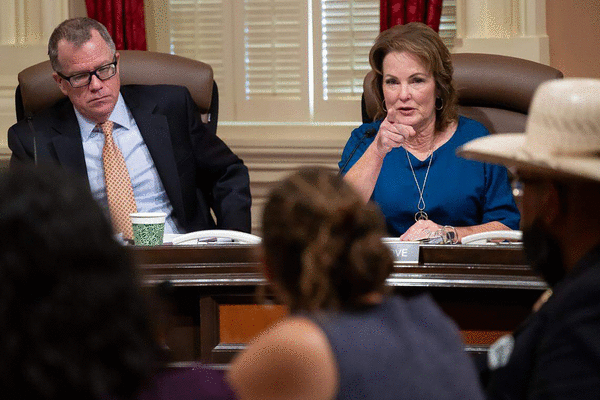
California lawmakers on Tuesday moved forward on a bill that could lead to the re-introduction of grizzly bears to the state, more than a century after the quarter-ton predators were hunted into local extinction.
The measure, which is backed by two Native American tribes, calls for a comprehensive study on the feasibility of bringing back the golden bears that festoon the state’s flag.
Language that would have declared it the policy of the state of California to reintroduce them was removed and it was amended to focus on studying the possibility of bringing back grizzlies. The bill faced opposition from ranchers and law enforcement officials who say the state is already unable to handle resurgent populations of wolves, mountain lions and other predators.
“This bill will lead us on a journey to re-establishing a relationship with grizzly for all Californians,” said Tiana Williams-Claussen, director of the wildlife department of the Yurok Tribe, which is co-sponsoring the bill with the Tejon Tribe.
The measure passed the state Senate Natural Resources and Water Committee with an initial vote of 4-1, and will next be heard by the Senate Appropriations Committee.
Predator ranks growing
California is struggling to manage the behavior of other predators whose ranks are growing thanks to the state’s conservation programs and endangered species protections.
Conservationists celebrated when wolves — which were rendered locally extinct in 1924, the same year that the last grizzly was killed — migrated into the state from Oregon 15 years ago. Under state and local endangered species act protections, their numbers grew to about 70 animals in 10 packs.
But last year a single pack was responsible for killing about 100 calves in less than seven months in the high ranchland of Sierra County north of Truckee, costing ranchers and the state millions and terrifying residents. In 2024, a mountain lion killed a man in El Dorado County, and in 2023 a black bear killed a woman in her own home in Downieville.
At a legislative hearing called to address escalating concerns about wild predators, including coyotes, Wade Crowfoot, the state’s top environmental officer, called the situation a crisis. The California Department of Fish and Wildlife, which would be responsible for managing any population of grizzlies, is facing budget cuts in both its biodiversity conservation program and its law enforcement division, which employs game wardens and wildlife officers.
Already, the department is overburdened, leaving the responsibility for handling many attacks by wolves and other predators to local law enforcement, said David Bess, a retired chief of CDFW’s enforcement division.
“Advancing this proposal at this time will place unrealistic demands on the California Department of Fish and Wildlife and risk compounding existing carnivore management challenges,” Bess told the committee.
Sierra County Sheriff Mike Fisher, whose department was tasked with responding to last year’s rash of wolf attacks, told the committee he opposed the measure “until CDFW can manage the current apex predators we have in California.”
Work with opponents
But Sen. Laura Richardson, who represents parts of Los Angeles County including Torrance and Inglewood, promised to work with opponents of the bill to make sure that their concerns were addressed in the study if it is eventually approved.
She pointed to her decision to remove the language declaring the state’s intention to restore grizzlies to the landscape and said she would add the potential impact on ranchers and other human settlements of bringing back the golden hump-backed bears.
It was a promise that Rick Roberti, president of the California Cattleman’s Association, welcomed.
“This is just the beginning,” said Roberti, who said he opposed the bill, “at this time.
“If it happens, I want to make sure it is going to be done in such a way that our members are protected,” he said.
Richardson said that the loss of grizzlies disrupted the state’s ecosystems and eliminated an animal that was so synonymous with California that its image remains on the state flag, on water bottles and in the names of its university teams. Grizzlies were viewed as relatives by many tribes and played an important spiritual role.
“Their rapid demise was not due to habitat loss or lack of food, but the direct result of deliberate extermination efforts by a small number of settlers, miners, ranchers and government agents who hunted, trapped and poisoned them relentlessly,” she said.
Now, she said, the state could begin to rectify that — or at least conduct a study to see if reintroduction makes sense.
“Now is the moment for California to explore the possibility of reconnecting us truly to the grizzly bear,” she said. “And not just (on) a water bottle.”
____
©2026 The Sacramento Bee. Visit at sacbee.com. Distributed by Tribune Content Agency, LLC.






Comments