Hope calls to them, fear keeps them away: South Florida Venezuelans on returning home
Published in News & Features
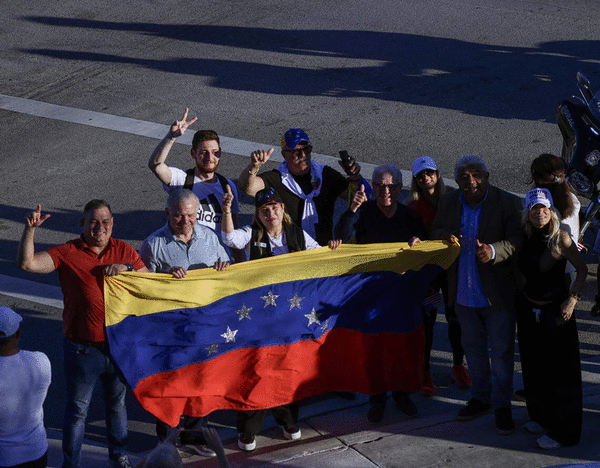
MIAMI — Three months after Venezuelans woke up to the news that strongman Nicolás Maduro had been captured by U.S. military forces and taken to New York to face drug-trafficking charges, many in South Florida and elsewhere are still weighing a question that has lingered for years: Are they willing to return home?
For Victor Jiménez, the answer is yes — but not right away, and only under certain conditions.
Jiménez, 58, left his hometown of Barquisimeto, in western Venezuela, eight years ago after what he described as years of rampant crime.
“It was an absolute disaster. They made a complete mess of Venezuela,” Jiménez said. “I was robbed and kidnapped several times. That’s why so many of us ended up leaving.”
Jiménez’s concerns echo a broader trend across the Venezuelan exile community in South Florida and elsewhere in the state: Security consistently ranks as the top factor influencing decisions about returning home.
Venezuelans living in South Florida celebrated the ouster of Maduro on Jan. 3 and view the U.S. action as a crucial step toward political change, even as questions remain about who will eventually lead the country. Many, however, describe their decision about returning as deeply complicated.
Over time, many have built families, careers and social networks far from home, transforming communities and economies well beyond Venezuela’s borders. In the United States alone, recent estimates put the Venezuelan‑origin population at around one million, a community that has expanded rapidly in recent years as migration accelerated.
Jiménez, a businessman in Doral — the South Florida municipality with the largest concentration of Venezuelans in the United States — says he is hopeful his homeland could eventually transition toward democracy and that he might return some day — but not immediately.
He identifies himself as a supporter of opposition leader María Corina Machado — whom many Venezuelans view as a symbol of democratic hope — and also counts himself among those in the community who have expressed support for President Donald Trump’s stance against Maduro. Yet his family’s decision to return is not an easy one to make. Jiménez said he and his wife have already built a life in the United States, particularly for the sake of their children.
“Our kids are in the university,” he said. Perhaps, he added, the answer is “not to return permanently right away, but to start rebuilding our life again in Venezuela so that eventually we can go back.”
Consolidating power
After the initial wave of celebrations abroad following Maduro’s capture faded, the sweeping changes many had hoped for have yet to fully materialize. Maduro’s former vice president, Delcy Rodríguez, now leads the country, consolidating power while relying on key figures tied to the previous regime.
During Rodríguez’s time in office, the U.S. and Venezuela have moved to restore diplomatic relationship as well as business ties in the oil sector and expand economic cooperation.
The recent improvements have not translated into a dependable rule of law or effective legal protections in the South American country — a factor that Venezuelan legal experts say remains a critical security concern.
Doral resident Liduzka Aguilera, a former criminal attorney who fled Venezuela due to political persecution and sought asylum in the United States, says her country remains trapped in a legal and institutional crisis.
“The Constitution and the laws continue to be systematically violated, leaving citizens without any real protection from the state,” Aguilera said. “Far from any genuine change, the so-called transition is being led by the same actors linked to the ruling power — many of whom have been implicated in corruption, repression and ties to criminal organizations. The conditions that forced millions of Venezuelans to flee have not changed in the slightest.”
Rodríguez has introduced a series of cabinet changes that experts say do not sideline the military but instead reposition it. She appears to be following a strategy reminiscent of Hugo Chávez: redistributing power within the armed forces by rewarding loyalists, rotating key figures, demoting others, and removing those who risk accumulating too much influence.
Aguilera, 55, lost her Temporary Protected Status when the Trump administration ended the program last year and has remained in the country with a pending asylum claim.
She highlighted the rise of Gustavo González López, a longtime figure within Venezuela’s intelligence apparatus, as a sign that the country’s repressive structures remain entrenched. Aguilera noted that his recent appointment as defense minister places a seasoned intelligence official in one of the country’s most powerful posts, overseeing the armed forces.
González López built his career within SEBIN, Venezuela’s intelligence service, serving multiple terms as director and facing U.S. and international sanctions over alleged human rights abuses — including repression of political opponents and arbitrary detentions.
Aguilera added that the government in Caracas often portrays Venezuelans abroad as enemies, or treated as if they no longer belong. “There is no mechanism to guarantee a safe return; on the contrary, the risks have increased.”
Long-term perspective
For some Venezuelans in South Florida, returning home is no longer part of immediate life plans. Mario Benedetti, an automotive industry businessman in Miami, rebuilt his life almost two decades ago and has no desire to go back, even if there are improvements. After emigrating in 2009, he now runs multiple car dealerships, a body shop and insurance businesses across Miami-Dade, employing more than 340 people.
Despite being optimistic about potential changes, Benedetti says he has no plans to return or invest in the country.
His education and early business experience were shaped in Venezuela, and starting over in the United States proved far more challenging than expected.
“It was essentially starting from scratch — or at least navigating a steep learning curve,” he said. “Even though it was the same business model, everything was different. It wasn’t just adapting to a new culture; the way business works here is completely different from what I had known in Venezuela.”
Now, Benedetti says, returning would mean repeating that process all over again, in a country he no longer recognizes.
“The people have changed; the country itself has changed in so many ways,” he said. “I would have to start all over once again — and at 62 years old, I don’t have the desire or the energy to do that.”
Benedetti left 17 years ago with his wife and children, fleeing escalating violence. They were from Cumaná, an eastern city in Venezuela where armed groups have long operated near the Colombian border, and he said the danger was personal: his daughter, who was 8 at the time, was at risk of being kidnapped by Colombian FARC guerrillas, which had a presence in border areas and was known to carry out kidnappings.
He had to negotiate directly with the guerrillas, he said. “The police were involved. All of this was a very, very, very complex process — very difficult.”
‘This is my home’
The caution among Venezuelans abroad — and the reluctance of many to return even in the event of a democratic transition — contrasts with remarks by opposition leader Machado, who has said in several interviews that a return to democracy would enable millions of exiles to come back and help rebuild the country, framing their return as a central goal of the transition.
Gustavo Rodríguez, a chef and dog trainer who has lived in the United States for more than 26 years, ruled out the possibility of returning to Venezuela.
“This is my home,” Rodríguez said. “If I were to go back, it would only be for a visit — like a vacation.”
Rodríguez, 52, who lives in Fort Lauderdale, left Venezuela in 1999, the year Chávez took office, and said his departure was directly tied to the fear and uncertainty many Venezuelans felt at the time. Even if conditions were to improve, he said, returning permanently isn’t something he envisions; he has spent roughly half his life in the United States and now considers it home.
“I live here now; all my friends left, my whole family is here,” he said. “I haven’t been back there in 26 years.”
His experience reflects a broader trend among his community abroad, where as many as 9 million Venezuelans now live in more than 90 countries: Many who left years ago have established deep roots in their host countries and are unlikely to return permanently even if the country moves to democracy.
‘If it truly becomes free’
María Arrieta is among those who left Venezuela seeking stability. She emigrated more than two decades ago amid the country’s deepening economic crisis and insecurity.
“I didn’t want to bring children into the world only for them to suffer hardship and have no future,” she said.
Arrieta, 45, works as an insurance agent in Jacksonville, where she has lived for the past eight years after spending 15 in Miami. Like many Venezuelans, she has rebuilt her life in the United States. A year and a half after arriving in Jacksonville, she and her family bought a home.
She does not miss Venezuela, she said, and has no immediate family there. Her sister and mother are in the United States and her father died over a year in this country. Still, Arrieta holds on to a dream: to live out her last years in her native Maracaibo, the country’s second-largest city.
“Our plan is to retire in Venezuela,” she said, “if it truly becomes free.”
That uncertainty is shared by many Venezuelans who no longer believe a democratic transition will happen as quickly as once hoped. The lack of confidence in dismantling the system originally imposed by Chávez makes them cautious about returning home.
For Arrieta the decision to stay in the United States is deeply personal: Both of her children were born in the United States. Her eldest is about to turn 21, which could allow her to apply for permanent residency.
Worries about retiring in U.S.
Another major concern shaping her decision is her youngest son, 10, who has autism. In the United States, he receives specialized support at school that allows him to make progress, something she fears would not be possible in her homeland.
“In Venezuela, there is no inclusion, no empathy,” she said.
Even so, Arrieta cannot picture herself growing old in the United States. She describes it as a country built for young people.
“The United States is very lonely and cold for older people,” she said, adding that she worries her retirement savings alone may not be enough. “My husband doesn’t want to be working here at 70. He wants to rest. That’s why we’ve already started saving, to invest in Venezuela.”
Their plan is to someday buy a farm in Venezuela. Her husband studied agronomy, and his family once owned farmland, a life they hope to rebuild.
When she imagines her homeland’s future, Arrieta looks to the past, to the country she remembers before chavismo, “a Venezuela with decent, well-paid jobs, where the health system works, where we can feel safe.”
Until then, her closest dream is more immediate: to show her children the country they have never seen — and to bury her dad, who longed to return home: “I want to take my father’s ashes to Venezuela.”
Safer abroad, but uncertain
For many Venezuelans in the U.S., the daily struggle to rebuild their lives has not been easy. Even so, many questions whether going back home could ever be a safe option.
Valentina Veloz, 28, has been contemplating a return for some time, not because of the capture of Maduro, but because her partner, and the father of her only child, was deported to Venezuela by the Trump administration in October despite holding Temporary Protected Status.
Since then, Veloz, who has been in the U.S. since 2021, has struggled to raise her 20-month-old son by herself while earning a living on her own in Tampa. At first, she considered reuniting the family to the western Venezuela city of Valencia. But after Maduro’s capture, she grew increasingly fearful that political instability could put her child, a U.S. citizen, at risk.
Now, with her partner back in their homeland, she says she hears that Venezuela “is even worse than before.” Basic services continue to deteriorate, with frequent power outages disrupting daily life.
“The rationing of electricity has gotten even worse,” she said. “At least here, my baby has a better guarantee that his needs will be met.”
Intention to return
A month after Maduro’s capture, the Venezuelan Diaspora Observatory, a global nonprofit with offices in Miami and elsewhere that has tracked migration for over a decade, surveyed Venezuelans living in more than 50 countries including the U.S. According to the survey, 87% of respondents said improved security would be necessary before considering a return. Other key factors shaping that decision include economic stability, reliable public services, political stability and job opportunities.
Although “democracy” was not listed as a survey response, for many Venezuelans abroad the political system at home is not an abstract concept, said sociologist Tomás Páez, president of the Venezuelan Diaspora Observatory.
For migrants, he said, democracy is most meaningful when it translates into a sense of security — not only protection from crime, but also trust in the courts, respect for property rights and reliable access to basic services. Those conditions have steadily deteriorated during Venezuela’s prolonged crisis, contributing to widespread insecurity and institutional breakdown that many migrants cite as key reasons for leaving the country.
Over the past three decades, migration from Venezuela has accelerated dramatically. In the early 2000s, roughly 120,000 people were leaving the country each year as economic pressures began to build, Páez said. After 2013, as the country’s GDP sharply contracted and social and political conditions deteriorated, the exodus intensified dramatically. Annual migration reached an estimated 1.2 million people a year.
The poll results reflect the hesitation that many Venezuelans abroad have about going back.
Only 11% of respondents said they plan to return in the short term, while 10% would like to but not immediately; 19% plan to remain abroad, and 45% said they would consider returning if conditions improve.
Shaping Venezuelan from afar
The study, based on interviews with 1,204 Venezuelans over age 18, shows that the decision to return depends largely on structural changes — particularly improvements in security, political stability and economic opportunity. For most, returning is not an immediate plan but a future possibility.
Even as Venezuelans build new roots across the globe, their influence on the country they left behind continues. Páez said that whether through remittances, political advocacy or partnerships with civil society inside Venezuela, the exile community has become a force for change — not by returning physically, but by remaining engaged from afar, shaping the nation’s future from wherever they now call home.
“The Venezuelan population has been transformed,” Páez said. “Today it’s difficult to find a family that doesn’t have at least one member living abroad — a child, a parent, a grandparent.” For many living in exile, that enduring bond — shaped by family, memory and economic support — means Venezuela is never far from their daily lives.
“There is a mistaken assumption that people need to physically return to participate in rebuilding their country,” he added. “That’s not true. Participation does not necessarily mean physical return.”
For Benedetti and many others, the choice to stay abroad does not diminish their intention to help Venezuela, but reflects how deeply migrants have built new lives while still holding onto a homeland they continue to support in other ways.
“My vision is that the entrepreneurs currently in Venezuela who have struggled, who have endured the hardest of times for 26 years, and survived this catastrophe that befell us, they are the ones who deserve the opportunity to flourish right now,” Benedetti said.
“My vision involves helping anyone, offering advice, assisting them in whatever way I can, with my experience of over 41 years in the automotive business,” he added. “But as for me physically going back there to start from scratch all over again? No. That is simply not going to happen.”
_____
©2026 Miami Herald. Visit miamiherald.com. Distributed by Tribune Content Agency, LLC.





Comments