Chicagoans gather in Grant Park for 'No Kings' rally to protest President Trump's 'unconscionable' actions
Published in News & Features
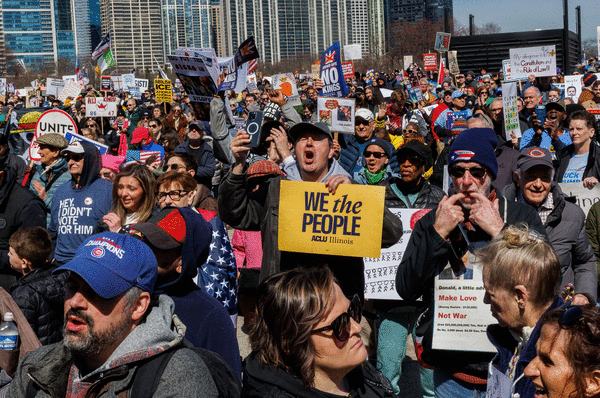
CHICAGO — Hours before the “No Kings” rally officially began, people from across the Chicagoland area streamed into Grant Park Saturday morning, carrying handmade signs, wearing anti-Trump regalia and blasting protest music that echoed through the park and surrounding areas.
Arriving at Butler Field with her family and a close friend around 11:45 a.m., Katie Bruli, 30, came from the Elgin area, saying she has attended each “No Kings” protest in Chicago. She carried a sign listing campaign promises she believes President Donald Trump has reversed since taking office, including pledges to lower grocery prices and avoid foreign conflicts.
“Everything (Trump) has ran on has been a broken promise and now he’s endangering tens of thousands of lives, possibly millions, with this war,” Bruli said. “That’s not even to mention ICE and everyone they’ve bullied.”
Bruli was among the hundreds expected to march downtown and across the suburbs Saturday for the latest “No Kings” rally, continuing the series of nationwide demonstrations opposing Trump’s administration.
Chicago’s rally kicked off at 1:30 p.m. at Butler Field in Grant Park. In a city that served last fall as ground zero for Trump’s mass deportation campaign, it was expected to highlight “attacks on immigrants and our democracy” as well as opposition to the war in Iran.
One issue that weighs heavily on Bruli’s mind is cuts to Medicaid. As a recipient herself, Bruli said she fears potential policy changes could leave her without coverage. “I’m not going to have any help next year, and that’s kind of terrifying,” she said.
Among the early arrivals, motivations for attending varied widely, but many shared a sense of urgency.
Leslie Travis, 75, walked along the Jackson Boulevard bridge toward the rally, adorning her hand-made No King’s apron. At its center was a yellow crown stitched with black, glittering lines crossing it out.
A South Side resident, Travis said she has been active in protests since moving to Chicago in 1968. She pointed to increased media coverage and the city’s response, such as adding public transit service and providing police protection for demonstrators, as evidence that public pressure can make an impact.
As a breast cancer survivor whose mother also survived the disease, Travis said her activism intensified at the beginning of Trump’s second term when federal funding for certain medical research programs was reduced.
“My mother and I were both in the same research study, generations apart. She did not die of cancer. I am not going to die of cancer because of the research studies that helped us,” Travis said. “But the idea that there are people who should be living through medical research studies and are going to die because funding has been just totally cut off is unconscionable.”
Since then, her concerns have broadened. She said she is particularly troubled by potential rollbacks to laws protecting diversity and Title IX, the federal law that prohibits sex-based discrimination in education programs.
“The idea that the administration is trying to cut back diversity, equity and inclusion measures for women, for Latinos, for Black women, for Brown women, for people of color makes no sense to me,” Travis said.
Also amongst the new arrivals, April, 59, and Greg Hamilton, 65, were concerned with many issues, including rising gas prices, the war in Iran, women’s rights and the SAVE America Act, a bill that would require additional verification for voting, which April Hamilton believed could disenfranchise many eligible voters.
Residents of Logan Square, the married couple said they both have served in the military, April in the Army and Greg in the Marines.
“When you serve in the military, you have a deep commitment to the United States and the democracy and the Constitution,” April Hamilton said. “The commander in chief is supposed to uphold the Constitution, and he is not doing that right now.”
“I liked serving my country, and I was proud to be here,” Greg Hamilton added. “But the moment that Trump got elected the first time, it just all went downhill.”
The couple began protesting years ago when their son, Corey Hamilton, now 27, encouraged them to get involved in activism during President Trump’s first term.
“I’m hoping that we have twice as many people as we had the last time now that people see what’s going on,” April said. “It’s time for people to stand up and take a stand against all this.”
Organizers were expecting roughly 3,000 similar demonstrations across the country on Saturday. In the Chicago area, marches are planned in Naperville, Western Springs and other communities.
“We will come together to show that our communities reject corruption, senseless war, and division,” MoveOn Civic Action Executive Director Katie Bethell said ahead of the march. “Instead, we welcome immigrants, believe in the rule of law, and stand up for an economy that works for everyone.”
During Operation Midway Blitz, the monthslong aggressive immigration enforcement campaign waged in Chicago, federal agents arrested thousands of immigrants, most of whom didn’t have a criminal record, and repeatedly deployed tear gas and pepper spray.
Chicagoans protested the campaign in a variety of ways, including carrying whistles, hanging “Hands Off Chicago” posters and showing up to large “No Kings” protests. Tens of thousands of people showed up to rallies in June and October, some of the largest protests in Chicago in recent memory.
©2026 Chicago Tribune. Visit chicagotribune.com. Distributed by Tribune Content Agency, LLC.



Comments