Maryland's online casino gaming bills are all but dead in General Assembly
Published in News & Features
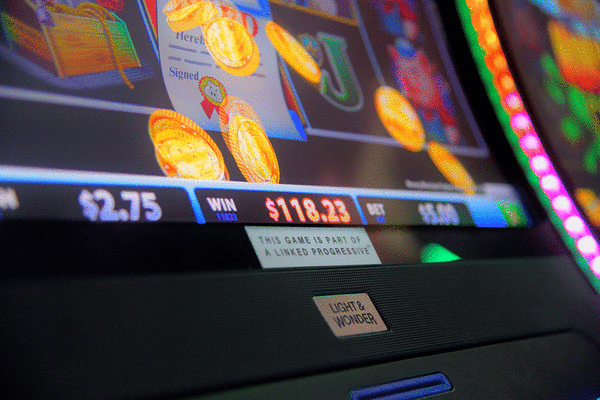
An effort to let Maryland voters decide whether to legalize online casino games is practically dead in the General Assembly, according to a chief sponsor.
Legislation introduced in both chambers would have placed a referendum on the November ballot on whether games such as blackjack and slots could legally be played on phones and other online devices.
Critics warned that Maryland already has enough gambling options, and that the new games can be dangerously addictive. Sponsors said that — with Maryland facing a projected $1.4 billion budget deficit — internet gaming, or iGaming, measures would have established an important new revenue stream without raising taxes.
“With the challenges faced by our budget, it’s disappointing that we have failed again to move forward in modernizing gaming in the state of Maryland,” Democratic Sen. Ron Watson of Prince George’s County told The Baltimore Sun. He said the legislation, if approved by voters, would have delivered $1.5 billion to the state over five years.
His bill was not passed by Monday’s “crossover” deadline, meaning the last day for the Senate or House to approve legislation and send it to the other chamber for consideration without requiring a special rule.
The iGaming bills faced opposition from the Maryland Center of Excellence on Problem Gambling, which says gambling issues have been growing in the state, especially among young men who grew up loving sports — and their phones — and can’t control their betting habits. Problem gambling is gambling that causes harm or disruption to a bettor’s life.
Blair Innis, the center’s government relations coordinator, said the state shouldn’t be making money “off the backs of addiction.”
Innis said in a text on Tuesday that “24/7, online access to gambling is highly addictive. The Center will continue to prioritize the public health of Marylanders and are glad this bill is not moving forward this year.”
Maryland has six casinos that, under state law, must share a portion of their revenues with the state. The casinos collectively contributed $831.3 million in fiscal year 2025, ending last June. Maryland also launched mobile sports betting in 2022, enabling gamblers to bet on professional and college games on their phones.
In 2024, the state House passed legislation permitting an iGaming ballot referendum, but it died in the Senate. Since then, some General Assembly leaders have urged the state to take a cautious approach to gambling, citing problem gambling concerns and saying expansion would compete with existing outlets such as sports betting that already benefit the state.
State taxes on companies’ sports betting revenue increased last July from 15% to 20%. Sports wagering contributed $89 million to the state in fiscal 2025.
Under Watson’s bill, most of the new proceeds would have gone to education — specifically, the Blueprint for Maryland’s Future Fund. He previously said the bill could have been amended to direct money toward a variety of concerns.
Watson noted that neighboring Virginia is considering a casino that could compete with MGM National Harbor — across the Potomac River in Prince George’s County — the state’s top revenue-producing casino.
“Virginia is making moves, and we are remaining stagnant,” he said. “We must understand we are in competition with our regional neighbors and we have to fight.”
________
©2026 The Baltimore Sun. Visit at baltimoresun.com. Distributed by Tribune Content Agency, LLC.






Comments