Cesar Chavez accused of abusing girls, raping fellow leader Dolores Huerta, newspaper inquiry finds
Published in News & Features
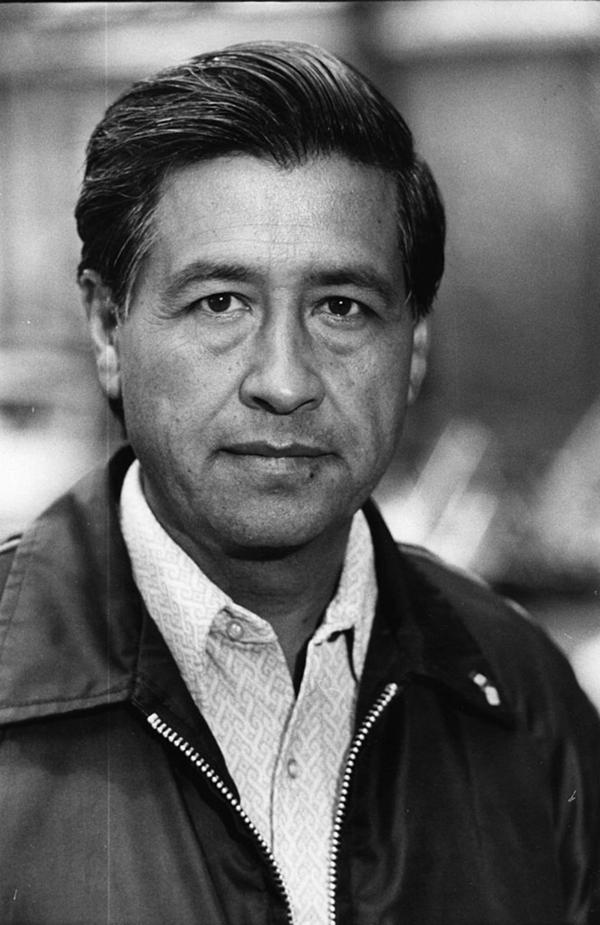
LOS ANGELES — Labor leader Cesar Chavez is accused of sexually assaulting two underage girls in the 1970s as well as fellow farmworker leader Dolores Huerta in the 1960s, according to an investigation from The New York Times.
The allegations have sparked public outcry from elected leaders and spurred a wider reckoning of a towering figure in California history — the namesake of many streets, parks and even a state holiday.
The New York Times interviewed two women who said they were sexually abused by Chavez, one repeatedly, when they were children. One of those women said Chavez raped her when she was 15.
“Both women have struggled with depression, panic attacks and substance abuse in the years since. They maintained their silence for decades, fearing speaking out would tarnish Mr. Chavez’s legacy, but decided in recent months, after being approached by reporters, that their stories also counted,” the paper reported.
Huerta told the paper that she was raped by Chavez in a grape field in Delano in 1966.
In an Instagram post, Huerta said she kept the incident secret for 60 years because she believed “exposing the truth would hurt the farmworker movement I have spent my entire life fighting for.”
In a statement to the Los Angeles Times, the Chavez family expressed their shock and sadness regarding the allegations.
“As a family steeped in the values of equity and justice, we honor the voices of those who feel unheard and who report sexual abuse,” the statement said. “This is deeply painful to our family.”
Huerta said she experienced two separate sexual encounters with Chavez. The first time, she was “manipulated and pressured into having sex with him,” she said, and felt she couldn’t say anything because he was her boss and the leader of a movement to which she was devoted.
“The second time I was forced, against my will, and in an environment where I felt trapped,” her statement said. “I had experienced abuse and sexual violence before, and I convinced myself these were incidents that I had to endure alone and in secret.”
Huerta became pregnant from both encounters and later arranged for the children to be raised by other families.
“Over the years, I have been fortunate to develop a deep relationship with these children, who are now close to my other children, their siblings,” her statement said. “But even then, no one knew the full truth about how they were conceived until just a few weeks ago.”
The New York Times’ investigation found Chavez fathered four children out of wedlock with three women and that there had been “whispers within the movement” for decades about his conduct.
The paper reported that a handful of Chavez’s relatives and former farmworker leaders have been aware of allegations of sexual misconduct for years, but it found no evidence that they made any efforts to investigate the accusations against him or acknowledge the victims.
“As family members, we also carry our own memories of the person we knew — someone whose life included work and contributions that matter deeply to many people,” the Chavez family statement said. “We hope that these conversations are approached with care, fairness, and compassion for everyone involved.”
Huerta said in her statement that “the knowledge that he hurt young girls sickens me. My heart aches for everyone who suffered alone and in silence for years.”
Leaders throughout California reacted with shock and outrage Wednesday.
Los Angeles Mayor Karen Bass released a statement honoring “every woman and girl horrifically harmed by those in power.”
“Dolores and leaders like her inspired so many of us to activism,” Bass said. “Mr. Chavez’s crimes do not diminish the courage of farm workers and workers everywhere who fight for their rights, equality for Latinos, and a stronger nation for everyone.”
L.A. City Councilmember Monica Rodriguez said the devastation caused by the allegations is being felt by victims, their families and everyone inspired by Chavez’s work.
“Honoring the broader movement for justice requires us to be honest about its history, even when that truth is painful,” Rodriguez said. “Accountability and compassion can coexist, and both are necessary to move forward with integrity.”
L.A. County Supervisor Janice Hahn said she believes it’s time to rename Cesar Chavez Day to “Farmworker Day” in the county. A number of California elected officials issued statements Wednesday in favor of renaming or otherwise altering observation of the March 31 holiday.
Gov. Gavin Newsom said the state will focus on honoring “a farmworkers’ movement and a labor movement that was much bigger than one man” when deciding how to handle Cesar Chavez Day.
“It’s about the movement. It’s about farmworkers. It’s about labor. It’s about social justice, economic justice, racial justice, all things that the movement has inspired and we should all be celebrating,” he said Wednesday at an unrelated news conference in Alameda.
Gaining national prominence in the mid-1960s in the San Joaquin Valley, Chavez galvanized public support on behalf of farmworkers after organizing community groups across Central and Southern California. For decades, agricultural laborers had lived in substandard housing and were paid terrible wages. Efforts to organize migrant laborers were usually crushed violently by farmers and local law enforcement.
But Chavez’s legacy became increasingly tarnished as the years went on. Labor victories became fewer and fewer. His fierce criticism of illegal immigration — Chavez argued that they undercut his unionization efforts — put him at odds with immigration activists. A 2006 L.A. Times investigation detailed how dozens of former associates and workers left the Chavez-led United Farm Workers because of what they described as his increasingly autocratic ways.
Chavez died in 1993.
The latest allegations publicly surfaced a day after the UFW said it would not participate in celebrations of its longtime leader due to “troubling allegations” against him, which it said “are incompatible with our organization’s values.”
“Allegations that very young women or girls may have been victimized are crushing. We have not received any direct reports, and we do not have any firsthand knowledge of these allegations,” the union said.
On Tuesday morning, the Cesar Chavez Foundation said it had become aware of “disturbing allegations” that its namesake had “engaged in inappropriate sexual behavior with women and minors during his time as President of the United Farm Workers of America.”
The foundation said it was working with leaders in the farmworker movement to be responsive to these allegations and support the people who might have been harmed.
Arnoldo S. Torres, a political consultant who has spent decades working on immigration and agriculture legislation at the state and national levels, was 10 years old and working as a seasonal farmworker when Chavez began organizing. He said he did not idolize Chavez after the leader went after undocumented migrants and encouraged people to report them to federal agents, but it was clear that Chavez became an intrinsic national figure for farmworker rights.
“It’s just a very, very sad day — just profoundly sad, all the way around,” he said in an interview. “If any of this is true, my lord, how do you ever associate him with the moral high ground?”
With so few Latinos to idolize, Chavez’s status was often fiercely protected, his image one of a national hero for farmworker rights and a champion of labor.
“I can’t say there was an element of disbelief because there has been talk in our community for a very, very long time that something like this was out there,” Torres said Tuesday. “But many of us made a very conscious decision that it couldn’t be true.”
Ana Padilla — the executive director of the UC Merced Community and Labor Center, which conducts research on farmworker communities — said Wednesday that the center “is greatly saddened at the news of abuse.”
Padilla said it was important to remember that the farmworker movement has always been about more than just Chavez. Today, decades after the movement began, farmworker-centered organizations and unions still play an important role in protecting workers against a modern system of oppression, she said. She praised the women and survivors “who made historic contributions in the shadows yet endured unimaginable harm.”
The allegations also raise the question about what, if any, repercussions the UFW or others could face.
“Even though Chavez is deceased, we must find out if there were co-conspirators who aided and abetted the abuse,” said Brian Claypool, one California’s most experienced attorneys in terms of cases involving sexual abuse of minors.
Walking his miniature poodle Lulu along Evergreen Cemetery in Boyle Heights, Fidel Flores said he heard about the allegations against Chavez while watching the evening news.
Flores, 71, said he already had mixed feelings about Chavez. When he arrived in the United States in 1975, he would hear not just about the farm labor movement, but also how Chavez spoke out against undocumented immigrants.
“At the time, I didn’t have documentation and was in the country illegally,” Flores said. “To him, we were a stone in his shoe.”
Flores said the allegations against Chavez were still disappointing, especially given the Trump administration’s actions targeting immigrants and Latinos.
“It’s hard being a Latino right now,” he said.
_____
©2026 Los Angeles Times. Visit at latimes.com. Distributed by Tribune Content Agency, LLC.





Comments