Venezuela reshuffles military as Delcy Rodríguez removes defense chief
Published in News & Features
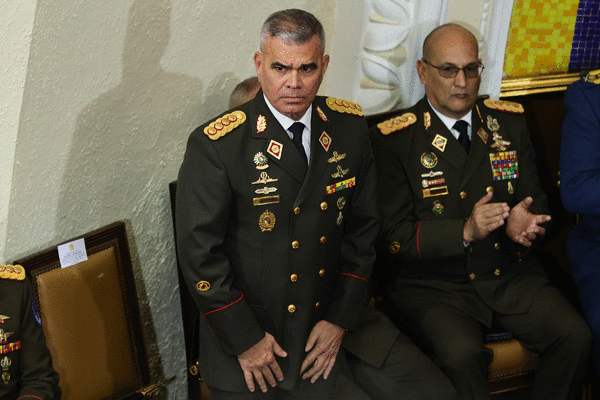
Venezuela’s interim president, Delcy Rodríguez, on Wednesday removed Defense Minister Vladimir Padrino López after more than a decade in the post and appointed Gen. Gustavo González López as his replacement, in a major shake-up of the country’s military leadership amid a fragile political transition.
The appointment of González López — a close ally of Interior Minister Diosdado Cabello — could strengthen Cabello’s control over the country’s powerful security apparatus, analysts say, at a pivotal moment when competing factions within the ruling coalition are maneuvering to retain influence following the capture of strongman Nicolás Maduro in a pre-dawn U.S. raid in Caracas in January.
“We thank Gen. Vladimir Padrino López for his dedication, his loyalty to the nation, and for having been, all these years, the leading soldier in the defense of our country,” Rodríguez said in a message posted on Telegram.
She added that the outgoing minister will take on “new responsibilities that will be entrusted to him,” without providing further details.
Padrino López had led the defense ministry since Oct. 24, 2014, when he was appointed amid a wave of anti-government protests that marked the beginning of Maduro’s first term. Over the years, he became one of the most powerful figures within Venezuela’s military establishment and a central pillar sustaining the Chavista government through political crises, sanctions and internal dissent.
His removal comes two and a half months after a U.S. military operation in Caracas and other parts of the country led to the capture of Maduro and his wife, lawmaker Cilia Flores, who are now detained in New York City facing criminal charges tied to drug trafficking and corruption.
Rodríguez emerged as Venezuela’s interim leader after that dramatic turn of events on Jan. 3, when U.S. forces carried out what Washington described as the culmination of a years-long criminal investigation into alleged “narco-terrorism” activities by the Venezuelan leadership. The operation abruptly ended more than a decade of Maduro’s rule and triggered a scramble among senior regime figures to stabilize the country’s governing structure.
In the immediate aftermath, senior officials within the ruling coalition and the National Assembly moved quickly to install Rodríguez as interim president. The arrangement was presented as a temporary mechanism to preserve institutional continuity while negotiations with the United States and other international partners unfolded.
Since then, Rodríguez’s government has been navigating a delicate and often opaque transition, balancing pressure from Washington to cooperate on corruption and criminal cases with the demands of powerful figures within Venezuela’s military and intelligence services, who remain wary of the rapidly shifting political landscape.
Against that backdrop, the removal of Padrino López — long seen as one of the regime’s most influential military power brokers — marks one of the most consequential personnel changes since Maduro’s fall.
González López, the new defense chief, is a veteran intelligence and security official widely considered close to Cabello, one of the most powerful figures remaining within the Chavista hierarchy. Since Jan. 6, he had served as commander of the Presidential Honor Guard while also leading the Military Counterintelligence Directorate, one of the country’s most feared security agencies.
He also headed the Bolivarian National Intelligence Serviceduring two separate periods, 2014-18 and 2019-24, and previously served as interior and justice minister and as commander of the Bolivarian National Militia.
Analysts and observers say his appointment could further consolidate Cabello’s influence over the state’s coercive apparatus by placing a trusted ally at the helm of the Defense Ministry at a critical juncture.
The move comes as Washington and Caracas engage in complex negotiations that could shape the future of Venezuela’s transition.
According to sources familiar with the talks, the discussions — which also include the potential extradition to the U.S. of businessman Alex Saab, a key Maduro ally — are part of a broader effort by the United States to push the interim government to demonstrate its willingness to cooperate with international justice and dismantle elements of the previous regime’s alleged criminal networks.
Among the most sensitive issues is the fate of senior security officials who remain in positions of power.
Both Cabello and Padrino López have been indicted by U.S. prosecutors and face multimillion-dollar rewards for information leading to their arrest. U.S. authorities accuse them of playing leading roles in the so-called Cartel de los Soles, an alleged drug trafficking organization that prosecutors say operated with the protection of the Venezuelan state.
Sources say Washington has not demanded that Rodríguez immediately hand over either official. Instead, the Trump administration has so far pushed for their gradual removal from positions of authority — a step viewed as essential to restructuring Venezuela’s military and security institutions during the transition.
Padrino López’s dismissal appears to align with that objective, though his reassignment to unspecified “new responsibilities” suggests the government is trying to manage internal tensions carefully rather than provoke a direct rupture with powerful military factions.
The elevation of González López, however, underscores the complexity of that balancing act.
While his appointment may be seen as a concession to Cabello and his allies within the security apparatus, it also raises questions about how far Rodríguez is willing — or able — to go in meeting U.S. expectations for dismantling the structures associated with the Maduro era.
©2026 Miami Herald. Visit at miamiherald.com. Distributed by Tribune Content Agency, LLC.


Comments