Havana will allow Cubans abroad to own businesses on the island, trade minister says
Published in News & Features
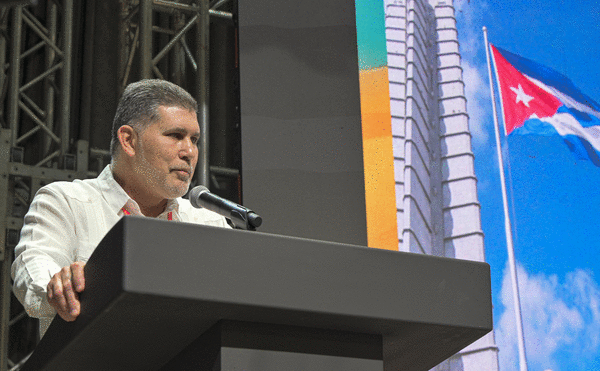
Cubans living in Miami and elsewhere will be able to invest and own private businesses on the island, the country’s deputy prime minister said Monday, confirming earlier reporting by the Miami Herald.
Oscar Pérez-Oliva Fraga told NBC News on Monday morning that “Cuba is open to having a fluid commercial relationship with U.S. companies” and “also with Cubans residing in the United States and their descendants.”
“This extends beyond the commercial sphere,” said Pérez-Oliva, who is a grandnephew of Fidel and Raúl Castro and also Cuba’s minister of foreign trade and investment. “It also applies to investments — not only small investments, but also large investments, particularly in infrastructure.”
On Friday, the Miami Herald reported that Cuban authorities were expected to announce measures leading to an economic opening, including for Cuban nationals abroad to own business on the island.
The announcement comes after the island’s hand-picked president, Miguel Díaz-Canel, admitted Friday that Cuba is indeed in talks with the Trump administration, weeks after the Herald broke news that members of Secretary of State Marco Rubio had met Raúl Castro’s grandson in St. Kitts in February. The grandson, Raúl Guillermo Rodriguez Castro, was seated in the audience in a government meeting in which Díaz-Canel first disclosed the talks and later in a news conference Friday, even though Rodriguez-Castro has no official title.
A source with knowledge of the conversations who asked not be identified to speak of the sensitive issue said Cuba’s move to allow Cuban Americans to own property and invest on the island — a major concession that Cuban leaders have been resisting for decades — is a direct response to the increasing pressure by the Trump administration to make reforms on the communist-run island.
Cuban nationals abroad had not been previously allowed to invest on the emerging private sector nor legally own their own businesses in the country. They also cannot vote.
Over the past few months, President Donald Trump put in place what amounts to an oil blockade, preventing oil from Venezuela, Mexico and other countries to reach the island, finally forcing Cuban leaders to negotiate. In recent days, he has urged Cuban authorities to reach a deal quickly.
“Cuba is a failed nation,” Trump told reporters Sunday aboard Air Force One. “Cuba also wants to make a deal, and I think we will pretty soon either make a deal or do whatever we have to do.”
Cuban officials have said the island has received no oil shipments from three months. The lack of oil has exacerbated the existing problems with Cuba’s crumbling electrical grid and led to nearly constant blackouts all over the island.
According to the NBC report, the deputy prime minister suggested the reforms aim at reviving a range of sectors, from tourism and mining to modernizing the crumbling power grid. Pérez-Oliva is expected to provide more details later Monday. Until now, the Cuban government has not allowed private businesses to invest in the country’s infrastructure.
Pérez-Oliva told NBC the U.S. embargo and other U.S. sanctions have made it difficult for the government to reform its economy. If Cubans in Miami – and U.S. companies in general – were to own businesses in Cuba, they would need authorization from the U.S. Treasury and Commerce departments that oversee the enforcement of the U.S. sanctions, which means that, ultimately, it’s in Trump’s hands to decide on whether U.S. capital can flow to Cuba again.
A law Congress passed in 1996, known as Helms-Burton, precludes the president from fully lifting the embargo until a democratically elected government is in place on the island. But the Trump administration can change regulations to ease sanctions in response to economic reforms in Cuba. Another major roadblock still lies on the Cuban side: Cuba’s legal system and constitution provide little protection for investors and private property. Without such changes, the large Cuban American fortunes and big American companies are unlikely to invest on the island, several experts and Cuban American businessmen have told the Herald in recent days.
It is unclear how far Cuban authorities would go in their efforts to reform the country’s economy, which stills follow a centrally planned socialist model that has proved ineffective and unable to sustain the population unless getting help from abroad. Still, on Saturday, Cuba’s foreign minister, Bruno Rodriguez, a hardliner, said talks with the United States do not “pertain to domestic affairs, constitutional frameworks, or the political, economic, and social models of the two countries.”
The publication on X, however, was only in Spanish, hinting it might be directed to domestic audiences.
_____
©2026 Miami Herald. Visit miamiherald.com. Distributed by Tribune Content Agency, LLC.






Comments