US intensifies strikes, rhetoric in Iran war as oil rises
Published in News & Features
WASHINGTON — The United States said it had stepped up strikes on Iran to unprecedented levels as both sides in the war threatened to escalate a conflict hitting its two-week mark and upending energy flows and global financial markets.
“They’re going to be hit. They can talk all they want but, you know, let’s see what they do,” President Donald Trump told Fox News Radio in an interview that aired Friday. “They’re going to maybe do something having to do with the straits, I don’t know, but they are being hit so hard, it’ll take them 20 years to rebuild.”
Earlier on Friday, U.S. Defense Secretary Pete Hegseth told a briefing at the Pentagon that the campaign is “on plan to defeat, destroy, disable all of their meaningful military capabilities at a pace the world has never seen before.”
The 14th day of the war marked the largest attacks yet against the Islamic Republic, with the U.S.-Israeli alliance hitting around 15,000 targets since the war began, Hegseth said. The Pentagon has sent a Marine expeditionary unit to the Middle East, The Wall Street Journal reported, citing two U.S. officials.
Oil prices edged higher once again Friday with Brent crude trading above $101 a barrel and U.S. oil rising above $96 a barrel by 12 p.m. New York time. U.S. crude is on track to end the week more than 6% higher after surging more than 30% last week as millions of barrels of oil remain trapped in the Persian Gulf and traffic through the vital Strait of Hormuz is effectively still at a standstill.
A series of moves from the Trump administration and other governments have so far had little effect on taming soaring energy costs for consumers. Asian countries are grappling with shortages of cooking gas and road fuel — and in the United States, gasoline prices at the pump are already at the highest levels in about two years.
The dollar, perceived as a haven in times of turmoil, has gained against all the other 16 major currencies since the war began. Most stocks and government bonds have sold off, with emerging markets particularly hard hit.
Iran’s Supreme Leader Mojtaba Khamenei on Thursday said the Islamic Republic would seek to ensure the Strait of Hormuz remains effectively closed. And in his first public comments since succeeding his father, he also warned Tehran would look to open other fronts in the war if the U.S. and Israeli attacks continue.
Hegseth said Iran’s supreme leader was “likely disfigured” in the U.S.-Israeli operation, and the fact that he had only released a written statement suggested his injuries prevented him from making public appearances. Trump in the Fox Radio interview said that Khamenei was “probably alive in some form.”
The U.S. also announced that the death toll for its military operation had risen. U.S. Central Command in a statement said all six crew members aboard a U.S. refueling aircraft that crashed in western Iraq Thursday were killed, bringing to 13 the number of American service members who have died. The loss of the plane wasn’t due to enemy or friendly fire, the military said.
Almost 2,600 people have died in the war, most of them in Iran, latest tolls from officials and nongovernment agencies show.
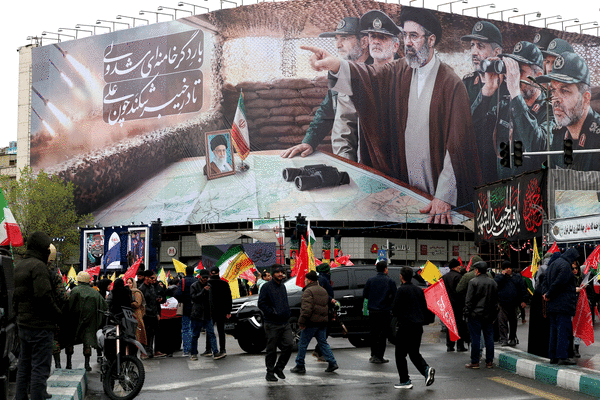
Pro-government rallies were held across Iran on Friday to mark Quds Day, an annual pro-Palestinian event. An explosion was reported a few blocks away from a march in Tehran, and Iran’s Tasnim news agency said a woman was killed in a U.S.-Israeli attack.
Pictures posted on social media showed Ali Larijani, the secretary of Iran’s Supreme National Security Council, and several government ministers participating in the proceedings.
Airstrikes on the Islamic Republic and Tehran’s retaliation across the Arab Gulf and against Israel continued into Friday.
A French military staffer was killed in an attack in Iraq’s Erbil region, French President Emmanuel Macron said in an X post. Reuters reported at least six French soldiers were wounded in the drone strike.
Turkey’s defense ministry said NATO neutralized an Iranian ballistic missile that entered the country’s airspace on Friday, the third such interception since March 4. Ankara has cautioned Iran against targeting its soil and expanding the scope of the conflict.
In Oman, two people were killed after drones crashed in the Sohar region, state media said Friday. Oman’s Port of Sohar has suspended operations. Dubai, the financial hub of the United Arab Emirates, reported missile threats and Saudi Arabia intercepted more than a dozen drones in its airspace.
Meanwhile, the U.S. Central Command has assigned investigators to look into an attack on an all-girls elementary school on the first day of strikes on Iran that killed about 180 people.
Several back channels have opened between Tehran and U.S. allies in recent days about reopening the Strait of Hormuz, according to people familiar with the matter, but they were downbeat the attempts would succeed. An Italian government official separately denied reports on talks with Iran.
Saudi Arabia, Oman and Turkey are leading ongoing mediation efforts, with the support of European countries and France taking a lead role. Qatar backed off from talks after it came under repeated attack.
Reuters cited UAE’s State Minister Lana Nusseibeh as saying she was confident the war will end in a negotiated settlement and that Trump “will lead us all to that moment” when he was ready to.
Strikes on three commercial ships in the Arabian Gulf over the past two days have highlighted the risk of expanding maritime-transport disruptions.
The blockage of the Strait of Hormuz has disrupted the flow of millions of barrels of oil a day, causing what the International Energy Agency described as the biggest hit to global supply on record. Saudi Arabia, Iraq, Kuwait and the United Arab Emirates have all have had to curb crude output.
The U.S. and Israel first launched airstrikes on Iran on Feb. 28, killing Supreme Leader Ali Khamenei, after accusing the Islamic Republic of pursuing nuclear weapons — an allegation Tehran has long denied. Iran struck back, firing missiles and drones at Israel and nations across the Gulf, plunging the region into crisis.
Almost 700 people have been killed in Lebanon, where Israel is battling Iran-aligned Hezbollah. A dozen Israeli civilians and two soldiers have been killed, according to the health ministry. Several more people in other Arab countries have also died.
_____
(With assistance from Mike Cohen and Devika Krishna Kumar.)
©2026 Bloomberg L.P. Visit bloomberg.com. Distributed by Tribune Content Agency, LLC.






Comments