Netanyahu says no guarantee of Iran regime change after war
Published in News & Features
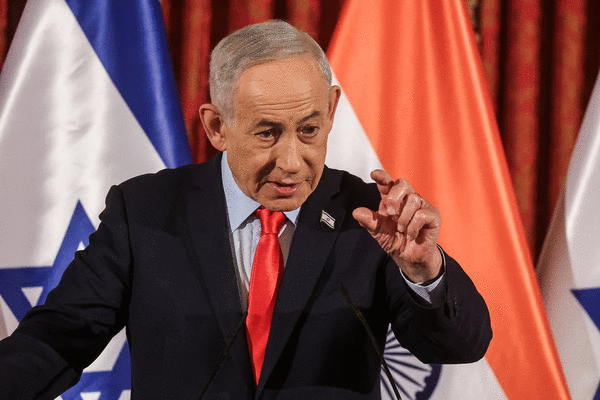
TEL AVIV, Israel — The U.S.-Israeli strikes have significantly weakened Iran and its clerical leadership but cannot guarantee regime change in the country without an internal uprising, Prime Minister Benjamin Netanyahu said in his first press briefing since the start of the war.
“We are creating the optimal conditions for a toppling of the regime,” the Israeli leader told reporters via a video conference, adding that forms of aid for the Iranian opposition will include airstrikes such as those carried out by the Israeli Air Force on Basij Force roadblocks and soldiers in Tehran a day earlier.
“But, again, I do not deny that I can’t tell you with certainty that the Iranian people will bring down the regime. A regime is ultimately brought down from within,” he said.
Both U.S. President Donald Trump and Mojtaba Khamenei — who succeeded his late father and previous supreme leader Ali Khamenei — struck defiant tones on Thursday, suggesting the war may not end in the near term. The younger Khamenei said in his first statement issued since taking power that Tehran will look to open other fronts in the war if the U.S. and Israel persist with their attacks.
Asked whether a lack of regime change would mean failure or repeated confrontations with Iran, Netanyahu did not directly answer but said the only way to ensure Israel’s continued existence and prosperity is to “be very strong.”
The Israeli premier asserted that the war was inevitable once Iran accelerated efforts to revive its nuclear and missile programs following the June 2025 conflict and conceal key activities and facilities underground.
“If we had not acted imminently, in several months Iran’s death industry would have been immune to any hit,” Netanyahu said.
Asked whether the new Iranian leader will be targeted, Netanyahu replied he wouldn’t recommend insurers to issue “a life insurance policy for any of the leaders of terror organizations.”
Khamenei’s threat of expanding the conflict came as Israel faces a resurgence of hostilities against Hezbollah. Exchanges of fire between the two sides, which began when the militant group joined Iran’s retaliation against Israel on March 1, escalated on Wednesday, when Hezbollah fired over 200 rockets and missiles and drones at Israeli communities and towns.
Israel has already carried out attacks on over 70 targets in Beirut in the past week by air and sea after warning residents of the Lebanese capital’s southern suburbs to leave.
Netanyahu said that Iran-backed Hezbollah will pay a “heavy price” for its attacks.
“I told the Lebanese government they were playing with fire, and if they don’t take their fate into their own hands, we will do so,” he said, adding that Israel is “holding very serious discussions on what to do next in Lebanon, not for the sake of discussions but for the sake of action.”
When asked about claims of divergence on strategic goals between Israel and the U.S., Netanyahu said the two countries have an “unprecedented alliance.” Donald Trump said Thursday that the relationship between him and the Israeli leader is “stronger than that of all former Israeli-U.S. leaders,” Netanyahu told reporters.
_____
©2026 Bloomberg L.P. Visit bloomberg.com. Distributed by Tribune Content Agency, LLC.





Comments