A Pa. teen was internet-savvy entrepreneur. Now he's an alleged bomber behind the NYC terror plot
Published in News & Features
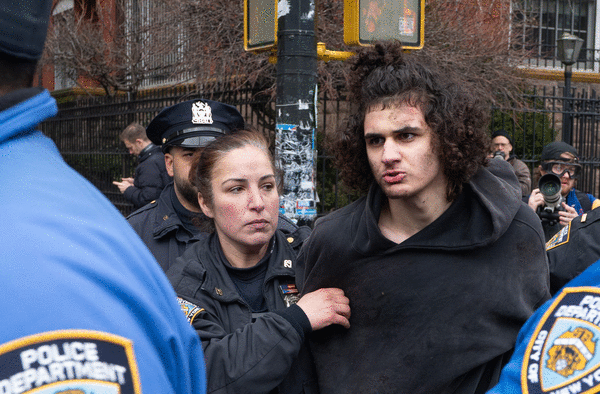
From a young age, Emir Balat was building things. First, it was electronic models on Roblox, a popular online game where users can generate their own 3D virtual worlds. Then it was writing code to sell sneakers.
Then, police said, it was a bomb plot.
By age 13, Balat had programmed a computer system to buy up new sneakers before they sold out online. Image-conscious teens in his native Bucks County, Pennsylvania, were willing to pay up to $400 for a pair of the latest Nikes that retailed for half that price.
Balat was a “botter,” according to one of his clients. Using automated software, he had found a way to squeeze profit out of the gap between supply and demand.
It was a remarkable display of entrepreneurship for a teen. Five years later, it is now one of many details federal prosecutors are likely examining as they try to determine how Balat, 18, became radicalized and allegedly attempted to throw a homemade explosive device into a crowd of anti-Islam protesters outside Gracie Mansion in New York City. Prosecutors said he and another Bucks County teen told police they were inspired by ISIS.
Authorities say Balat and 19-year-old Ibrahim Kayumi drove to Manhattan on Saturday to the scene of a far-right protest outside the home of Zohran Mamdani, New York City’s first Muslim mayor. They attempted to set off two homemade explosive devices packed with metal bolts and explosive compounds, police said, but the bombs did not detonate and no one was injured.
Both men were arrested at the scene.
Images of the two quickly circulated around the globe as the latest would-be attackers allegedly inspired by the Islamic State of Iraq and Syria. Prosecutors said that after the men were apprehended, they admitted carrying out the attempted attack in the name of the jihadist militant organization.
“This isn’t a religion that just stands when people talk about the blessed name of the prophet,” Balat told police after his arrest, according to prosecutors. ”We take action! … If I didn’t do it someone else will come and do it.”
No details about the two men’s online habits or whether they had contact with any terror groups have been released.
The Inquirer found one of Balat’s usernames was connected to an account on Roblox, a world-building simulator that has been used by terror factions to recruit children across the globe using the platform to simulate attacks. The account was created in 2018, when he was 11 years old, under a username that he would later use to cultivate his sneaker business.
The account does not contain much visible activity, and there are no outward signs of radicalization on any of the suspect’s visible social media accounts.
Nicolas Stockhammer, a counterterrorism researcher at Danube-University Krems, in Austria, said that such online platforms have increasingly become “an entry point” for recruitment efforts by Islamic radicals.
“Many young jihadis have their first contact with Islamic propaganda through very simple video content on TikTok, Twitch, and others,” he said. “The videos are an entry point. Games, like Roblox, are used as a communication platform to exchange ideas.”
These platforms are used to gradually entice victims into more private media for communication — such as encrypted chat services, like Telegram — where their activities are harder to trace.
Such recruitment efforts have exploded following recent military conflicts in Gaza, Iran, and elsewhere. Recruiters, he said, typically targeted second- or third-generation immigrant children in the U.S. or Europe — in some cases, as young as 13 years old.
“They are kids whose parents are working and they are coming home and spending time alone at home … and searching their own community,“ he said. ”These are marginalized young men who feel forgotten to some extent.”
Attorneys for Balat and Kayumi could not be reached for comment. Attempts to reach their families were unsuccessful.
It is not clear how Balat and Kayumi knew each other before the protest, and Balat’s lawyer, Mehdi Essmidi, said Monday he was not sure the two were acquainted prior to last weekend.
They were a year apart in age and attended different high schools about seven miles apart in Bucks County. Balat, a budding entrepreneur, was a senior at Neshaminy High School, enrolled as a remote student for his final year. Kayumi graduated from Council Rock North High School in 2024.
Few former classmates have spoken publicly about the teens.
Balat’s faint online footprint suggests that he was fascinated by computers, business, Islam, and speaking Spanish.
Balat grew up in Langhorne, Pennsylvania, the son of Turkish parents. His father was granted asylum in 1998 and gained citizenship in 2017, according to court records. According to a 2009 bankruptcy filing, his father ran a painting business and his mother was a homemaker.
When Balat started selling sneakers, one of his customers was Garry Pozdnyakov, 25, a Trevose business owner who sold sneakers in Bucks County. He made multiple payments to Balat on Venmo between 2022 and 2024 for sneakers the teen had acquired.
Pozdnyakov described Balat as professional beyond his years. The teen would text him the models and sizes he had secured from the latest sneaker drops before they sold out on Nike’s website, he said. Pozdnyakov would then meet Balat and his father in a Wawa parking lot in Penndel to complete the exchange.
“He was a normal kid,” Pozdnyakov said. “I always met him with his father. He shook my hand and asked about business. I never got signs of an extremist.”
By 2024, both Balat and Pozdnyakov left the sneaker resale business, as profits declined due to increased manufacturing. Pozdnyakov moved on to automobiles.
Balat’s online history indicates he began using his virtual retail acumen to follow in his father’s footsteps into the trades. His father worked in construction in Bucks County, according to Mehmet Isak, a former president of the Turkish American Muslim Cultural Association, a mosque and community center in Levittown.
Between September and December, a Facebook account under Emir Balat’s name posted dozens of listings on a commercial page called Bucks County Exchange.
The teen’s inventory drew from every aisle of the home improvement store: heavy-duty extension cords, cases of laminate flooring, bathroom vanity lights, DeWalt nail guns, cases of motor oil, and boxes of contractor bags.
“SERIOUS BUYERS ONLY,” the account wrote on several posts, along with a retail price comparison and a note that he spoke Spanish.
Balat’s Facebook account is locked. A header image is visible that contains a Quranic verse detailing God’s creation of earth: “He released the two seas, meeting (side by side).”
How Balat allegedly graduated from online sales into bomb plotting remains unclear. Law enforcement on Monday searched a self-storage facility near Balat’s family home in Langhorne on a quiet residential street where American flags hang from houses above well-barbered lawns.
On March 2, Balat visited the Phantom Fireworks store in Penndel and purchased a 20-foot roll of slow-burning fuse, according to the company, which later sent surveillance footage of the FBI.
Five days later, authorities said, Balat and Kayumi traveled in a car registered to one of Balat’s family members to Manhattan, where they joined a counterdemonstration against far-right provocateur Jake Lang, who had organized a protest called “Stop the Islamic Takeover of New York City.”
Journalists photographed Balat at the protest throwing a device with a lit fuse into a small crowd of anti-Muslim protesters, before dropping a second smoking device near police officers. Prosecutors said one of the devices — which were extinguished without harming anyone — contained the explosive material TATP, which has been used in other terror attacks.
After his arrest, Balat said he intended the attack to be “bigger” than the 2013 Boston Marathon bombing that killed “only three,” according to the criminal complaint.
Speaking to reporters Monday outside a courthouse in New York, Balat’s attorney, Essmidi, said his client had “complicated stuff going on” in his personal life, without offering details. He also suggested Balat and Kayumi may not have known each other well.
“They do not live together. They did not have friendly, family, or school ties,” Essmidi said. “There is no reason to believe they knew each other prior to this incident, and I don’t know how well they knew each other at the time of this incident.”
Kayumi’s mother had filed a missing-person report for her son that day, saying she had last seen him around 10:30 a.m. The man’s father, speaking to the New York Times, suggested his son might have been suicidal, and said the family was scouring local parking lots looking for him.
“If he’s going to be five minutes late, he calls,” the father said. “Maybe he had killed himself. We didn’t know what was going on.”
_____
(Staff writers Jesse Bunch and Chris Palmer contributed to this article.)
_____
©2026 The Philadelphia Inquirer. Visit inquirer.com. Distributed by Tribune Content Agency, LLC.






Comments