US Commission on Civil Rights chair hears testimony on ICE tactics in Minnesota
Published in News & Features
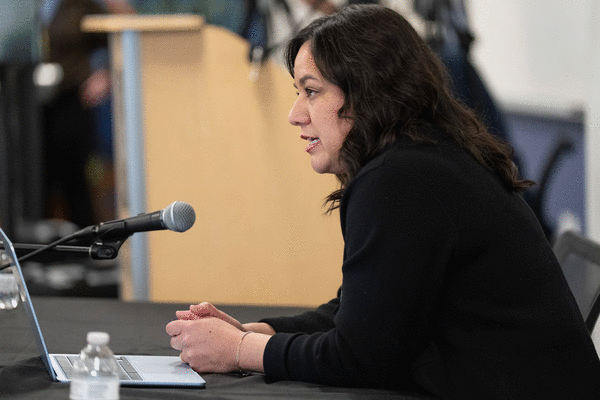
ST. PAUL, Minn. — Minnesota residents told the chair of the U.S. Commission on Civil Rights on Tuesday about what they experienced during the nation’s largest federal immigration enforcement action.
Madeline Lohman, director of advocacy at the Advocates for Human Rights, said that during the weekslong Operation Metro Surge, Minnesota saw three main civil rights violations, which she described as “unchecked racial discrimination,” “weaponization of detention” and “lack of any accountability mechanism or remedy.”
“Metro Surge should not be just a failed operation,” she said. “It should be the catalyst to create a new system, because our entire community belongs here and is deserving of safety, dignity and equality.”
Billed as the “People’s Hearing on Immigration Enforcement,” the hearing was held at Comunidades Latinas Unidas En Servicio (CLUES), the state’s oldest Latino advancement nonprofit, on the east side of St. Paul.
Rochelle Garza, appointed to the commission by former President Joe Biden, heard testimony on use-of-force by federal agents, detainment and treatment of protesters and the deaths of two citizens.
However, Tuesday’s event was not an official hearing of the U.S. Commission on Civil Rights, a bipartisan fact-finding agency created by the Civil Rights Act of 1957. The commission, evenly divided between Democrat and Republican appointees, is focusing on antisemitism on college and university campuses for this year’s annual report, according to Garza.
She said despite that, “centering community” and documenting “potential civil rights implications” was the point of the listening session.
“Never before have we seen nearly 4,000 armed, masked, mostly men, descend upon our state, bringing chaos, violence and death,” said Minnesota Attorney General Keith Ellison, who opened the hearing. “Minnesotans know well the impact of this surge, and they deserve to be known across the United States.”
Others who spoke included Kaohly Her, mayor of St. Paul, where ICE agents allegedly asked residents where their Asian neighbors lived, and Amada Marquez Simula, the mayor of Columbia Heights, where multiple elementary school students were apprehended with their families and detained in Dilley, Texas.
Ben Berkman, a lawyer for the family of Renee Good, testified about the Department of Homeland Security’s “absurd and false statements” about Good’s killing by an ICE agent in February, which included calling her a “domestic terrorist.” He also discussed the difficulties that the Good family continues to face trying to sue the federal government.
The “deck is stacked against accountability for federal officers,” Berkman said, citing section of federal law that allows individuals to take legal action against local and state law enforcement, but doesn’t authorize lawsuits against ICE and Border Patrol agents.
“The current path to holding federal officers accountable is a narrow and uphill climb,” he said. “That’s not going to deter us in the slightest from pursuing justice for Renee and for our other clients, but the system can and must change.”
Representatives from the Immigrant Defense Network and Unidos Minnesota, who organized constitutional observer trainings, told Garza they collectively trained about 85,000 people from Minnesota and surrounding states to observe and document federal actions before and during the surge. They said observers were retaliated against by being followed to their homes and threatened with arrest.
“Those of us who are working to document these abuses are increasingly becoming targets ourselves,” said Edwin Torres DeSantiago of Comunidades Organizando el Poder y la Acción Latina. “I have personally been followed by ICE agents for five hours. They have shown up on my doorsteps numerous times. My personal information has been doxed online.”
Melisa López Franzen with Voyageurs Public Affairs, who helped coordinate the event, said the testimony will be used to potentially persuade the commission to approve a formal investigation into ICE tactics and a report to Congress.
Immigration has been a significant part of Garza’s background as a Texas civil rights attorney. She represented pregnant unaccompanied minors in the reproductive rights case Garza v. Hargan, which resulted in the federal requirement that detained immigrant teenagers have access to abortion.
Tuesday’s forum was convened by civil rights and community organizations, including the Hispanic Federation, the Latino Victory Foundation and the Miranda Family (family of composer and actor Lin-Manuel Miranda).
Testifiers signed up beforehand. They faced Garza as they spoke, and Garza occasionally asked follow-up questions.
After hearing people speak about lack of medical intervention in ICE detention and stories of breastfeeding mothers separated from their infants, Garza said she was “particularly touched.”
“That’s bravery, telling the truth about what happened and naming who the real victims are,” she said. “I mean, I have very young kids. I just finished my nursing journey with my youngest, so I know how critical that bonding time is, and what has been done is just atrocious.”
The forum was not open to the general public, but was livestreamed by the Hispanic Federation.
“Moments like this matter, because the full impact of enforcement policies often become clear only with time,” said Yohuru Williams, a historian and founding director of the Racial Justice Initiative at the University of St Thomas, who testified at the hearing. “How policies are implemented, how concerns are addressed, and how carefully the public record is preserved will shape how this period is understood in the future.”
The Minnesota Attorney General’s Office is also collecting reports about federal actions on its website.
©2026 The Minnesota Star Tribune. Visit at startribune.com. Distributed by Tribune Content Agency, LLC.






Comments