They made a delivery to Camp Pendleton, or maybe a wrong turn. Then they were arrested by ICE
Published in News & Features
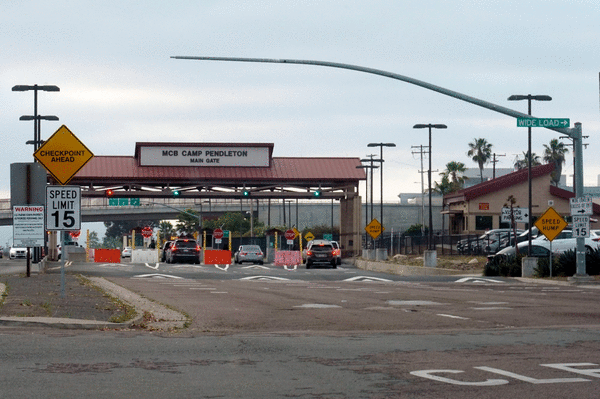
SAN DIEGO — Federal court records show that in recent months, at least 22 foreign-born individuals living lawfully in the United States have been detained for hours by Marine Corps personnel at Camp Pendleton, and then arrested by immigration officers and held for weeks or longer, for trying to access the military base inadvertently or for work purposes.
In each of those cases, the person who was arrested filed a habeas corpus petition, alleging that their detention was unlawful. In the 20 cases that have been decided, federal judges in San Diego have agreed with the detainees and ruled that those individuals were unlawfully held in detention by U.S. Immigration and Customs Enforcement. Two recently filed petitions are still pending.
San Diego immigration attorneys said there are dozens of such cases, mostly involving ride-share or delivery drivers, or Interstate 5 travelers in need of food or gas who didn’t realize their phones’ navigation apps were leading them onto a military base. Court records showed the 20 individuals who successfully petitioned for release, most of whom are seeking asylum, were arrested despite being in the U.S. lawfully, obtaining proper work authorizations and abiding by the terms of their immigration parole.
At least three additional individuals not included in the court records were arrested under similar circumstances last month, according to reports by NBC 7 San Diego and the Military Times.
“This is a concerted, coordinated effort between Camp Pendleton and ICE that anybody who shows up on that base without a green card will be detained,” said Brian McGoldrick, a San Diego immigration attorney who has represented at least 10 such clients.
“The military bases are becoming traps,” said Bashir Ghazialam, a San Diego immigration attorney who has also filed at least 10 habeas corpus petitions on behalf of ICE arrestees at Camp Pendleton.
Marine Corps officials did not answer specific questions about the practice of detaining certain individuals and turning them over to ICE. Instead, they provided a lengthy statement that included a link to a webpage with detailed procedures for accessing the base, including instructions for both foreign nationals and ride-share drivers.
“The safety and security of Marine Corps Base Camp Pendleton and the Marines, Sailors, families, civilians, and visitors who live and work here remain a top priority,” Capt. James Sartain, a communications officer from Marine Corps Installations West, said in the statement. “Individuals seeking entry must have approved credentials and a valid reason to access the base.”
Last May, Camp Pendleton announced that it was launching “an interagency security initiative” with ICE and U.S. Customs and Border Protection. It was designed, in part, “to deter unauthorized installation access by foreign nationals.” In its announcement of the initiative, base officials acknowledged that “most unauthorized access attempts are inadvertent, often caused by civilian motorists unintentionally navigating to base gates due to GPS misdirection.”
That was the case for Artak, who has lived in the U.S. for more than a decade, according to records in his habeas corpus petition. Artak — who the Union-Tribune is identifying by his first name only at the request of his attorney — was granted immigration parole in 2015 after authorities determined he had a credible fear of returning to his birth country of Georgia.
Since 2015, he has applied for asylum, been granted work authorization, integrated himself into his community and lived in the U.S. “without issue,” according to a judge’s ruling.
It was two days after Thanksgiving last year, while driving from Los Angeles to San Diego, that Artak and another person in his car pulled off Interstate 5 in search of a bite to eat. Unbeknownst to them, their cellphone navigation app was leading them to a Jersey Mike’s Subs located on Camp Pendleton. Rather than allowing the pair to turn around and leave, base guards questioned them about their immigration status, then made Artak wait roughly four hours until ICE officers arrived and arrested him.
Artak remained in ICE custody for nearly a month until a San Diego federal judge ruled he’d been wrongfully detained without due process and should be released.
McGoldrick said that while Camp Pendleton guards typically allow confused drivers to turn around, those guards are increasingly identifying his clients by their California driver’s licenses, which are marked with the word “limited.” When the guards see that designation, McGoldrick said, they ask the person if they have a green card. When his clients answered negatively, the guards kept them until ICE officers arrived and arrested them.
“Coordination with other law enforcement agencies is not new,” Sartain, the Camp Pendleton spokesperson, said in the statement. “Marine Corps installations routinely coordinate with appropriate law enforcement authorities when potential violations of federal or state law occur on Marine Corps installations.”
But immigration attorneys such as McGoldrick and Ghazialam have successfully argued their clients are not violating any laws, and San Diego federal judges have instead repeatedly ruled in the habeas petition cases that it’s the government that’s acting unlawfully.
Those 20 successful habeas petitions filed by Artak and the others arrested at Camp Pendleton are part of a broader trend across San Diego and the nation. According to data from the U.S. Attorney’s Office in San Diego, which defends federal government agencies and employees in such cases, there were just 99 civil immigration-related cases handled by the office in 2024. That number, the vast majority of which are habeas petitions, jumped to 593 in 2025 and nearly 800 just in the first two months of 2026.
In the 20 Camp Pendleton cases reviewed by the Union-Tribune that have been decided, each individual has eventually been released from custody or granted an immigration bond hearing. Judges ruled in those cases that the Trump administration violated the detainees’ due process rights by revoking their immigration parole and detaining them without justification.
The Department of Homeland Security did not respond to questions specifically about the ICE arrests on Camp Pendleton. In a statement responding to questions about habeas cases in the San Diego region more generally, a DHS spokesperson accused “activist judges” of trying to thwart the Trump administration’s deportation efforts.
Individuals born in China, Russia, India, Nepal, Afghanistan, Turkey, Mexico, Georgia, Honduras and the former Soviet Union filed the 22 Camp Pendleton habeas cases reviewed by the Union-Tribune. One man had been in the U.S. since 1988, while several others had arrived as recently as 2024. At least four were working for Uber — the company did not respond to questions about what steps it is taking, if any, to help its drivers — while at least two were working for DoorDash and at least one was working for Lyft. At least five were looking for food or a restroom when they inadvertently took an I-5 exit to the base.
McGoldrick said that while judges have continually granted his clients’ petitions and freed them from detention, they still suffer a great hardship by being ripped from their homes and unlawfully detained for weeks or months at a time.
“It really destroys their lives,” he said, relating the story of a ride-share driver whose car was impounded after he was arrested at Camp Pendleton. By the time a judge ordered the man released from custody about six weeks later, McGoldrick said the impound fees cost more than what the car was worth.
“All because he was delivering somebody on the base,” McGoldrick said.
_____
(Staff writer Kristen Taketa contributed to this report.)
_____
©2026 The San Diego Union-Tribune. Visit sandiegouniontribune.com. Distributed by Tribune Content Agency, LLC.






Comments